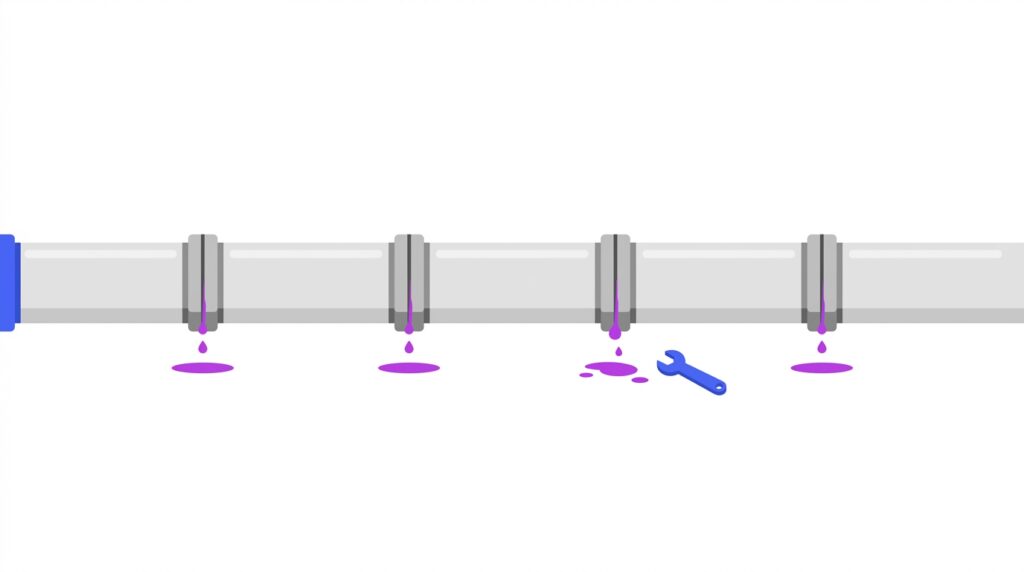
When a B2B marketing program stalls, the reflex is to blame the strategy. Re-segment, re-message, re-plan, launch the next campaign, and accept a few quiet weeks before it starts. That reflex is usually wrong, and it is a big reason always-on marketing stays a slide in the planning deck instead of the way the team actually runs.
Strategy, to me, is a collection of tactics, and most marketers pick the right ones. What breaks is smaller and harder to see.
Every one of the five failures below sits in the gap between two roles: the writer and the web owner, demand gen and paid media, sales and marketing. Nobody was given the job, and no SOP says how it gets done. The work is getting done. The seams are where it leaks, and a better plan will never close a seam. Naming who owns it will.
I have skipped the obvious ones (no technical SEO, no matched audiences, no “post more on LinkedIn”). Each section names the seam, shows how it leaks and ends with the fix, and there is a five-line audit at the end.
Executive Summary
- Most stalled B2B programs have the right strategy. The failures live in the gaps between two roles.
- Over-segmentation is far more common than under-segmentation. Every cut is a promise to produce for it.
- Content without desire paths turns your team into a media company. Measure where readers go after the first click, then pave that path.
- The dark time between campaigns is a cost nobody measures, and 2 to 4 percent of your list goes stale every month.
- One thought leader caps your output and your channel. Run several credible voices concurrently.
- Stale or rationed data quietly breaks every other program. Heavy reliance on events is often the symptom.
- Assign a named person to each seam. Most of these fixes cost an SOP, not a budget line.
Where the program leaks
Five failures, five seams.
Each one sits between two roles. The fix column shows how many need a budget line.
| Failure | The seam | The fix costs |
|---|---|---|
| Over-segmented list | Demand gen + paid media | Saves money |
| No desire paths | Writer + web owner | An SOP |
| Dark time between campaigns | Campaign ops + leadership | A calendar change |
| One voice carries everything | Writer + the rest of the company | A cultural change |
| Limited or stale data | Sales + marketing | Real budget |
Four of five cost almost nothing. The fifth is the foundation the other four run on.
1. You segmented past the point where your message changes
Every cut of your list is a promise to produce content for that cut, and most teams make more promises than they can keep.
The cohort test
Send broadly. Let the audience tell you when to split.
Start at the highest level of the list where the message holds, then read the engagement.
Keep producing for the whole cohort and let it rock. More cuts would only add work.
This is the moment a new cut earns its keep, and the promise to produce for it.
That is your messaging, and you are probably cut too fine already. Go near-generic, then drill down.
The seam
Demand gen and performance marketing. In paid media you pay for every impression, so leaking spend on the wrong audience is a real problem and heavy segmentation is survival. Demand gen runs email and events, and it often inherits that same granularity, pushed by the paid team or by an agency. The logic that saves money in ads costs money in email.
How it leaks
I watch companies cut a list of tens of thousands into groups of 400 to run highly personalized messaging. I am all for personalizing and contextualizing. But if nine segments get the same message, you have one segment and nine times the work.
The industry preaches more customization and more list segmentation. Almost nobody prices it. I see over-segmentation far more often than under-segmentation, at every team size, and in my opinion it is crushing a lot of marketing programs.
Josh Tessler asks the right counter-question: when does under-segmenting make the message useless? The data tells you. Send broadly and watch cohorts. If one clear persona goes quiet while the rest respond, segment that group. If nobody responds, that is your messaging, and you are probably cut too fine already. If engagement looks fairly even across the list, stay at that level and let it rock.
The fix
- Move up to the highest level of your list where the message still holds: minimum viable segmentation
- Start near-generic for the whole cohort, then drill down only where a group goes quiet
- Send a variety, learn, and keep tightening the screws. Speculating on what will land is hard
- Give one person the call on how far email segments, separately from how far paid segments
2. Your content has no desire paths
Everyone measures content volume. Almost nobody measures where a reader goes after the first article.
The seam
The writer and the website owner, almost never the same person. The writer’s job ends at publish. The web owner’s job starts at the template. Nobody was assigned the work in between: how one piece connects to the next, where it sits in the funnel and how a reader ultimately converts.
How it leaks
Picture a park with paved sidewalks around the edge and a dusty trail cut straight across the grass. That trail is a desire path. People wanted to go directly across. Josh and I were using the phrase 15 years ago, and it is still one of the most common design principles around.
A lot of companies producing great content now operate as a media company with no conversion path. Someone lands on a strong article and finds no internal link and no obvious next step. The same gap runs off-site: your G2 profile, your listing among Gartner’s vendors and your LinkedIn posts all send people somewhere. Most teams think about the first click and never continue the thought past it. That is the B2B content distribution problem nobody reports on.
Josh asks whether it is a tooling problem, a skills problem or just an unassigned one. Possibly all three, and it starts with information architecture. Treat every landing page as a mini-site with entries and exits everywhere.
The fix
- Assign one person the job of connecting pieces, sitting across the writer and the web owner
- Watch the flow through your site in Google Analytics, bounce rates included
- Offer more paths, see which ones readers take, then narrow them. Find the desire path and pave over it
- Write linking into the content workstream so it happens with every piece
- Decide where each off-site placement should send people next
3. You think in campaigns, so you accept the dark time between them
Two weeks of nothing between campaigns is a decision somebody made by default, and your market keeps shopping while you wait.
The seam
Campaign ops and the leadership that approved the calendar. Leaders want a specific campaign and a calendar that shows weeks and months of activity. The operations team delivers it. The dead space between campaigns goes unnoticed, because nobody was asked to look at it.
How it leaks
This is my biggest pet peeve. I do not even like the word campaign. One ends, and that audience gets nothing for a week, two weeks, sometimes five. Think of it as a fire. You spent six months throwing a log on it every week, and at the end you let it go out.
Most of your market was not shopping during your campaign window, and they did not stop looking when it closed. They are simply forgetting about you, and you lose the compounding effect. Teams measure campaign performance. Nobody measures the drop in share of voice during the gap.
Email makes the cost concrete. People leave, change titles and change details at 2 to 4 percent of your list per month. Go dark for a month and that slice is stale and no longer mailable.
What a dark stretch costs
Your list keeps decaying while the calendar is empty.
At 2 to 4 percent of a B2B list going stale every month, the gap is never free.
1 to 2% stale
The “normal” gap between campaigns.
2 to 4% stale
No longer mailable, and nobody noticed it leave.
6 to 12% stale
Plus the share of voice you never measured.
Always-on marketing means no gaps. Campaigns take over the stream for a while, then hand it back.
Always-on marketing means no gaps. Volume can stay exactly where it is. I only commit to work I could keep doing in perpetuity.
Josh pushes on whether a gap is ever the right call. Two honest exceptions. A transactional product sold to micro or SMB buyers, with a days-long cycle and a freemium tier, can run a seasonal campaign that simply ends. And some campaigns are time-based: an event, a webinar, a release, a sale. Those still run inside the stream. With a webinar coming, switch email and ads over to it for two weeks, then go straight back to the regular newsletter.
The fix
- If your sales cycle runs from a couple of months to a year, treat every pause as a cost
- Build an always-on workstream you could sustain forever, and let campaigns take it over temporarily
- Fold smaller releases into the regular send as a header or footnote
- Name one person who owns the weeks between campaigns
4. One person is carrying every piece of content
The bottleneck in most B2B content programs is production, and production is capped by how many people the writer can get time from.
The seam
The writer and the rest of the company. The meeting with the writer is one of the first things a busy executive drops, and it gets rescheduled constantly. Nobody means it as disrespect. People are busy.
How it leaks
Founder-led thought leadership is valuable, especially for a young brand. The problem is relying on one person, or too few, to be the voice. One person can only make so much unless they love it, and few companies have enough people who love being a thought leader. Push too hard and they burn out, the market burns out on them, and quality slides. Add over-segmentation and demand for content multiplies while supply stays with one person.
If that person leaves, you lose the channel along with the person.
Josh asks whether adding voices dilutes the brand. In my experience it does the opposite. We call it the Mount Rushmore strategy: several credible faces instead of one. In Josh’s words, they are the experts in the room, and each one adds credibility.
The fix
- Run several voices concurrently. In sequence, one bottleneck leaves your always-on stream empty that week
- Care less about whose piece comes out next and more that the next piece meets your standard
- Treat writers as your company’s journalists. Celebrate them and give them the time they need
- Make contributing a named expectation, owned by a leader who protects the writer’s calendar
5. You are running on limited or stale data
Data is the least exciting failure on this list and the one that breaks all the others.
The seam
Sales and marketing. Sales buys one data source, marketing buys another, and they fight over both, overconsuming one and underusing the other. Sales may hold the only three or five ZoomInfo licenses in the building while marketing has no access at all.
How it leaks
Sales finds out first. An email bounces, a number is disconnected. Marketing mails the list anyway, because nobody told them. Sometimes the data was never enriched or run through basic cleansing and validation in the first place, and in a lot of companies nobody owns the lists at all.
When this layer breaks, everything above it fails quietly: email, ads, webinars. When I find a data problem, I usually find a company over-relying on events. They tell me the only way they can do business is in person, when the real reason is that the data pipes are broken.
Email is cheap, so people abuse it with bad data. Ads are expensive, yet teams run them on platform filters instead of matched data. ABM can be the most expensive of all, and there signal data matters more than contact data: job postings, funding rounds, public filings, board notes, and for government sellers, published RFPs and budgets. Website visitor identification is another layer most teams neglect.
More data is available than ever, pricing is in a race to the bottom, and companies like ZoomInfo are falling by the wayside. The ownership gap has not moved.
Reading the symptoms
A data problem rarely calls itself one.
It shows up as something else first.
What it looks like
What it actually is
Cheap, so it gets abused with bad data.
Ads
Expensive, yet run on platform filters instead of matched data.
ABM
Most expensive. Needs signal data, not just contacts.
The verdict
Garbage in, garbage out. Get the data layer right and every other program gets better.
The fix
- Build a feedback loop in which sales reports what marketing throws over the fence
- Watch engagement as your canary in the coal mine. If nobody engages, you may have the wrong audience
- Keep the fundamentals running: sunsetting, bounces, regular verification. Email list management is a job, so give it to a person
- Stitch together more than one data source, or choose a platform or agency that does the data work for you
Run the seam audit
For each of the five, write one name. Not a team. A person.
| Seam | Who owns it here? |
|---|---|
| Deciding how far to segment | |
| Connecting one piece of content to the next | |
| What runs between campaigns | |
| Adding voices beyond the main one | |
| Telling marketing the data is stale |
If you cannot write a name, that is the failure. Most teams get two or three of five.
Most of these fixes are a cultural change or an SOP. Getting segmentation right saves money, and connecting your content gets more out of what you already made. Data is the exception and the foundation: garbage in, garbage out.
The question worth asking your team on Monday is which of these five nobody knew was their job.
Context on Outkeep’s Approach
Outkeep works where most of these seams surface first: the list, the send and the data underneath them. Segmentation choices, gaps between campaigns and stale records all show up on the email side early, as bounces, flat engagement and lists that quietly stop being mailable.
In the programs we look at, the strategy is usually sound. What holds them back is a handful of jobs sitting between two people, and the fix is almost always the same: name an owner and give them a system that keeps running between campaigns.
FAQ for Modern B2B Email Programs
How much list segmentation is too much in B2B email?
You have gone too far when several segments receive the same message, or when you cannot produce consistently for every segment. Start broad and split only when one clear group stops responding while the rest engage.
What is always-on marketing in B2B?
A continuous program with no dark weeks between campaigns. You commit only to work you can sustain indefinitely, and campaigns temporarily take over that stream instead of replacing it.
How fast does a B2B email list go stale?
Roughly 2 to 4 percent of a B2B list changes every month as people leave, change titles or change details. A month-long pause costs more than the missed sends, so verification and sunsetting need to run on a schedule.
What is a desire path in B2B content distribution?
The route readers actually take through your content, as opposed to the one you designed. Find it in Google Analytics by following where people go after a page, then make that route easier with internal links and clear next steps.
Who should own email list management in a B2B company?
One named person, usually in marketing ops or demand gen, with a feedback loop from sales. They own verification, sunsetting, bounces, data sources and the call on how far to segment.
How do you scale thought leadership beyond the founder?
Recruit several credible experts inside the company and run their content concurrently, so one busy calendar never empties the pipeline. Protect the writer’s time with each of them.