If you turned off your paid search, paid social, and event program tomorrow, would your company go completely dark? No traffic. No conversations. No reach. If the honest answer is yes, that is a structural problem.
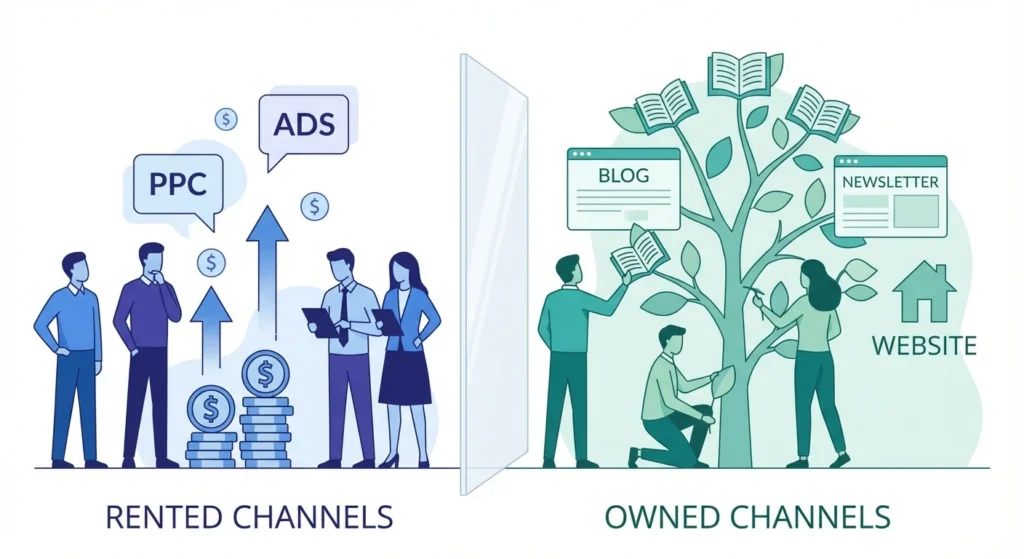
Most B2B marketing budgets are built on access you are renting. Pay-per-click, pay-per-lead, pay-per-meeting, sponsored placements, events, and SDR vendors all share the same fundamental characteristic: someone else owns the audience, and you are paying to borrow it. The moment you stop paying, the access stops. There is no long tail. There is no compounding. You get what you paid for, and nothing more.
Owned channels work differently. Your email list, your organic search presence, your actual social following, and your team’s personal networks are assets that accumulate over time. They do not disappear when the budget gets cut. And the economics, when you actually run the numbers, are not close.
This is a conversation about the imbalance, why it quietly kills growth, and what it actually looks like to build a marketing program that does not evaporate under pressure.
TL;DR
- Rented channels: pay-per-click, paid social, pay-per-lead, events, SDR vendors, sponsored placements. You pay per unit of access. The access stops when payment stops.
- Owned channels: email list, organic social following, SEO presence, personal networks. You build access once and keep it.
- Most B2B marketing budgets are roughly 50% events and 40% digital, with the majority of digital going to paid. The owned channels get a fraction of both the money and the attention.
- Budget allocation and attention allocation are not the same thing. Paid channels get heavily scrutinized, so they consume most of the team’s time too.
- Email delivers 35–45X ROI and remains the most effective prospecting channel for 59% of B2B marketers. It almost never gets the investment that matches that return.
- Algorithm changes in owned channels are feedback, not punishment. They reward good marketing and penalize bad marketing. There is no adversarial relationship.
- Brand is what makes owned channels compound. Specifically, juxtaposition: being consistently next to the right ideas, people, and partners until the market associates you with them.
- The shift does not require blowing up your paid program. It requires redirecting a small portion of budget and a larger portion of time toward channels you will still have when circumstances change.
Channel ownership at a glance
Rented vs. Owned: Two Different Relationships With Your Audience
Where your budget goes determines how resilient your marketing program actually is.
Rented
You pay per unit of access
Someone else owns the audience. Access stops the moment payment stops. No compounding, no long tail.
Examples
Pay-per-click Paid social Events Pay-per-lead SDR vendors Sponsored placementsOwned
You build access once and keep it
You control the audience. It accumulates over time. It persists when budgets get cut and amplifies everything else.
Examples
Email list Organic social SEO presence Team networksThe key question: If you turned off all paid channels tomorrow, would you go completely dark? If yes, you are more fragile than your current results suggest.
1. What your budget is actually buying
If you mapped your marketing budget against channels you rent versus channels you own, most B2B teams would be surprised by what they find.
A typical healthy marketing budget in B2B looks something like this: roughly 50% events and 50% digital. Of that digital half, around 40 percentage points go to paid channels and roughly 5 to 10 go to tools and infrastructure. What remains for owned channel development is often an afterthought, if it shows up at all.
That budget distribution is not necessarily wrong in every context. If you are selling something with clear triggers, a short cycle, and obvious purchase signals, paid channels can be your most efficient path. If someone is actively searching for what you sell and the deal closes in days or weeks, pay-per-click is probably the right call.
But most B2B is not that. Most B2B involves months or years to build a reputation, long consideration cycles, and purchase decisions made by buying committees that churn at 20 to 30 percent per year. In that environment, paying per unit of access does not compound. It just keeps the lights on as long as the check clears.
What this means
Events, paid social, and paid search all have a role. The problem starts when 80 or 90 percent of the budget flows there and the owned channels get starved of money, time, and attention. The team ends up optimizing endlessly for channels they do not actually own.
Why it matters
When you go to a conference and meet 30 people, there are typically 300 more you did not talk to. The attendee list is a second-party asset. Your job, at every event, is to convert as many of those contacts into owned relationships as you can: an email subscriber, a social follower, something that persists beyond the conference hall. Most teams do not do this. They follow up on the 30 and leave the other 270 to decay. They spent $40,000 on that conference. They did not spend the extra $2,000 to keep those people engaged afterward.
Operator moves
- Map your marketing budget against rented versus owned channels. Be honest about where the money actually goes.
- For every rented channel, ask: what is the conversion path to an owned relationship? How are you turning borrowed access into durable access?
- At events, prioritize converting attendees you did not speak with into owned contacts. The conference is a point in time. Your email list is not.
2. Budget and attention are not the same thing
The more money you spend on a channel, the more scrutiny it gets, and scrutiny consumes time.
When you are spending $20,000, $30,000, or $40,000 on a single event, every stakeholder is watching. Did it produce pipeline? What was the cost per meeting? Were the right people in the room? That level of scrutiny is appropriate. That kind of money should be interrogated.
But the scrutiny does not stop at analysis. It generates requests, readouts, follow-up campaigns, retrospectives, and prep work for the next one. Paid channels, by virtue of being expensive and visible, pull the team’s attention disproportionately toward them. Meanwhile, the email program, the organic social strategy, and the SEO content run on autopilot or get dropped entirely when bandwidth gets tight.
What this means
Budget allocation and attention allocation tend to move together, and they are rarely equivalent. A team spending 80 percent of its budget on paid channels will spend far more than 80 percent of its energy on those channels too. The owned channels, which cost relatively little in out-of-pocket dollars, get treated as low-priority, even when their ROI is dramatically higher.
Why it matters
The internal framing has to change. Owned channels are the durable layer of your marketing program that makes everything else more efficient. Treating them as a fallback for when the real budget runs out is exactly how teams end up with nothing to stand on when conditions change. An organic social strategy running consistently in the background will make your paid social spend go further. An email list of the right people will warm up the audience before sales reaches out. The paid channels amplify owned channels. It rarely works the other way.
Operator moves
- Audit where your team’s time actually goes, not just where the budget goes. If 90 percent of internal meetings, reporting cycles, and planning conversations are about paid channels, you have an attention problem, not just a budget problem.
- Set a recurring time commitment for owned channel work that is protected from being pulled into paid channel fire drills. A cadence you protect beats a strategy you never execute.
- Change the framing with leadership: owned channels are infrastructure, not overhead. They depreciate slowly and compound over time. Paid channels do neither.
The ROI comparison
Email vs. Paid Social: What the Numbers Actually Show
Same goal, very different economics. One channel builds an asset. The other charges you every time.
~$2K / month
Drives 11% of web traffic. You know exactly who clicked and can reach them again for free.
59% of B2B marketers call it their most effective prospecting channel
~$9K / month
Drives 6% of web traffic. Stops the moment spend stops. Nothing carries over.
4.5x more expensive per unit of traffic than email — with no asset left behind
3. The visibility test
Ask yourself one question: if you cut your paid budget in half tomorrow, what would you wish you had already built?
Budgets get cut. Economic conditions shift. A single bad quarter triggers a line-item review. And every B2B marketing team that has lived through a budget reduction knows exactly which channels evaporate immediately and which ones keep producing.
Paid channels are instant gratification with no long tail. The moment you stop paying, the traffic stops. Organic and owned channels are the opposite. They build slowly, they require patience, and they feel unrewarding for months before they compound. But when the budget gets cut, they are the ones still standing.
Josh put it simply: paid is fireworks. Bright, immediate, attention-grabbing, gone. Owned is a bonfire. Takes longer to get going. Harder to build. Burns for a long time with far less ongoing fuel.
What this means
Resilience is only part of it. The ROI case is just as strong. Email as a channel delivers 35 to 45X return for every dollar invested. 59 percent of B2B marketers report it is their most effective prospecting channel. If you use UTM tracking, you can see exactly what each channel contributes: email driving 11 percent of web traffic on a couple thousand dollars a month in platform costs, while $9,000 a month in paid social drives 6 percent. The math is not close, and yet the email program is almost never the one getting the attention or the budget.
Why it matters
Most B2B buyers have already built a short list before they ever talk to sales. 70, 80, 90 percent of their research is done. They have already seen your content and formed an opinion, or they have never heard of you. Owned channels determine which scenario plays out. You cannot buy your way onto it with a single campaign. You earn it by being persistently present, consistently useful, over time.
Operator moves
- Run the visibility test. Be honest. If paid disappeared, would you have any reach? If the answer is essentially no, you are more fragile than your current results suggest.
- Track cost per unit of traffic and pipeline contribution by channel. Use UTM parameters and attribute correctly. The owned channels often look like they are underperforming because nobody is measuring them properly.
- When your web traffic or organic reach drops after an algorithm change, check whether it dropped to a smaller, better audience. Going from 7,000 visitors a month to 3,000 is a problem if you needed all 7,000. It is progress if the 3,000 are exactly who you were trying to reach.
4. Algorithm changes are feedback, not punishment
There is no hack that beats LinkedIn, Google, or email deliverability. There is not going to be one. Stop looking.
Algorithm changes, inbox filtering, declining organic reach — these are not adversarial attacks on your marketing program. They are signals. Every platform, whether it is a search engine, a social feed, or an email inbox, is designed to deliver content that people actually want. When your reach drops, the algorithm is telling you something about what you were delivering.
Anyone who promises you a shortcut — inbox every time, 7 leads in 7 days, do this one thing and bypass the algorithm — is selling something that will work until it does not, and when it stops working, it will stop abruptly. Those are people you should run far away from.
What this means
Working with the algorithm is free. Reading the documentation on how LinkedIn distributes content, understanding what Gmail’s filters are optimizing for, learning what causes email deliverability to degrade — none of that costs money. It costs attention. And it rewards you with reach that compounds instead of reach that evaporates.
The algorithm is not your enemy. It is an enforcer of quality. If your LinkedIn posts are not generating engagement, that is information about whether your content is resonating, not evidence that the platform is broken. If your emails are landing in spam, that is information about list quality, consent, and content relevance, not a reason to try a new warm-up tool.
Why it matters
The teams that treat algorithm changes as external catastrophes spend their energy on workarounds. The teams that treat algorithm changes as feedback spend their energy on their actual content and audience quality. Over time, the second group builds a position that is much harder to disrupt.
Operator moves
- When reach drops, do a content audit before you change your distribution strategy. The problem is usually what you are saying, not where you are saying it.
- For email specifically: if deliverability degrades, look at list hygiene, engagement rates, and consent practices before anything else. The deliverability problem is almost always a list or content problem.
- Build your organic strategy around content that would earn engagement even without algorithmic amplification. That is the bar. If it would not get shared organically, paying to amplify it will not fix the underlying problem.
What brand actually is
The Five Elements That Make Owned Channels Compound
Less than 10% of B2B companies maintain consistent brand across channels. These are the elements that separate the ones that compound from the ones that plateau.
| Element | What it looks like | Consistency rating |
|---|---|---|
| Tone of voice | The same directness, confidence, and point of view across every channel — email, social, blog, sales deck |
●●●●●
Critical
|
| Publishing cadence | A committed frequency you maintain in perpetuity — blog every 4 weeks, email every week, podcast every week |
●●●●●
Critical
|
| Point of view | A genuine position on your market that is distinct from your competitors — not a tagline, an actual belief |
●●●●●
High
|
| Juxtaposition | Appearing consistently next to the right ideas, speakers, partners, and publications your audience already trusts |
●●●●●
High
|
| Visual identity | Consistent colors, logo usage, and aesthetic that make your content immediately recognizable in a crowded feed |
●●●●●
Supporting
|
The stat that matters: Less than 10% of B2B companies maintain consistent brand across channels (LinkedIn / Ipsos). The bar is low. Most of your competitors are not doing this.
5. Brand is what makes owned channels compound
Brand is not your logo. It is the association people make between you and the things they already trust.
Most marketers think about brand as visual identity: the logo, the colors, the tagline. Those things matter, but they are not what makes a brand stick. What makes a brand stick is juxtaposition. It is being consistently next to the right ideas, the right people, and the right organizations until the market cannot think of one without thinking of the other.
Think about what actually builds memory: being on a stage next to a speaker your audience already respects. Having a case study with a company your buyer already trusts. Showing up consistently in the same newsletter or community your ICP actually reads. It is the associations that accumulate, not the logo placements.
When someone in your market thinks “George from Outkeep,” they are not recalling a brand asset. They are recalling a combination of things: the content, the people it was near, the consistency of the voice, the ideas that kept showing up over time.
What this means
Owned channels are the infrastructure for brand building. Email, organic social, and SEO are where you show up consistently, in your own voice, with your own point of view, next to the ideas and people that matter to your audience. You cannot rent brand. You can rent attention. Brand is what you are left with when the rented attention is gone.
Less than 10 percent of B2B companies maintain consistent brand across channels, according to a LinkedIn and Ipsos study. Consistent tone of voice, consistent visual identity, consistent publishing frequency. The bar is genuinely low. Most companies are not doing it, which means the ones that commit to it stand out by default.
Why it matters
Buyers are already forming opinions before your sales team ever reaches out. The always-on nature of owned channels is what allows you to be in the room (so to speak) before the formal evaluation begins. You cannot win that early with a single campaign. You win it by being persistent, showing up regularly in the right context, and making sure that when someone Googles your space or scrolls their feed, they have already seen your name somewhere they trusted.
Operator moves
- Define your point of view before you define your content calendar. What do you actually believe about your market that your competitors do not? That conviction is what makes owned channels worth following.
- Commit to a publishing cadence you can sustain indefinitely. A blog every four weeks, a podcast every week, an email every week: whatever you pick, treat it as a standing obligation, not a when-we-get-to-it.
- Invest deliberately in juxtaposition. Who are you appearing next to? What events, communities, or publications should your brand be associated with? These are brand decisions, not just marketing tactics.
6. How to shift without blowing up what works
Keep your paid channels. Just stop funding owned channels with whatever is left over.
There are points of diminishing return in every paid channel. Adding more event spend above a certain threshold rarely produces proportional returns. The same is true for paid search and paid social. At some point, you are paying for marginal impressions in an audience that has already decided whether or not they care.
The shift does not have to be dramatic. If your event budget is $400,000, redirecting $40,000 toward SEO, email, and organic content development is a 10 percent reallocation. That $40,000, invested in owned channels over 9 to 12 months, can produce compounding returns that the event spend never could. The budget shift should be small. The attention shift should be larger.
Owned channels also make paid channels perform better, not worse. Use email to test messaging before you pay to amplify it. If your emails are not resonating organically, why would you pay $6,000 a month to amplify a message that is not working? The owned channels are where you prove the message before you buy the reach.
What this means
Pick one owned channel and go deep. For most B2B companies, that is email, organic social, or SEO. All three are valuable. All three take 9 to 12 months to build properly. If you can do all three, great. If resources are limited, pick the one that best matches your market’s consumption habits and commit to it with the same seriousness you give to your paid programs.
Why it matters
The teams that pull ahead will be the ones that built an audience that does not evaporate when the ad budget gets cut. That is a compounding advantage. Every month of consistent owned channel investment makes the next month more efficient.
Operator moves
- Start with the closing question: if your paid budget were cut in half tomorrow, what would you wish you had already built? Work backward from that answer. Whatever it is, that is where you should be investing now.
- Make a small budget shift from your most scrutinized paid channel to an owned channel. Treat it as a 12-month experiment with a clear hypothesis.
- Change how you measure owned channels. Subscriber count and follower count are vanity metrics. Track engagement rate, click-through from email, and pipeline contribution from organic sources. The right 3,000 subscribers are worth more than the wrong 30,000.
- Do not confuse spend with strategy. Do not confuse budget allocation with attention allocation. They are not the same thing, and assuming they are is how owned channels stay permanently underfunded.
The question is simple: build it now while you have the choice, or scramble to build it later when you do not.
The recommended shift
Small Budget Move. Large Attention Move.
The shift toward owned channels does not require blowing up your paid program. It requires making two separate decisions about money and time.
Budget shift (small)
Attention shift (larger)
The closing question
If your paid budget were cut in half tomorrow, what would you wish you had already built?
Whatever your answer is, that is where you should start investing now — before the budget pressure makes the decision for you.
Context on Outkeep’s Approach
Outkeep operates in exactly the environment this article describes. Email is our medium, and we see firsthand how dramatically the quality of an owned list affects what is possible downstream. A well-curated, well-respected email list drives pipeline in ways that are hard to attribute but impossible to ignore. The person who has been watching you for a year and shows up at a conference saying “I know who you are” did not arrive through a paid conversion. They arrived through an owned channel doing exactly what owned channels are supposed to do.
We believe in owned channels because we live inside them. That is the only honest position to hold.
FAQ for Modern B2B Marketing Teams
What is the difference between a rented channel and an owned channel?
A rented channel is one where you pay per unit of access and lose all access when payment stops. Pay-per-click, paid social, events, and SDR vendors are rented channels. An owned channel is one where you have built persistent access to an audience: your email list, your organic social following, your SEO presence. Owned channels accumulate value over time. Rented channels do not.
How should we think about the right balance between paid and owned channels?
A healthy balance depends on your sales cycle and ICP, but a useful baseline in B2B is roughly 50% events and 50% digital, with digital split meaningfully between paid and owned. The more important question is where your team’s time goes, not just the budget. Paid channels attract disproportionate attention because they attract disproportionate scrutiny. Owned channels often need more time investment than their budget share would suggest.
Why is email ROI so much higher than paid channels?
Email as a channel delivers 35 to 45X return on investment and remains the most effective prospecting channel for 59% of B2B marketers. The economics work because you are not paying per send to an audience you have already built. The platform cost is relatively fixed, and the reach compounds as the list grows. Paid channels charge you every time, at a rate that rises as competition for attention increases.
What do we do when an algorithm change hurts our organic reach?
Treat it as feedback before you treat it as a crisis. Algorithm changes across LinkedIn, Google, and email inbox providers are designed to surface content that people actually want. When reach drops, the signal is usually that something about your content or audience targeting needs to change. Do a content audit, check engagement rates, and look at list hygiene before assuming the platform is the problem. There is no gimmick that beats a platform’s core algorithm sustainably.
How do we know if our email list is actually good?
A good email list has three characteristics: the right people (your actual ICP, not competitors, job seekers, or partners), clean and current data (roles and companies that are still accurate), and content that earns ongoing engagement. Size is a vanity metric. Many teams run lists of 5,000 where only a few hundred are genuine prospects. A smaller, better-curated list almost always outperforms a larger, neglected one.
How do owned channels help paid channels perform better?
Use owned channels to test and validate messaging before you pay to amplify it. If your emails are not generating engagement organically, paying to run those same messages as ads will not fix the underlying problem. Email and organic social are low-cost proving grounds for what resonates. Paid channels then become amplifiers for ideas you already know work, rather than experiments funded at full media cost.
How long does it take to see results from owned channel investment?
Expect 9 to 12 months before owned channels are genuinely standing on their own. That is not a reason to wait. It is a reason to start now. The compounding happens in month 10 and 11 and 12, but only if you put in months 1 through 9 consistently. Teams that treat owned channels as something to build “when things slow down” almost never build them.
What is the first step in shifting toward owned channels?
Answer this question honestly: if your paid budget were cut in half tomorrow, what would you wish you had already built? Whatever your answer is, that is where you should start investing now, before the budget pressure makes the decision for you.