Your prospects’ inboxes are battlefields.
Dozens of sales emails daily. Generic pitches. Awkward personalization tokens. Follow-ups that feel like harassment.
Most of it gets deleted without being read. The rest gets flagged as spam.
Here’s the problem: when you send bad outreach, you’re not just wasting your time, you’re burning your domain reputation, training spam filters to block you, and making it harder for legitimate messages to land.
The solution isn’t to stop doing outreach. It’s to craft a real email outreach strategy that respects recipients, provides value, and actually generates conversations.
This guide shows you how.
Why does most B2B email outreach fail?
Let’s start with what doesn’t work.
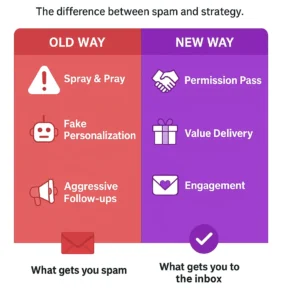
The spray-and-pray approach
Buy a list of 10,000 contacts, blast the same generic pitch to everyone, hope for a 1% response rate. This strategy worked in 2010. In 2025, it destroys your sender reputation and gets you blacklisted.
The fake-personalization approach
“Hi [FirstName], I noticed [Company] is hiring for [Role]. Clearly you’re growing fast…” Everyone sees through this. It’s automated garbage dressed up as personal attention.
The aggressive-follow-up approach
“Just bumping this to the top of your inbox!” after two days of silence. Then again three days later. And again. You’re not persistent—you’re annoying.
The fundamental mistake? Treating outreach like a numbers game instead of a relationship-building exercise.
Here’s what actually works: transparent permission, genuine relevance, and value-first communication. You won’t reach as many people, but the people you reach will actually engage.
And those who engage consistently may become qualified sales opportunities.
How do you build a prospect list instead of buying one?
Your outreach is only as good as your list.
Start with Your Ideal Customer Profile
Who actually buys from you? Not who you wish would buy, but who actually signs contracts and gets value from your product.
Define them by:
- Industry and sub-vertical: Not just “SaaS” but “B2B SaaS platforms serving mid-market financial services”
- Company size: Revenue range, employee count, growth stage
- Geography: Where they operate, what regulations they face
- Technology stack: What tools they already use (signals buying intent)
- Signals: Hiring, funding rounds, leadership changes, expansion
The more specific your ICP, the more relevant your outreach.
Find Prospects That Match
Quality data sources:
- First-party data: Website visitors, content downloaders, event attendees, referrals from customers
- LinkedIn Sales Navigator: Filter by company, role, seniority, activity
- Intent data providers: Companies showing buying signals (researching competitors, reading review sites)
- Industry databases: Trade associations, conference attendee lists, regulatory filings
- Let Outkeep do it: Outkeep helps you grow a brand-safe, always-on email audience — compliantly and automatically.
What to avoid:
- Purchased contact lists (outdated, low-quality, compliance nightmares)
- Scraped emails from websites (spam trap heaven)
- Third-party “lead generation services” with vague sourcing
Verify Before You Send
Every email address should be validated before it enters your outreach sequence.
Use verification tools to catch:
- Syntax errors: Typos that will hard bounce
- Inactive addresses: Accounts that haven’t been used in months
- Spam traps: Addresses specifically created to catch spammers
- Role-based addresses: info@, sales@, contact@ (low engagement, high complaint rates)
A 2% bounce rate will damage your sender reputation. Verify first, send second.
This is no walk in the park, most B2B teams spend 30/hrs a week preparing lists. Outkeep puts your list growth on autopilot. You define your ICP, and we find prospects that match, verify and permission pass them, and send email for you.
What is permission-based email marketing?
Here’s where Outkeep’s approach differs from traditional cold outreach.
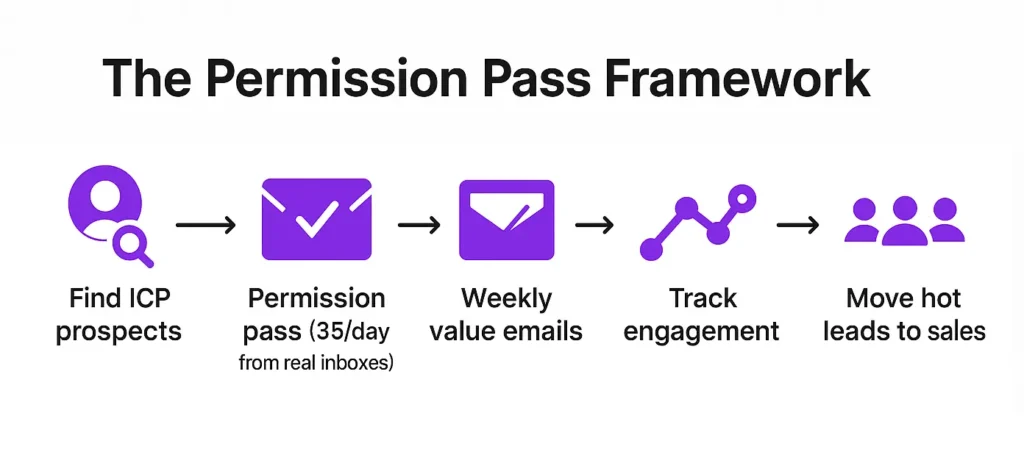
What Is a Permission Pass?
A permission pass is a transparent first email that:
- Introduces who you are and why you’re reaching out
- Explains what value you’ll provide if they stay subscribed
- Gives a clear, easy way to opt out
- Respects their choice without manipulation
Sending infrastructure: Permission passes are sent from real people’s inboxes, up to 5 team members’ actual Gmail or Outlook accounts, with a maximum 35 per day per inbox. This isn’t bulk mail yet. It’s transparent introduction from real humans, which is why deliverability stays high.
It’s not cold email (you’re not pitching anything). It’s not warm email (they may not know you). It’s transparent permission-seeking that acknowledges B2B relationships don’t always start with someone filling out a form.
Why It Works
Traditional cold outreach pretends to be something it’s not. Permission passes are honest about being outreach.
That honesty builds trust. When you say “I’m going to send you relevant insights about [topic] over the next few weeks with a prominent Unsubscribe option, you:
- Demonstrate respect for their time and inbox
- Set clear expectations about what’s coming
- Filter for interest (people who opt out weren’t going to engage anyway)
- Improve deliverability (fewer spam complaints, better engagement from those who stay)
How to Craft a Permission Pass Email
Subject line: Clear and specific
- “Intro + what I’ll share about [specific topic]”
- “Quick note on [relevant industry event]”
- “Permission to send you [specific value]?”
Body structure:
- Opening (2-3 sentences): Who you are and why you’re reaching out
“I’m [Name] from [Company]. I publish weekly insights on [specific topic] for [their role/industry] leaders.” - Value proposition (2-3 sentences): What you’ll send and why it matters
“Over the next few weeks, You’ll get tactical content on [specific topic relevant to their role/trigger]. This includes industry benchmarks, case studies, frameworks, etc. No sales pitches, just practical content you can use.”
- Opt-out (1-2 sentences): Clear, easy, pressure-free
If that sounds good, you don’t need to do anything—you’ll stay on our list.
If not, you can opt out right here: [opt out button] - Signature: Real person, real contact info
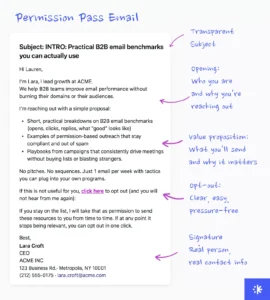
What this does:
- Acknowledges you don’t have explicit permission yet
- Offers genuine value in exchange for attention
- Makes opting out easy (reduces spam complaints)
Legal Compliance
CAN-SPAM requirements:
- Accurate sender information (no fake names or addresses)
- Clear subject line (no deception)
- Physical address in signature
- Obvious opt-out mechanism
- Honor opt-outs within 10 business days
GDPR requirements (if targeting EU):
- Legitimate interest basis (document why contact is relevant)
- Easy opt-out
- Clear identity and purpose
- Privacy policy available
- Data processing documentation
The permission pass approach satisfies both. You’re transparent about who you are, why you’re contacting them, and how to stop. Document your reasoning for each list source.
What does an outreach email that earns a reply look like?
After your permission pass, you’re not done. You still need to deliver value and earn engagement.
Subject Lines for Outreach
Forget the tricks. Your goal is clarity and relevance.
Good outreach subject lines:
- “WEBINAR: [title of the webinar]”
- “REPORT: [AI Adoption and ROI in industry]”
- “How [competitor/peer company] solved [specific problem]”
Bad outreach subject lines:
- “Quick question” (vague, used by every spammer)
- “Following up” (when there’s nothing to follow up on)
- “Re: [random topic]” (fake thread manipulation)
- Anything with “I tried calling…” (manipulation)
Email Structure That Works
Keep it short. Three short paragraphs max. Busy executives delete anything longer.
- Paragraph 1: Relevant hook
Reference something specific to their industry. A recent relevant news story, industry trend, or challenge they’re likely facing.“I saw [Industry] companies are struggling with [specific challenge]. New regulations require [specific change] by Q2.”
- Paragraph 2: Insight or value
Provide something useful immediately. A relevant data point, tactical advice, or resource they can use.“We analyzed 200+ companies navigating this change. The successful ones did three things differently: [brief insight]. Here’s a framework we put together: [link to ungated resource].”
- Paragraph 3: Single, clear CTA
One action only. Make it valuable, not sales-y.“Register for our webinar where we’ll walk through the complete framework: [CTA button]”
That’s it. No company pitch. No feature list. No multiple CTAs.
The Perpetual Drumbeat: Value-First Email Cadence
Forget four-touch sales sequences. This isn’t about getting responses—it’s about building brand awareness and trust through consistent value delivery.
The approach: Weekly (or bi-weekly) emails delivering pure value. No asks for meetings. No pitches. Just useful content your audience actually wants.
Recommended cadence:
- Same day, same time each week (or up to 2x per week max)
- Each email stands alone—not sequential, not a multi-part series
- Single CTA per email: register for webinar, download whitepaper, read case study
- Continue indefinitely for engaged subscribers
- Breakup email around email 7-8 for non-engagers (those not opening or clicking anything)
Why independent emails work better:
- No content workflow bottlenecks (each email can be created independently)
- Subscribers can join at any point and get value immediately
- Easier to maintain consistent cadence
The goal: Build trust and demonstrate expertise over weeks and months. Those who consistently engage (open, click, download) signal buying intent—that’s when you move them to one-on-one sales conversations.
Note on newsletters: Reserve traditional newsletters for existing customers and your most engaged subscribers. Don’t send newsletters to everyone on your permission-passed list. It’s too much, too soon. Start with focused value emails first.
The CTA That Works: Value, Not Asks
Stop asking for anything in bulk email. Your CTA should offer value, not request time.
Single-CTA rule: One clear action per email. No multiple links, no competing calls-to-action.
Good CTAs for bulk emails:
- “Register for our [specific topic] webinar”
- “Download the complete [industry] benchmark report”
- “Read the case study: How [Company] achieved [specific outcome]”
- “Get the framework: [Specific methodology]”
- “Watch the on-demand session”
Bad CTAs for bulk emails:
- “Book a 15-minute call”
- “Schedule a demo”
- “Reply to this email”
- “Let’s chat”
The goal is to demonstrate expertise and provide value.
How do you protect sender reputation on brand-led email?
Bad bulk email doesn’t just waste time, it tanks your ability to reach anyone’s inbox.
The Bulk Email Approach to Deliverability
Bulk email has different deliverability requirements than one-on-one sales sequences. You’re sending to larger lists, but less frequently.
Permission Pass Sending (Building Your List):
- Maximum 35 permission passes per day, per inbox
- Use up to 5 real inboxes (real people’s email addresses, not generic domains)
- Send through actual connected inboxes (Gmail, Outlook accounts of team members)
- Warm up each inbox gradually over 2-3 weeks before hitting 35/day
Why real inboxes matter: Email providers trust established accounts with sending history. Your CEO’s Gmail account with 5 years of legitimate email history has far better deliverability than a brand-new marketing@ address.
Bulk Content Sending (After Permission Pass):
- Start small: Few hundred recipients per send
- Send 1-2 emails per week maximum (never more)
- Gradually increase volume as you add more permission-passed contacts
- Remove low engagers simultaneously (kinetic growth: adding + removing for steady, safe scaling)
- Monitor engagement rates closely—if opens/clicks drop, pause and diagnose
The kinetic approach: Each bulk send should add newly permission-passed contacts while automatically removing those who haven’t engaged in 8-10 emails. This keeps your list healthy and engagement rates high.
Monitor Your Reputation
Track these metrics religiously:
- Bounce rate: Should stay under 2%. Higher means bad data.
- Spam complaint rate: Should stay under 0.1%. Higher means you’re annoying people.
- Engagement rate: Opens and clicks should remain steady or grow. Decline signals deliverability or relevance issues.
- Inbox placement: Use tools to check if you’re landing in spam folders.
If any metric deteriorates, pause sending and diagnose the problem.
Use a Dedicated Outreach Subdomain
If you’re doing cold outreach, make sure you use a subdomain created from your primary business domain.
Why:
- Protects your main domain’s reputation if outreach tanks deliverability
- Allows more volume on outreach domain
- Isolates risk
Setup:
- Create a subdomain on your domain control panel (if main is company.com, use mail.company.com or info.company.com)
- Set up proper authentication (SPF, DKIM, DMARC)
- Monitor separately from main domain
Automation and Tools: What to Automate, What Not To
The right tools let you personalize at scale. The wrong approach makes you look like a robot.
What to Automate
Research and data enrichment:
- Finding prospects that match your ICP
- Gathering firmographic data
- Verifying email addresses
Sequence management:
- Scheduling sends for consistent cadence
- Tracking opens and clicks
- Managing opt-outs
Outkeep can help you automate your email outreach strategy, from automated list growth to permission passes, sending and opt-outs.
What NOT to Automate
First-touch research: Don’t auto-generate “I noticed X about your company” intros. They’re transparently fake. Either do real research or use segment-based messaging.
Content quality: Don’t let AI write complete emails without human review. Use AI for research, not replacement.
Recommended Tool Stack
For brand-led outreach (what this guide covers):
Outkeep handles the complete workflow:
- Automated ICP-matched prospect discovery
- Email verification and validation
- Permission pass sending from real inboxes
- Weekly value-driven content delivery
- Engagement tracking and list hygiene
- Deliverability monitoring and reputation protection
For sales team research and one-on-one outreach:
LinkedIn Sales Navigator – Primary tool for sellers to research highly engaged prospects before moving them to personal sales sequences
Optional contact enrichment (if you need additional data beyond what Outkeep provides):
- Apollo, ZoomInfo, or Clearbit for deeper firmographic data
One-on-one sales sequences (for highly engaged contacts):
- Outreach.io, Salesloft, or Lemlist for personalized sales sequences
- Your CRM for relationship tracking and attribution
Additional deliverability testing (Outkeep monitors this, but if you want independent verification):
- GlockApps or Mail-Tester for inbox placement testing
- Postmaster Tools (Google) and SNDS (Microsoft) for direct reputation monitoring
Which engagement metrics actually matter?
Response rates don’t matter for bulk email. Engagement and content consumption do.
Open Rate
What it is: Percentage of recipients who open your email
Benchmarks for permission-based bulk email:
- First few emails: 30-50% (freshly permission-passed contacts)
- Steady-state: 20-35% (engaged, opted-in audience)
- Below 15%: Sign of deliverability issues or poor targeting
What it tells you:
- Subject line effectiveness
- Send time optimization
- List health and engagement
- Deliverability issues (sudden drops indicate spam folder placement)
Click-Through Rate
What it is: Percentage of recipients who click your CTA
Benchmarks for value-driven content:
- 3-8% for webinar registrations
- 2-5% for content downloads
- 5-10% for highly anticipated content (original research, industry benchmarks)
What it tells you:
- Content relevance and value
- CTA clarity and appeal
- Audience interest level
Click-to-Open Rate
What it is: Of those who opened, how many clicked?
Benchmark: 15-25%
What it tells you: Whether your email content delivers on the subject line’s promise. Low click-to-open means either subject line set wrong expectations or content wasn’t valuable enough.
Content Consumption Rate
Track which content types drive the most engagement:
- Webinar registrations and attendance
- Whitepaper downloads
- Case study views
- On-demand video views
This tells you what topics and formats resonate most with your audience.
Engagement Decay
Monitor how many contacts stop opening/clicking over time:
- No opens/clicks in last 5 emails: At-risk
- No opens/clicks in last 7-8 emails: Time for breakup/re-engagement email
- No opens/clicks after breakup email: Remove from list
Domain Health Metrics
Monitor continuously:
- Bounce rate: Under 2% is healthy
- Spam complaint rate: Under 0.1% is safe
- Unsubscribe rate: Under 0.5% per send
- Inbox placement rate: Above 90% is good
If any metric deteriorates, pause sending immediately and diagnose.
When Highly Engaged Contacts Signal Sales Readiness
Watch for these signals that someone is ready for one-on-one sales outreach:
- Consistent engagement (opens/clicks) across 3-5+ emails
- Multiple content downloads
- Webinar attendance (especially live Q&A participation)
- Clicks on product-specific content (case studies, ROI calculators)
- Visits to pricing or demo pages (if you can track website behavior)
These highly engaged contacts should be moved to personalized sales sequences using dedicated sales tools—not kept in bulk email indefinitely.
When should marketing hand off to sales outreach?
Here’s what most B2B companies get wrong: they start with cold sales emails, skipping the brand-building phase entirely.
The result? Low response rates, high spam complaints, and burned sender reputations.
The Outkeep approach flips this: brand first, sales second.
The Two-Phase Strategy
Phase 1: Brand-Led Bulk Email (What This Guide Covers)
- Permission pass transparent introduction
- Weekly/bi-weekly value delivery (webinars, content, insights)
- No asks for meetings, just value
- Build trust and demonstrate expertise over weeks/months
- Track engagement (opens, clicks, content consumption)
Phase 2: One-on-One Sales Sequences (Using Dedicated Sales Tools)
- Personalized outreach to highly engaged contacts only
- Specific asks (demo requests, discovery calls, meetings)
- Sequential follow-up logic
- Response tracking and conversation management
When to Transition Someone from Phase 1 to Phase 2
Move contacts to sales sequences when they show multiple engagement signals:
- Opened/clicked 3-5+ consecutive bulk emails
- Downloaded multiple resources
- Attended webinars or events
- Visited high-intent pages (pricing, case studies, product pages)
- Engaged with product-specific content
Why This Order Matters
Starting with sales outreach (Phase 2) before brand building (Phase 1):
- Gets you blocked/filtered as spam
- Generates low response rates (1-3% at best)
- Damages sender reputation
- Feels pushy and transactional
Starting with brand-led email (Phase 1) before sales outreach:
- Builds trust and credibility first
- Generates higher response rates when you do reach out (10-20%+)
- Protects sender reputation through high engagement
- Feels educational and helpful
What This Guide Covers vs. What It Doesn’t
This guide focuses on Phase 1: brand-led bulk email to build audience and engagement.
For Phase 2 (sales sequences), use dedicated tools:
- Outreach.io, Salesloft, or Lemlist for one-on-one sequences
- Your CRM for relationship management
- Sales engagement platforms for personalized follow-up
Don’t use bulk email infrastructure for sales conversations. Don’t use sales tools for brand-led content distribution. They’re different strategies requiring different tools.
The Bottom Line
Stop sending cold sales emails to people who’ve never heard of you.
Start with transparent permission, deliver consistent value, build trust over time, and move highly engaged prospects to sales conversations.
That’s how you build a sustainable, reputation-protecting, revenue-generating email program.
Done right, outreach becomes a reliable brand-building and lead-generation channel—not a reputation-destroying spam operation.
Want help implementing this approach? Outkeep provides the infrastructure for compliant, permission-based outreach that protects your domain reputation while unlocking genuine B2B opportunities.
We automate list building, verification, permission passing, and value-driven email cadence, so you can focus on creating great content while we handle the technical execution.
Because burning your sender reputation for cold sales emails isn’t a strategy—it’s self-sabotage.
For a comprehensive look at your entire B2B email marketing strategy (including nurturing, automation, and lifecycle campaigns beyond initial outreach), read our complete B2B email marketing strategy guide.
Build lists you own. Send emails that get engagement. Grow relationships that drive revenue.