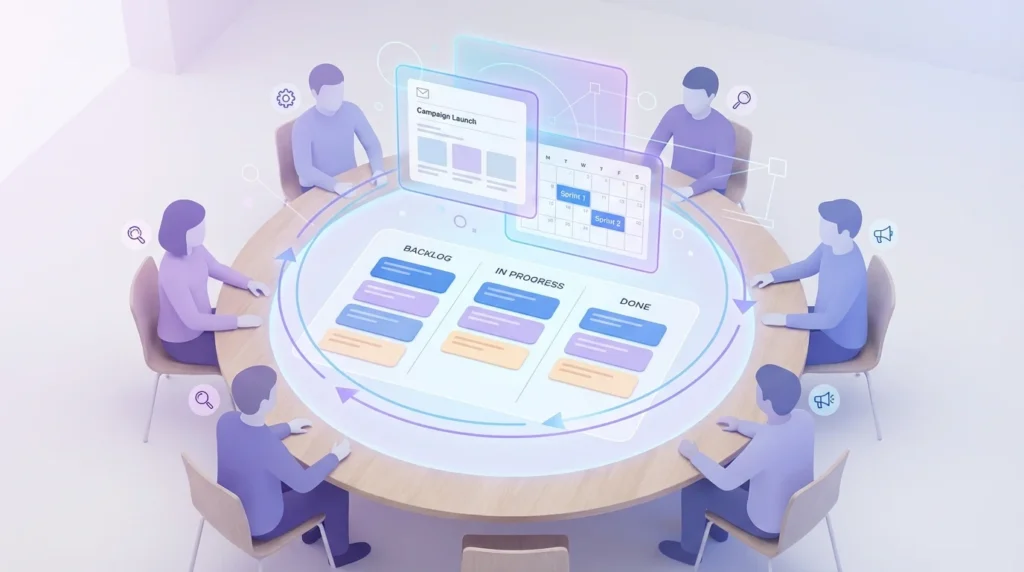
Most marketing teams have a calendar full of meetings, weekly syncs, maybe even daily stand-ups, but they still do not have a true operating rhythm. I have spent the last five years installing Agile frameworks into multiple marketing organizations, and this guide captures what actually works. It focuses on practical adaptations that make work visible, keep priorities clear, and create consistent feedback loops.
Executive Summary
After implementing Agile in marketing teams across different organizations, I have learned that success comes from adapting the framework to how marketing actually works. The approach that consistently delivers results centers on two-week sprints with streamlined ceremonies, simple board structures, and shared ownership of the process.
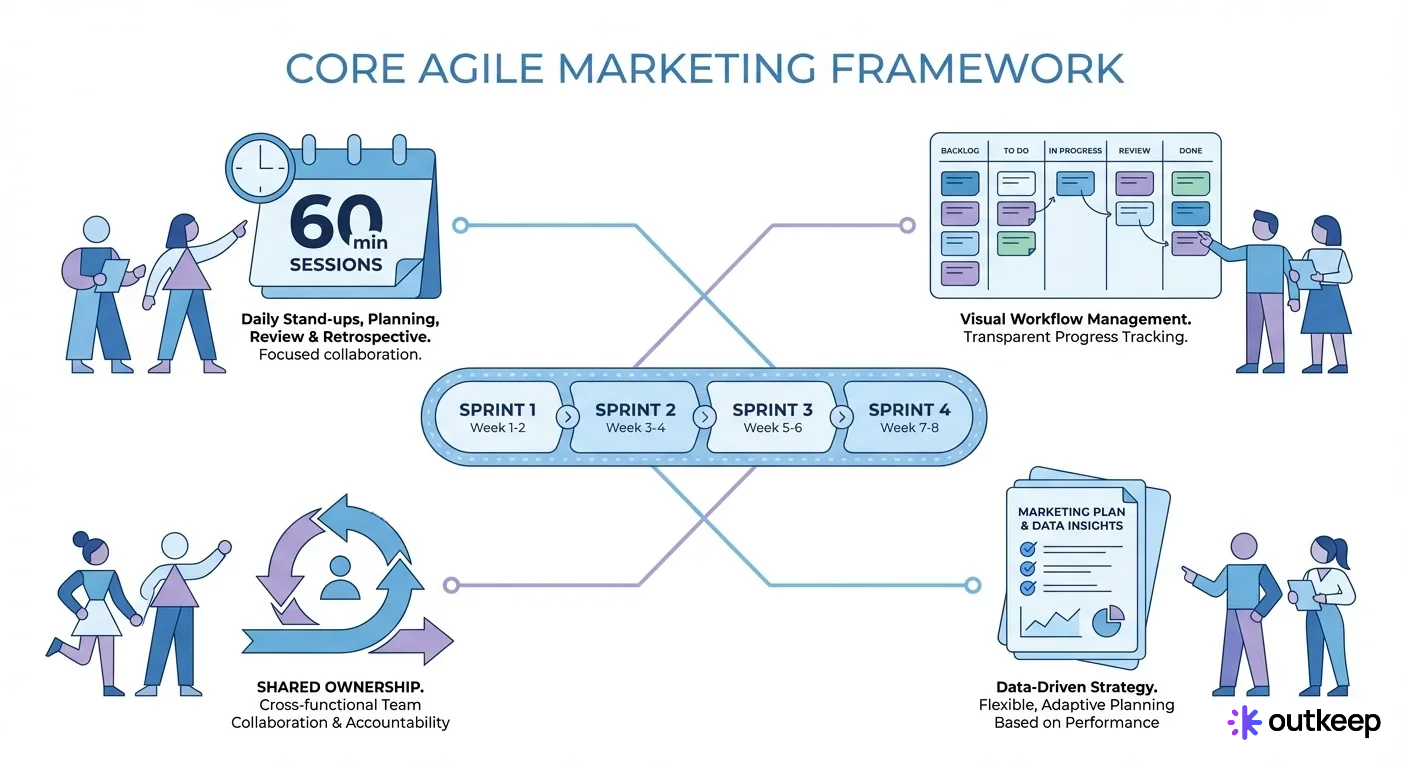
The core is straightforward. Bundle your sprint planning, retrospective, and grooming into a single 60-minute session every two weeks. Run 15-minute stand-ups twice weekly to keep work moving. Track all work on one board with 5-6 statuses, including explicit tracking of interrupt work that comes from sales, leadership, and other teams. Rotate who facilitates the process so everyone owns it. Write down your approach in a 1-2 page document so the system survives team changes.
When this rhythm clicks, you get something powerful: fewer meetings, better visibility into what is actually happening, and a team that ships consistently while handling the reality of constant interruptions. The four principles that make it work are simple: all work must be visible, priorities are clear and enforced, progress gets reviewed frequently, and the team captures learnings to improve each cycle.
1. Understanding Agile for marketing (without the capital A)
What it is
Agile comes from software development and includes specific ceremonies like sprint planning, daily stand-ups, retrospectives, grooming sessions, and demos. “Agile with a capital A” refers to following these ceremonies exactly as prescribed in frameworks like Scrum. In my experience, that purist approach rarely works in marketing. Instead, we need to take the core principles and adapt them to create a practical operating cadence.
How to run it
- Start with the mindset that Agile is your operating system for execution and learning, not a reporting framework.
- Adapt the ceremonies to your reality. Marketing does not need five separate meetings when one well-run session accomplishes the same goals.
- Set the expectation early that this system exists to help the team plan, execute, and improve their work.
Operator notes
- A certified Scrum Master would probably dislike many of these adaptations. That is fine. We are optimizing for marketing effectiveness, not certification.
- If the team experiences Agile as extra administrative burden, it will fail quickly.
- The goal is consistency and visibility, not perfect adherence to a methodology.
2. Use the four principles as the non-negotiables
What it is
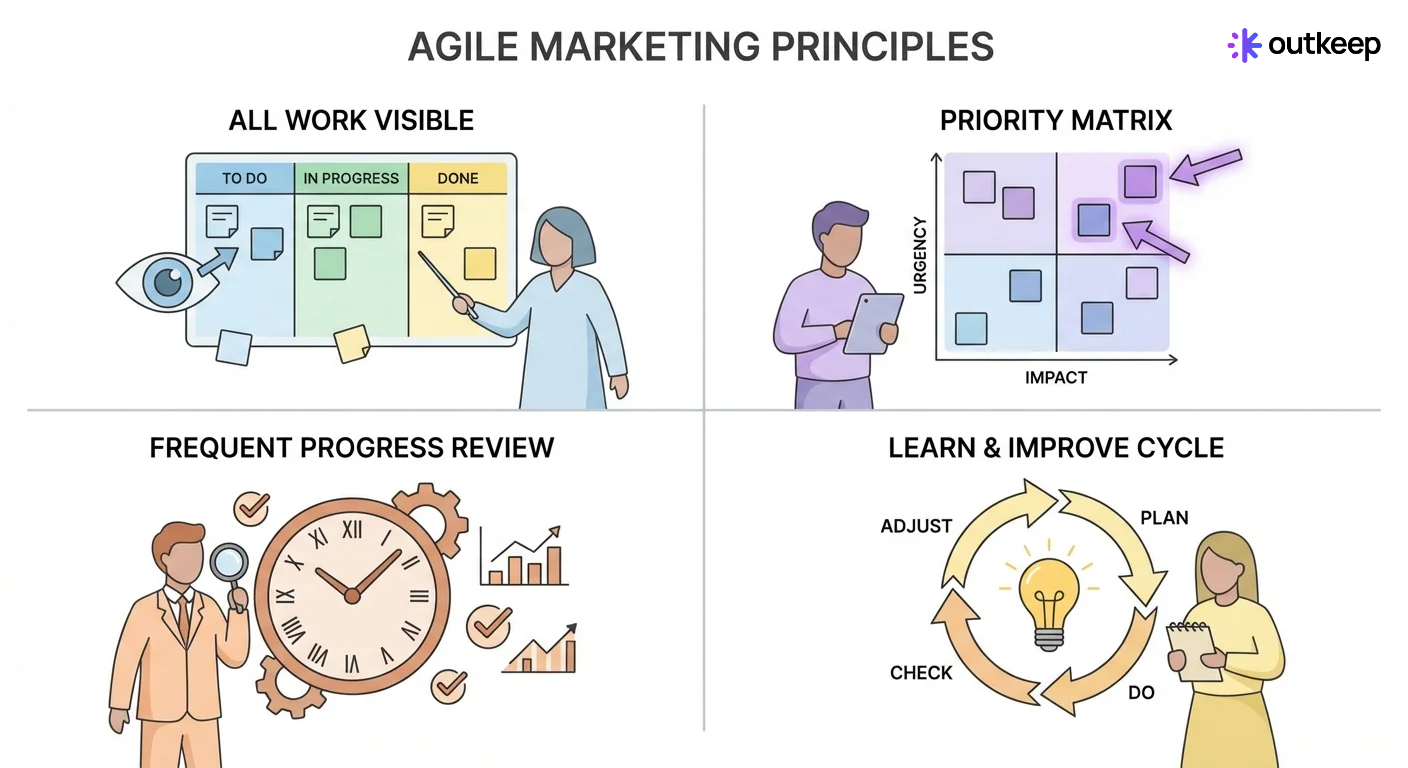
After years of iterations, I have found that most of what matters comes down to four principles: all work must be visible, work is ruthlessly prioritized, progress is reviewed very frequently, and the team looks back, learns, and feeds the next cycle.
How to run it
- Make visibility a hard rule: “If it’s not on the board, it doesn’t exist.”
- Prioritize consciously and ruthlessly, then commit to what fits.
- Review progress frequently through short stand-ups, not long meetings.
- Add a real feedback loop, even if it is lightweight, so each sprint improves the next.
Operator notes
- Marketing tends to accumulate side lists, personal checklists, and Slack threads. Those break the visibility principle immediately.
- “Prioritization” only counts when it causes trade-offs, including saying no or de-prioritizing.
- Continuous improvement is not a quarterly offsite, it is a repeating habit.
3. Two-week sprints are the sweet spot for marketing work
What it is
I have tried everything from one-week to month-long sprints. For most marketing teams, two weeks consistently hits the sweet spot. It is long enough to ship meaningful work and short enough to maintain clarity and urgency.
How to run it
- Run two-week sprints as the default cadence.
- Commit sprint work based on capacity, known constraints, and expected interrupts.
- Use the sprint boundary to force decisions, close loops, and reset priorities.
Operator notes
- Marketing work includes many moving parts, dependencies, and last-minute requests. Two weeks is long enough to ship meaningful work, short enough to correct quickly.
- Longer cycles tend to hide drift. You discover “we did not get to it” too late.
- The sprint is not a productivity contest, it is a container that reduces chaos.
4. Bundle closeout, mini-retro, grooming, and planning into one working session
What it is
Traditional Agile separates grooming, retrospective, and planning into different meetings. In marketing, I have found it far more effective to bundle them into a single 60-minute working session every other Monday, assuming people prepare their tickets in advance.
How to run it
- Hold one hour every other Monday as the core sprint working session.
- Require that people put tickets in advance, so the meeting is not live brainstorming.
- Use a simple agenda that covers the three components in sequence:
- 5–10 minutes: close out the previous sprint, what shipped, what did not, move unfinished cards to next sprint or back to backlog.
- 5–10 minutes: capture learnings, what should change, what should be added to an SOP or process.
- 5 minutes: confirm capacity constraints, vacations, major conflicts, anything that reduces output.
- Remaining time: groom and prioritize backlog, then pull work into the next sprint with owners and lightweight sizing.
Operator notes
- The split often ends up roughly half grooming and retro, half planning. That is normal.
- If people show up with nothing on the board, the meeting turns into estimation theater and chaos.
- This should be your longest meeting in the cadence, and it is still only one hour.

5. Stand-ups are the execution engine, keep them short and ticket-driven
What it is
Between planning sessions, stand-ups keep the sprint moving. After testing daily stand-ups and various formats, I have found that twice-weekly stand-ups work best for marketing teams. They need to be short enough that they do not create a second meeting culture.
How to run it
- Run stand-ups 2x per week, common options are Tuesday/Thursday or Monday/Wednesday/Friday.
- Keep them 15 minutes ideally, 30 minutes maximum.
- Run them in the morning so people can cover what happened yesterday, what is on deck today, and what they need to get unblocked.
- If you run 30 minutes, split it:
- First 10–15 minutes: strict ticket and blocker review.
- Last 10–15 minutes: quick strategic sync, only if needed.
Operator notes
- A stand-up is not a strategy meeting. It is a fast operational unblock.
- If the stand-up consistently turns into a long discussion, push the discussion to a smaller group after.
- The board should be the script. If the board is messy, stand-ups become fuzzy.
6. Build a single board with simple statuses, and enforce “one source of truth”
What it is
The board is the system. After building boards in Jira, Notion, Asana, and others, I have learned that the tool matters far less than keeping the structure simple and enforcing that all work lives in one place.
How to run it
- Use whatever tool you already have, Jira, Notion, Asana, ClickUp, Trello, it matters less than the structure.
- Keep statuses simple, avoid 7 to 12-step pipelines. A practical set is:
- Backlog
- To Do (in this sprint)
- In Progress
- Blocked
- In Review
- Done
- Define “In Review” clearly: work is with someone outside the team and out of the assignee’s direct control.
- Separate complex multi-step workflows onto a different board if you truly need them.
Operator notes
- Personal preference on board view is real. Many marketing teams find list views easier to manage than heavy Kanban-style boards.
- The strict rule matters: “If it’s not on the board, it doesn’t exist.” No shadow systems.
- “Blocked” should mean external dependency, not “I am annoyed by this task.”

7. Make tickets operationally useful: single owner, lightweight sizing, and sprint priorities
What it is
A board only works if tickets are written and managed in a way that supports execution. Through trial and error, I have found that clear ownership, reasonable sizing, and explicit priorities make the difference between a useful system and ticket soup.
How to run it
- Assign a single owner to every ticket.
- Use lightweight t-shirt sizing (S, M, L, XL) to avoid false precision.
- Treat XL as a signal that the work should be broken down, it is usually too big for one ticket.
- Tag a small handful of tickets per sprint as truly critical, the “must ship” items.
Operator notes
- “Single owner” does not mean the owner does all the work, it means they are accountable for getting it done.
- Shared ownership on a single task is a common failure mode. Two owners usually means no owner.
- Most teams have routine execution tasks that always exist. The priority tags are for the 2–3 things that create real risk if they slip.
8. Track interrupts explicitly with request types, then use that data to protect capacity
What it is
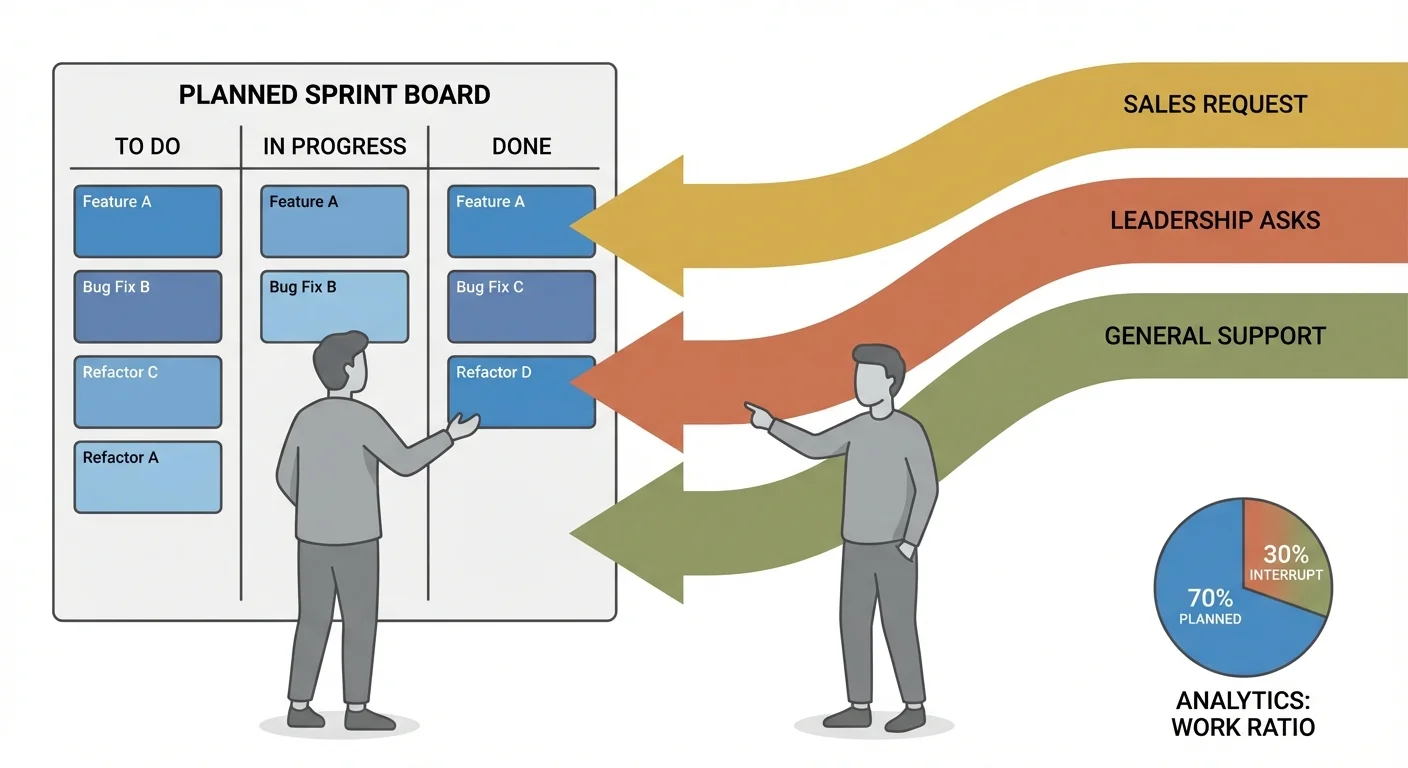
Marketing is interrupt-driven. Every team I have worked with underestimates how much unplanned work hits mid-sprint until we start tracking it. Ticket types make interruptions visible without turning the system into organizational politics.
How to run it
- Use ticket types to separate planned work from request-driven work, for example:
- Marketing-initiated
- Sales request
- Leadership request
- General request
- Require that external requests go onto the board, not Slack, email, or drive-bys.
- Review the mix at the end of each sprint, for example, “we started with 100 planned tickets and got 50 request-driven tickets mid-sprint.”
Operator notes
- This is not about complaining, it is about visibility. Most teams underestimate interrupts until they can quantify them.
- The board gives you a clean pushback mechanism: “We are at capacity, what should we de-prioritize?”
- If external requests routinely bypass the board, you lose the ability to plan, and the sprint becomes fiction.
9. Use epics (and occasional demos) to keep longer initiatives visible without bloating sprints
What it is
Marketing has initiatives that span multiple sprints. Webinars, conferences, launches, quarterly campaigns. Epics are a simple way to group related tickets so you can track progress on bigger initiatives without turning every sprint into a project plan.
How to run it
- Create epics for bigger themes that span sprints, for example:
- A webinar series
- A specific conference or event
- A big new offer or product launch
- A strategic initiative for a quarter
- A specific segment or program
- Tag tickets with epic, sprint, assignee, priority, and status.
- During stand-ups, filter views to keep it fast, for example “Bob’s tickets, current sprint, not done.”
- Add demos when useful, weekly, bi-weekly, or monthly, to show what the team created and get quick feedback.
Operator notes
- Epics preserve visibility on long-running work without forcing every sprint to become a project plan.
- Demos are optional but often valuable in marketing because output is diverse, assets, workflows, campaigns, reporting.
- If demos become theatrical, reduce scope and frequency. Keep them about showing shipped work.
10. Make the process shared ownership: rotate facilitation and write a 1–2 page SOP
What it is
Most marketing teams do not have a dedicated Scrum Master. Even when there is a coordinator or manager, they are wearing multiple hats. I have found that shared ownership of the process makes it far more resilient and effective.
How to run it
- Rotate facilitation for sprint sessions and stand-ups, every sprint, every month, or every couple of months.
- Ensure everyone can:
- Run planning and the mini-retro
- Facilitate stand-ups
- Keep the board clean and up to date
- Write a one or two-page SOP for your team’s version of Agile and follow it.
Operator notes
- Rotating facilitation keeps the system from feeling like “a meeting rhythm enforced by a boss.”
- Junior team members and interns can run these meetings, and they should learn to.
- The SOP matters because marketing teams change quickly. Without it, the cadence drifts and becomes inconsistent.
11. Structure your team for success with the right mix of generalists and specialists
What it is
The team composition significantly impacts whether Agile works well in marketing. Through multiple implementations, I have found that a blend of generalists and specialists creates the right balance for sprint-based execution.
How to run it
- Staff for a mix of:
- Generalists who own larger workstreams and glue execution together
- Specialists for deep work like content, design, field and events, paid and performance
- If you are a larger or globally distributed org, break into multiple Agile pods, often around:
- Geography (Europe pod, US pod)
- Region (Southeast, Northeast)
- Industry vertical (financial services vs healthcare)
- Each pod runs its own sprints and ceremonies but uses the same overall approach and SOP.
Operator notes
- Pods work when each uses the same overall approach and SOP, even if they execute on different backlogs.
- Generalists are often the “glue” that makes sprint execution realistic across specialists.
- Keep pods to about 8 people maximum for effective collaboration.
Tip: For teams running EOS, my take on making it work with Agile
If your company runs EOS (Entrepreneurial Operating System), you may find that EOS and Agile compete at the team execution level. The classic L10 meeting structure does not translate well to running a marketing team’s daily and weekly work. In my experience, it works best when the head of marketing participates in the leadership L10, but the marketing team itself runs on an Agile cadence for execution. This avoids forcing a square peg into a round hole and lets each framework do what it does best.
12. What “good” feels like when the rhythm is working
What it is
When Agile is working in marketing, it does not feel like being busy. After getting this right in multiple organizations, I can tell you it feels like fewer interruptions, fewer unnecessary meetings, and tighter collaboration because everyone can see the work and the trade-offs.
How to run it
- Use the sprint boundary to reduce carryover tickets and improve capacity planning.
- Keep the board clean so gaps and missed areas become obvious quickly.
- Maintain the feedback loop, look back, learn, feed the next cycle.
Operator notes
- Collaboration improves across content, design, dev, and other functions because the work is visible and planned.
- The system surfaces what is not getting done, which drives better prioritization and often better creativity.
- The practical outcome is a team rowing in the same direction, with a flywheel that keeps turning.

Context on Outkeep’s Approach
Outkeep has operated inside real marketing and go-to-market teams where execution depends on clean process, visibility, and cross-functional coordination. This perspective comes from using sprint-based rhythms to manage interrupt-driven work while still shipping planned programs consistently.
FAQ for Modern B2B Email Programs
What sprint length works best for a marketing team running email and campaigns?
Two-week sprints are usually the sweet spot. They are long enough to ship meaningful work and short enough to review progress and adjust priorities frequently.
What should be included in a marketing sprint planning meeting?
A practical format is a single 60-minute session that closes out the last sprint, captures learnings (mini-retro), grooms the backlog, checks capacity constraints, and plans the next sprint.
Do you need a Scrum Master to run Agile in marketing?
Usually no. Most marketing teams use shared ownership and rotate facilitation for planning, stand-ups, and retrospectives, supported by a short SOP.
What board statuses should a marketing team use?
Keep it simple. A common set is Backlog, To Do (in this sprint), In Progress, Blocked, In Review, Done. “In Review” typically means the work is with someone outside the team.
How do you handle ad hoc requests that hit mid-sprint?
Put them on the board as tickets, tag them by request type (sales, leadership, general), then make a trade-off explicit by de-prioritizing something else if capacity is full.
How many tickets should a marketer complete in a two-week sprint?
A rough benchmark is 6 to 16 tickets per sprint, depending on role and ticket sizing. Senior marketers often have fewer, larger tickets, tactical operators may have more, smaller ones.
Can EOS L10 meetings replace sprint planning and stand-ups for a marketing team?
In practice, L10 structure often does not translate well to marketing execution. It is usually more effective for marketing to run an Agile cadence, with the head of marketing participating in the leadership L10.