By George Linville, CEO & Co-Founder, Outkeep · Updated October 2026 · Pricing and policies checked October 8, 2026
The short answer
The best B2B email marketing platforms for long, high-consideration sales cycles are HubSpot Marketing Hub, Adobe Marketo Engage, Salesforce Marketing Cloud Account Engagement (Pardot), Oracle Eloqua, Outkeep, Microsoft Dynamics 365 Customer Insights – Journeys, Act-On, and ActiveCampaign. Seven of them email the contacts already in your database. Outkeep builds and emails an audience of the buying committees who aren’t there yet.
- CRM and marketing in one system, with intent data on new accounts: HubSpot Marketing Hub
- Complex programs run by a marketing operations team: Marketo Engage
- Companies that run on Salesforce: Marketing Cloud Account Engagement (Pardot)
- Global enterprises with many business units: Oracle Eloqua
- Reaching buying committees who aren’t in your database yet: Outkeep
- Companies on the Microsoft stack: Dynamics 365 Customer Insights – Journeys
- Mid-market B2B that pays only for contacts it emails: Act-On
- Capable automation on a small budget: ActiveCampaign
How we chose and ordered these: We evaluated platforms on how much of a B2B buying committee each can reach, how it handles third-party data, and what it costs, using vendor pricing pages, product documentation, and acceptable use policies checked in October 2026. The list is ordered by fit for long, high-consideration sales cycles rather than ranked by score. Outkeep is our product, a B2B email marketing platform used on its own or alongside a marketing automation platform. Vendors can send corrections to the author.
In this guide: Why long cycles change the comparison · The Reach Scale · At a glance · Third-party data · The 8 platforms · HubSpot vs. Marketo vs. Salesforce vs. Eloqua · Cost · FAQ
Why long sales cycles change how you should compare email platforms
Every platform on this list can send a good newsletter and run a nurture sequence. In long-cycle B2B, the harder problem is who receives it. Four numbers explain why:
- Up to 95% of B2B buyers aren’t in market at any given time, according to research by Professor John Dawes of the Ehrenberg-Bass Institute for the LinkedIn B2B Institute (LinkedIn B2B Institute). The people who will buy next year mostly aren’t raising their hands this year.
- A typical purchase now involves 13 internal stakeholders plus outside influencers (Forrester, 2026). Most of them never fill out a form.
- The B2B buying journey averages 272 days, up from 211 (Dreamdata, 2026).
- Email lists decayed by 23% in 2025 as people changed jobs and addresses went stale (ZeroBounce).
Put together, a database built from inbound leads covers a small share of the people who will decide your next deal, and that share shrinks every year. A quick way to size your own gap:
Your reach gap
Example
Example: 500 target accounts × 13 people = 6,500. If 1,000 of them are opted-in contacts in your database, your email reaches about 15% of the buying committee.
So compare reach before you compare features.
The Reach Scale: Inbound, Blended, and Outbound marketing
We placed each platform on a three-point scale based on how far beyond your existing database it can take you, using three tests: whether the vendor’s own data surfaces accounts you don’t have yet, whether it builds ad audiences at the company level, and whether it identifies anonymous website visitors by company. A platform that passes two of the three natively is Blended.
The Reach Scale
How far beyond your database each platform reaches
Emails and nurtures the contacts already in your database. Some identify visiting companies, but they don’t natively reach people beyond your contact list.
Platforms
Marketing email still requires opt-in, but native capabilities reach people beyond your contact list, either new accounts or new people at accounts you know, through company-level ad audiences, visitor identification, or intent data.
Platforms
Builds the emailable audience itself from your target accounts, introduces your company, then nurtures those contacts through a long cycle.
Platforms
Placement reflects each vendor’s native capabilities in October 2026. Add-on products such as Adobe Journey Optimizer B2B Edition or Salesforce Data 360 can extend some platforms. Microsoft’s retired “outbound marketing” module in Dynamics 365 is unrelated to this tier.
HubSpot passes all three tests. Oracle Eloqua passes two: its native LinkedIn company audiences reach new people at accounts you already have, and it identifies visiting companies. Dynamics 365 builds company-level LinkedIn audiences through Customer Insights – Data, and Account Engagement (Pardot) and Act-On identify visiting companies, so each passes one.
The best B2B email marketing platforms at a glance
Platforms at a glance
HubSpot Marketing Hub
Who it can email
Opted-in contacts
How it reaches new accounts
Buyer intent on companies not in your CRM; LinkedIn audiences
Best for
Growing teams that want one system
Adobe Marketo Engage
Who it can email
Opted-in contacts
How it reaches new accounts
Through Journey Optimizer B2B or partners
Best for
Complex, multi-touch enterprise programs
Marketing Cloud Account Engagement (Pardot)
Who it can email
Opted-in contacts
How it reaches new accounts
Visitor company ID; ads through separate Salesforce products
Best for
Salesforce-first sales alignment
Oracle Eloqua
Who it can email
Opted-in contacts
How it reaches new accounts
LinkedIn audiences at accounts you already have; visitor company ID
Best for
Global programs with heavy governance
Outkeep
Who it can email
Your target buying committees
How it reaches new accounts
Builds the audience from your target accounts
Best for
Reaching buyers not yet in your database
Dynamics 365 Customer Insights – Journeys
Who it can email
Opted-in contacts
How it reaches new accounts
Company-level LinkedIn audiences through Customer Insights – Data
Best for
Microsoft-standardized companies
Act-On
Who it can email
Opted-in contacts
How it reaches new accounts
Website Prospector names visiting companies
Best for
Mid-market B2B with a large database
ActiveCampaign
Who it can email
Opted-in contacts
How it reaches new accounts
Contact syncs to Meta and Google ads
Best for
Small B2B teams; an entry point before a long-cycle stack
Can you use third-party data in B2B email marketing platforms?
Not for marketing email in most of them. Six of the seven prohibit sending to purchased or rented lists outright, and Oracle advises against it.
Third-party data policies
| Platform | Email contacts who haven’t opted in? | What the policy says |
|---|---|---|
| HubSpot | No | Contacts “purchased, rented, borrowed, or otherwise obtained from a third party list” can’t receive marketing email (HubSpot) |
| Marketo Engage | No | Requires “first-party consent”; prohibits “renting, purchased lists, co-registration” (Adobe) |
| Marketing Cloud Account Engagement (Pardot) | No | “Supports only permission-based email marketing” (Salesforce) |
| Oracle Eloqua | Advised against | Oracle “does not recommend appends, rentals or purchasing of marketing email lists” |
| Dynamics 365 | No | Purchased or rented lists “are grounds for termination” (Microsoft) |
| Act-On | No | Bars sending to “purchased lists, or addresses obtained through harvesting” (Act-On) |
| ActiveCampaign | No | “We do not allow any form of paid, rented, borrowed, etc. lists” (ActiveCampaign) |
| Outkeep | Yes, US business addresses | Built for it under CAN-SPAM: one transparent introduction, an easy opt-out, and automatic removal of people who don’t engage |
These rules are enforced. HubSpot can suspend email sending at 5% hard bounces or 0.1% spam reports in a month, and Microsoft at 8% and 0.3%. The third-party data some platforms offer, such as HubSpot’s Breeze Intelligence, enriches records and informs targeting but doesn’t change who can receive marketing email.
Practice differs from policy. In a self-reported Outkeep survey of 124 US B2B marketers in late 2024, more than 98% said they had sent email to contacts who hadn’t opted in. US law permits B2B email without prior opt-in under CAN-SPAM’s opt-out rules (FTC), but doing it from a platform whose policy forbids it puts the account at risk.
How do B2B teams reach buyers who haven’t opted in?
Three ways to reach buyers who haven’t opted in
| Approach | Examples | Strength | Trade-off |
|---|---|---|---|
| One-to-one sales email | Outreach, Salesloft, Apollo, HubSpot Sequences | Personal, and allowed by most platform policies | Takes rep time and rarely covers a full buying committee |
| Account-based advertising | 6sense, Demandbase, LinkedIn Ads | Reaches target accounts without email | Paid per impression, and the audience isn’t yours |
| Outbound marketing email | Outkeep | An audience on your own domain that hears from you every week | Builds over about 90 days and needs a steady supply of content from your team |
The 8 best B2B email marketing platforms in 2026
Ordered by fit for long, high-consideration sales cycles. Prices and policies checked October 8, 2026.
1. HubSpot Marketing Hub
HubSpot puts CRM, marketing, sales, and service on one database, which is why lean teams can run it without a dedicated admin. It also reaches beyond your contact list natively: Buyer Intent surfaces companies researching your category that you don’t have yet, and company segments sync to LinkedIn as ad audiences. Breeze Intelligence enriches those accounts, though it runs on credits. A common migration path is Pardot to HubSpot, often with HubSpot sitting on top of Salesforce.
- Reach tier: Blended
- Good fit if: You want one system marketing and sales both work in, plus some visibility into accounts you haven’t reached.
- Trade-off: Cost rises with marketing contacts, you can’t lower your contact tier until renewal, and Professional requires a $3,000 onboarding fee.
- Price: Professional from $890/mo with 2,000 contacts (about $2,100 at 25,000); Enterprise from $3,600/mo with 10,000
2. Adobe Marketo Engage
Teams usually arrive at Marketo when their programs outgrow HubSpot or Pardot and they have the marketing operations staff to run it. Smart campaigns support detailed nurture logic, and it adds lead and account scoring, native Salesforce and Dynamics sync, and revenue attribution through the separately licensed Marketo Measure. Rollouts commonly take three to six months with a certified admin or agency. Account-level ad audiences and buying-group journeys now live in Adobe’s separate Journey Optimizer B2B Edition.
- Reach tier: Inbound
- Good fit if: You run complex, high-volume programs and need program-level attribution.
- Trade-off: Admin effort is significant, and pricing isn’t published.
- Price: Quote only; third-party estimates run about $30,000–$60,000 a year at 25,000–50,000 contacts
3. Salesforce Marketing Cloud Account Engagement (Pardot)
Salesforce renamed Pardot to Marketing Cloud Account Engagement in 2022, but most marketers still use the old name. For Salesforce shops, the integration is native: Engagement Studio runs nurture journeys, and lead scoring and grading feed sales directly. The 2026 “+” editions bundle Marketing Cloud Next, Salesforce’s newer AI agent platform. Running it well usually takes both a Salesforce admin and someone who knows Pardot. It’s separate from Marketing Cloud Engagement (formerly ExactTarget), which is built for B2C.
- Reach tier: Inbound
- Good fit if: Your sales team lives in Salesforce and alignment between marketing and sales matters most.
- Trade-off: Annual contracts only, and LinkedIn account targeting requires separate Salesforce products.
- Price: $1,250/mo (Growth+) to $15,000/mo (Premium+), billed annually; 10,000 contacts included (75,000 on Premium+)
4. Oracle Eloqua
Eloqua serves very large, often global enterprises that coordinate campaigns across regions and business units under strict governance. Campaign Canvas handles complex orchestration and multi-model lead scoring, and it integrates with Salesforce, Dynamics, and Oracle’s sales tools. It added native LinkedIn company audiences in 2025, which reach new people at accounts you already have, and it identifies visiting companies by IP, which puts it in the Blended tier. Implementations commonly run three to nine months, and many teams staff a center of excellence around it. Oracle says it has been named a Gartner Magic Quadrant Leader for B2B marketing automation for more than a decade.
- Reach tier: Blended
- Good fit if: You’re a global enterprise with a marketing operations team, or already run on Oracle.
- Trade-off: Customization takes specialist skills, and price jumps between contact bands can be steep.
- Price: Quote only; third-party estimates start around $2,000/mo at 10,000 contacts
5. Outkeep
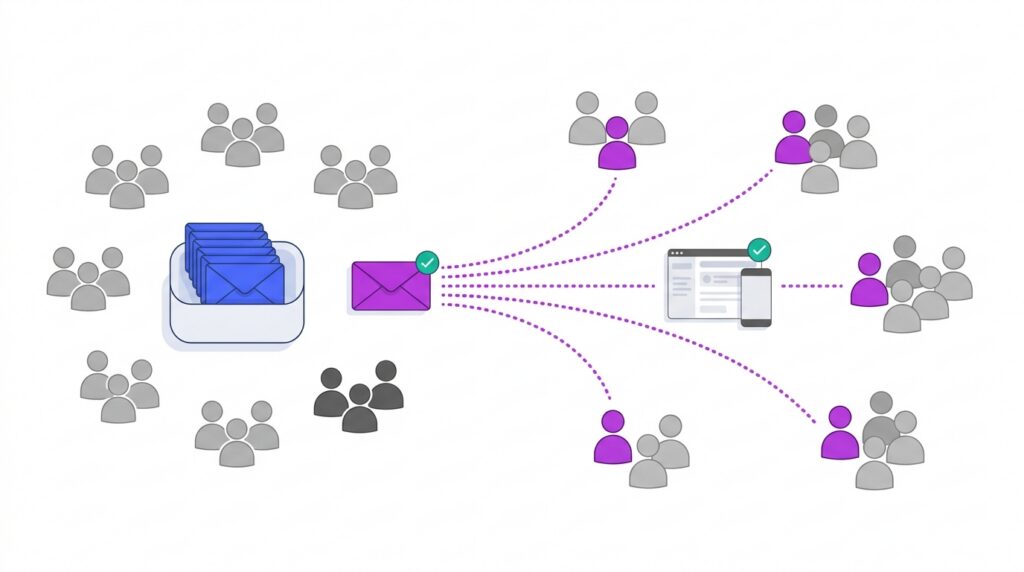
Outkeep is a B2B email marketing platform for outbound marketing: reaching the buying committees in your target market who aren’t in your database yet, then nurturing them through a long cycle until they’re ready to buy. Teams use it on its own or alongside one of the platforms on this list.
Outkeep builds and verifies the audience from your target accounts. Each new contact gets one transparent introduction from your team’s real inboxes with an easy opt-out, then receives your emails roughly weekly from a subdomain of your own domain. Workflows add new contacts as accounts change and remove people who don’t engage, with deliverability safeguards and frequency limits built in. You write the emails; Outkeep handles the audience, the sending, and the upkeep. It also includes website visitor identification and LinkedIn audience matching.
- Reach tier: Outbound marketing (our product)
- Good fit if: You sell large contracts to buying committees, already produce content worth sending, and want to reach the accounts sales needs.
- Trade-off: Builds over about 90 days, depends on a steady flow of content from your team, and isn’t a full marketing automation suite.
- Not a fit if: You sell low-ACV and high-velocity, or your recipients are outside the US.
- Price: $4,995 for the first 90 days, then $2,000/mo all-in, month to month
6. Microsoft Dynamics 365 Customer Insights – Journeys
For companies standardized on Microsoft, Customer Insights – Journeys keeps marketing in the same environment as Dynamics 365 Sales and Dataverse, with event-triggered journeys across email and other channels. Implementations are usually partner-led and call for Power Platform skills. Microsoft has retired its older “outbound marketing” module, so company-level LinkedIn targeting now runs through Customer Insights – Data, part of the same license.
- Reach tier: Inbound
- Good fit if: Your CRM and data already live in Microsoft.
- Trade-off: Less common outside the Microsoft ecosystem, and most teams need a partner.
- Price: Per tenant; Microsoft lists about $1,700/mo for Customer Insights, covering 10,000 interacted people a month, less for existing Dynamics 365 customers (Microsoft)
7. Act-On
Mid-market B2B companies, especially in financial services and manufacturing, often choose Act-On when leaving Marketo or Pardot to cut cost and complexity. Pricing is based on active contacts, the people you email each month, so a large database with a smaller sending audience costs less. Website Prospector names companies visiting your site. Most teams are live in four to eight weeks with one generalist admin.
- Reach tier: Inbound
- Good fit if: You want enterprise-style automation without enterprise complexity.
- Trade-off: Annual contract required, the interface feels dated to some users, and CRM integration is an add-on on Professional.
- Price: Professional from $900/mo at 2,500 active contacts; Enterprise by quote
8. ActiveCampaign
ActiveCampaign has one of the strongest visual automation builders at its price, and small B2B teams can be live within days without an admin. It covers segmentation, contact scoring, forms, landing pages, site tracking, and an optional CRM, with Salesforce and HubSpot integrations on higher plans. Teams tend to outgrow it when they need account-level marketing or deeper Salesforce sync.
- Reach tier: Inbound
- Good fit if: You’re a small B2B team on a tight budget, building toward a long-cycle stack.
- Trade-off: Account-based features are limited, so buying committees are hard to manage.
- Price: About $150–$600/mo at 10,000 contacts depending on plan, billed annually
Do you need outbound marketing?
An outbound marketing platform is worth considering if most of these are true: your average contract is $50,000 or more, a committee of several people decides, most of that committee isn’t in your database today, your recipients are in the US, and you already publish content such as a newsletter, research, or podcast. If your pipeline comes mainly from inbound demand, an inbound or blended platform on its own is usually enough.
Why we didn’t rank Mailchimp or Constant Contact
Both are built mainly for small businesses. About 84% of companies using Mailchimp have fewer than 50 employees (Enlyft), and Constant Contact skews toward small businesses and nonprofits, though its Lead Gen & CRM product (formerly SharpSpring) is closer to B2B marketing automation. Brevo, Customer.io, and Zoho Marketing Automation are worth a look for smaller or product-led teams.
HubSpot vs. Marketo vs. Marketing Cloud Account Engagement (Pardot) vs. Eloqua, and where Outkeep fits
Your CRM narrows the field. On Salesforce, Marketing Cloud Account Engagement (Pardot) is the most natural fit, with Marketo and HubSpot as the main alternatives. On Microsoft Dynamics, look at Customer Insights – Journeys or Marketo. Without a separate CRM, HubSpot gives you both.
Your operations team decides the ceiling. Marketo and Eloqua reward dedicated marketing operations staff and complex, global programs. HubSpot is the easiest for a lean team. Account Engagement depends heavily on Salesforce administration.
Your reach gap decides whether you need more than one. HubSpot and Eloqua help you reach people beyond your contact list, and all four nurture the people already in your database. None of them is designed to email buying committee members who haven’t opted in. Outkeep is built for that gap.
How much do B2B email marketing platforms cost?
Most platforms price by the contacts in your database. Approximate monthly cost at 25,000 contacts:
Approximate monthly cost at 25,000 contacts
| Platform | Approx. per month | Notes |
|---|---|---|
| HubSpot Marketing Hub Professional | ~$2,100 | From published rate card; plus $3,000 onboarding; excludes extra seats and credits |
| HubSpot Marketing Hub Enterprise | ~$3,800 | Plus $7,000 onboarding |
| Adobe Marketo Engage | ~$2,500–$5,000 | Third-party estimate; plus implementation |
| Marketing Cloud Account Engagement (Pardot) | $2,750+ (Plus+) | 10K contacts included; more by quote; annual contract |
| Oracle Eloqua | ~$3,000–$4,000 | Our interpolation of third-party estimates at 10K and 50K |
| Outkeep | $2,000 all-in | After $4,995 for the first 90 days; includes the audience |
| Dynamics 365 | ~$1,700 per tenant | Microsoft list price; discounts for existing customers |
| Act-On | Quote | From $900 at 2,500 active contacts |
| ActiveCampaign | ~$250–$1,000 | Estimate by plan; billed annually |
The prices above cover different things. Outkeep’s includes the audience itself. The other platforms’ prices cover the software, and any third-party data bought separately can be used for enrichment and targeting but not for marketing email.
Frequently asked questions
What is B2B email marketing?
Email sent by a business to people at other businesses to build relationships and pipeline, from newsletters and research to event invitations. In long sales cycles, its job is to stay in front of the whole buying committee until they’re ready to buy.
What is the best B2B email marketing platform?
For growing teams, HubSpot Marketing Hub. For enterprises with marketing operations staff, Marketo Engage or Oracle Eloqua. For Salesforce users, Salesforce Marketing Cloud Account Engagement (Pardot). For reaching buying committees who aren’t in your database yet, Outkeep.
Is Marketo better than HubSpot?
For complex, high-volume programs with a dedicated admin, Marketo offers more depth. For teams that want CRM and marketing in one system, plus intent data on new accounts, HubSpot is usually the better fit.
What is Pardot called now, and is it going away?
It’s Salesforce Marketing Cloud Account Engagement, part of Salesforce Marketing Cloud. Salesforce still sells it in 2026, bundled with Marketing Cloud Next in its “+” editions, though its branding has changed more than once in the past year.
Can you use purchased lists in HubSpot?
No. HubSpot prohibits marketing email to purchased, rented, or borrowed lists, and so do Marketo, Marketing Cloud Account Engagement (Pardot), Dynamics 365, Act-On, and ActiveCampaign.
Is it legal to email B2B contacts without opt-in?
In the US, yes, under CAN-SPAM’s opt-out rules, if you identify yourself, include a physical address, and honor unsubscribes. Many platforms set stricter rules than the law, and the EU, UK, and Canada have stricter laws.
How do you reach B2B buyers who haven’t opted in?
Through one-to-one sales email, account-based advertising, or an outbound marketing platform such as Outkeep, which builds the audience from your target accounts and introduces your company before sending content.
Can Outkeep replace HubSpot or Marketo?
For some teams, particularly those focused on reaching a defined target market. Teams with large inbound funnels or customer marketing programs usually keep their marketing automation platform and add Outkeep alongside it.
Will emailing contacts who haven’t opted in hurt my domain reputation?
It can if volume is high and engagement is low. Sending from a subdomain, introducing yourself before sending content, capping frequency, and removing people who don’t engage all reduce the risk.
How do you measure email impact over a long sales cycle?
Track engagement at the account level rather than by individual leads, and watch whether engaged accounts move into pipeline over the following months.
About the author
George Linville is CEO and Co-Founder of Outkeep. He has built B2B email programs since 2014, including audience and data operations at PayStream and Levvel, both through acquisition. He writes about deliverability, list building, and B2B marketing from Charlotte, NC.
Sources: vendor pricing pages, product documentation, and acceptable use policies (October 2026); LinkedIn B2B Institute; Forrester; Dreamdata; ZeroBounce; FTC CAN-SPAM guide; Enlyft; Outkeep proprietary survey of 124 US B2B marketers (late 2024); third-party pricing analyses where vendors don’t publish prices.