If you run a serious B2B email program, you already know the channel can move pipeline, but only when you treat it like a long-lived asset instead of a lever you pull for a short-lived boost.
TL;DR: Key Principles for Sustainable B2B Email
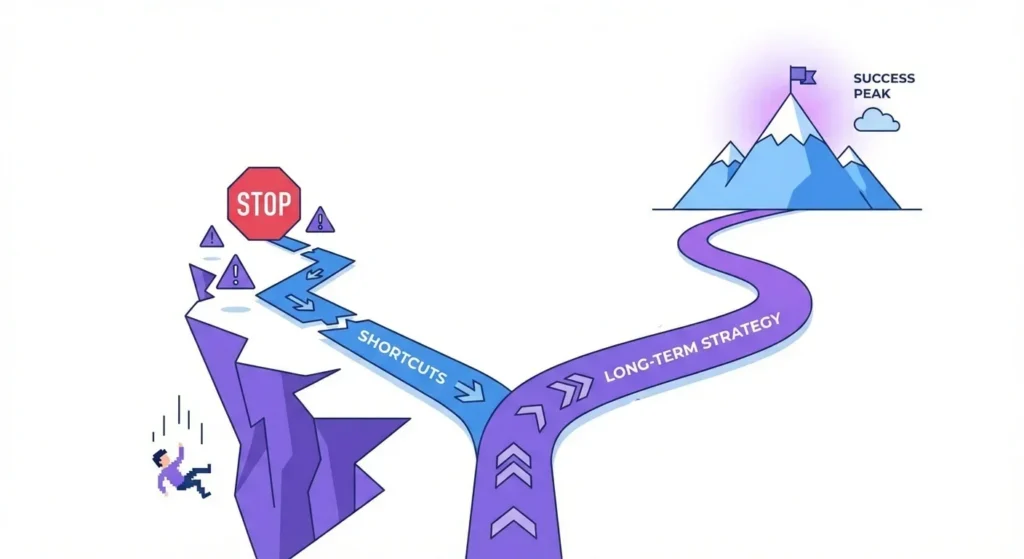
- Treat email like a compounding asset: If you wouldn’t run a tactic for a year as standard procedure, don’t run it for a week
- Set responsible frequency: Once a week maximum, once a month minimum for ongoing B2B communication
- Avoid manipulative subject lines: Don’t use “RE:” or “FW:” in initial outbound emails
- Match format to audience expectations: Plain text isn’t universally better than designed emails
- Be personable, not creepy: Mail merge tokens aren’t real personalization, relevance matters more than trivia
- Reputation beats rotation: Don’t solve deliverability by spinning up more domains
- Real warm-up over synthetic engagement: Bot-based warm-up is fragile and temporary
- Optimize for value, not word count: Shorter isn’t automatically better
- Fix upstream problems: If you need hacks, something structural is broken with messaging, audience, or content
1. Treat email like a compounding asset, not a spike channel
What it is
The baseline test is, “Would we be willing to run this exact tactic for the next 12 to 24 months as a standard operating procedure?” If the answer is no, it is probably not a fit for a high-ACV email program.
Email is a long-lived channel when you protect sender reputation, audience trust, and expectations. It compounds when the market learns what you send and why it is worth opening.
Why it matters
High-ACV deals are reputation and relationship driven. Anything that creates short-term lift by borrowing trust usually comes with a longer-term cost, lower inbox placement, lower response quality, or simple audience exhaustion.
For long-cycle sales, you do not get paid for “a moment.” You get paid for consistency.
Operator guidance
- Write down what you are trying to build: a trusted communication channel, not an isolated campaign.
- If a tactic only works at high volume or under time pressure, assume it will be time-limited.
- Optimize for long-lived reputation with inbox providers and buyers, not quick signal.

2. Understand why shortcuts are so tempting in B2B
What it is
Shortcuts show up when the environment is uncomfortable:
- Sales cycles are long.
- Response rates are low.
- Leadership wants proof now.
- Vendors promise acceleration and “done for you” outcomes.
This is why your feeds are full of aggressive plays and loud guarantees.
Why it matters
Pressure changes behavior. Teams start measuring the wrong thing, usually activity proxies, and then they adopt tactics that are hard to sustain in a market that actually talks to each other.
In high-ACV, the audience is smaller and more connected. You can burn through it faster than you think.
Operator guidance
- Separate “we need signal this month” from “we need a channel we can operate all year.”
- Be explicit about the tradeoff between short-run volume and long-run reputation.
- When evaluating a new tactic, ask: what happens to our sender reputation and brand perception if we do this every week?
3. Use outbound tooling for the right motion, not as a volume crutch
What it is
Tools like Lemlist, Instantly, Apollo, Mailmodo, and similar platforms can be useful. They help with things like ramping outreach, managing sending infrastructure, and moving faster when you have clear product-market fit and a motion that supports scale.
They also get misused when teams try to brute force complex deals.
Why it matters
For lower ACV or transactional products, speed and scale can be a rational strategy. For long-cycle, trust-heavy buying, the same tooling often becomes a “volume crutch.” It creates the illusion of progress while masking weak targeting, unclear messaging, or thin value.
The risk is not the tool. The risk is using high-volume mechanics to compensate for structural issues.
Operator guidance
- Match tooling to motion. If the deal is trust-heavy, your email program should look trust-heavy.
- If you are adding sending domains primarily to increase volume, pause and revisit root causes first.
- Use tools to help with good fundamentals, not to replace them.

4. Be skeptical of service vendor guarantees that rely on churn-and-burn
What it is
A common pattern is the services pitch: “7 meetings in 7 days,” “12 meetings a month or don’t pay,” and similar guarantees. These models usually depend on:
- Giveaways or gimmicky hooks
- Very high send volume
- Very short sequences
- Minimal respect for audience fatigue
Why it matters
In a tight market, this approach tends to chew through your audience. Even if it produces a short-term spike, it does not build a durable channel. It can also create internal expectations that are hard to unwind later.
High-ACV programs need to keep your total addressable audience intact. You want the market to keep taking your emails, not learn to tune you out.
Operator guidance
- Ask any vendor, “What does this look like in month 9?” If they cannot answer, assume it is not durable.
- Audit the offer. If the core lever is volume plus novelty, it will degrade.
- Treat your total addressable audience like a finite resource.
5. Do not use manipulative subject lines, and do not flirt with compliance risk
What it is
Classic example: putting “FW:” or “RE:” in the first outbound email to make it look like a reply or forward. People do it because it can bump opens occasionally.
It is also manipulative, and it crosses into CAN-SPAM risk when it misrepresents the nature of the message.
The one instance where forwarding works is if marketing sends you a great piece of thought leadership and you forward it personally to a prospect with a note like “hey Bob, I thought of you when I got this.” That is authentic. Using FW: simply to fake a reply thread is the problem.
Why it matters
You are training two systems at the same time:
- Spam filters and inbox providers learn whether your mail is trustworthy.
- Buyers learn whether you are willing to mislead them.
Any short-term lift in opens is typically outweighed by long-term trust erosion and deliverability damage, especially with Google and Microsoft properties.
Operator guidance
- Treat subject lines as a promise, not a lure.
- If you would feel embarrassed explaining the subject line to a buyer on a call, do not use it.
- Measure the downstream impact, not just opens. Opens without trust are not helpful.

6. Stop arguing “plain text vs HTML,” and focus on context and expectation
What it is
“Plain text always wins” is a myth that persists because plain emails can work well, often due to fewer links and images, and a more conversational feel.
The real driver is context:
- If your audience expects a newsletter, send a well-designed newsletter.
- If the audience expects expert-to-expert notes, use a peer-to-peer tone.
If you put a picture of yourself in your signature and humanize yourself, say where you work from, include your LinkedIn, that one link and image may slightly affect inbox placement, but you will get far better responses because people know a real human is on the other end. Authenticity beats the plain-text no-signature trick every time.
Why it matters
Plain text “winning” is often observed in cold mass outreach, which is a different motion than nurturing an opted-in, high-intent audience. People are not naive. Old tricks are stale, and buyers can tell when something is trying to mimic intimacy without earning it.
In high-ACV, mismatched format is a trust leak.
Operator guidance
- Align format with what the subscriber believes they signed up for.
- Use design to improve clarity, not to decorate.
- Keep the experience consistent so the audience builds recognition over time.
7. Replace surface-level personalization with targeted relevance
What it is
Two common misunderstandings show up here:
- Token personalization is not personalization. First name and company name is mail merge, and it has been around for decades.
- Hyper-scraped “personalization” often backfires. Alma mater references and profile trivia are so overused they signal automation, even when accurate.
Even when it is correct, it can feel creepy: “Why does this person know this about me?”
A more scalable alternative is building around “why you, why us, why now.” This can be targeted by role, segment, or audience without pretending you wrote a bespoke note.
Why it matters
High-ACV buyers are evaluating credibility as much as claims. The goal is to be personable, not to show off how much data you harvested.
Relevance comes from message-market fit and a coherent platform and tone of voice, not from trivia.
Operator guidance
- Invest in a clear messaging platform and tone-of-voice guidelines.
- Write “why you, why us, why now” by segment, then put it to work.
- Avoid personalization that is obvious, overplayed, or likely to trigger the “creepy” reaction.
8. Do not try to solve deliverability with more volume or rotating infrastructure
What it is
A common tactic is spinning up more domains, spoof or lookalike domains, and new IPs, then spreading volume across them. It can work in a narrow, short-term, high-volume play.
It does not solve deliverability. It delays consequences.
This is essentially snowshoeing, an old spammer strategy. Major blacklists track this behavior explicitly, including Spamhaus.
Why it matters
You are not building reputation, you are rotating away from accountability. The system has seen this since the early 2000s, and the window where it “works” keeps shrinking.
Long-lived reputation beats turn-and-burn infrastructure every time, especially when your sales motion depends on trust.
The more users engage positively with your emails, the more inbox placement you will see. That snowballs. Keep that in mind before reaching for gimmicks.
Operator guidance
- Treat sender reputation as an asset you protect, not a variable you rotate.
- If you need multiple domains just to get mail through, assume the upstream program needs work.
- Remember the operator truth here: 99% of your problems usually come from 1% of your data and practices.
9. Warm-up automation and “shorter always wins” are weak optimizations in long-cycle deals
What it is
Two areas that get oversold:
Warm-up automation that generates artificial opens, replies, and interactions can help ramp sending volume today. The underlying best practice is real: start low volume and increase gradually. The fragility is relying on fictitious engagement signals. The internet is now roughly 40% human traffic and 60% bot traffic, and bots are really good at detecting other bots.
Also, “keep it under 50 words” or “under 80 words” is not a law. Peer-to-peer emails, almost like a LinkedIn post in email form, can be longer and perform extremely well when they deliver genuine insight.
We are moving towards an age where we are fighting for the attention of agents and AI rather than directly with the consumer. Give the AI context and it can summarize better. That changes how you should think about email length.
Why it matters
High-ACV buyers need enough context to decide whether to trust you, not just enough bait to click. If you remove meaning to satisfy a template rule, you create low-signal email.
And if your “deliverability plan” depends on artificial engagement, assume it is time-limited.
Operator guidance
- Warm up gradually based on real sending behavior, and avoid over-dependence on artificial signals.
- Let the complexity of the idea determine length, not a rule of thumb.
- Structure longer emails clearly so they are easy to skim and summarize.

10. If you feel like you need shortcuts, look for the upstream problem
What it is
The punchline is straightforward: when a program relies on gimmicks, something structural is usually off. Shortcuts are symptoms, not solutions.
Common root causes show up repeatedly:
- Unclear messaging
- Loose ICP and weak targeting
- Content that is not compelling, expected, wanted, or valued
- You may be asking for marriage when you have not even said hello yet
- Over-mailing
- Poor list hygiene
Why it matters
No trick fixes positioning, bad data, or weak value. If the market does not want what you are sending, increasing cleverness just increases rejection.
Sustainable B2B email is boring in the right way. It is consistent, relevant, and trustworthy.
Operator guidance
- Fix hygiene first. Send expected and wanted email to clean lists.
- Tighten messaging before you touch sequencing mechanics.
- Operate frequency responsibly: once a week as an upper bound, once a month as a lower bound for ongoing communication.
- Be patient and professionally persistent.
- Keep the closing principle in mind: the more you try to outsmart the system, the faster the system outsmarts you.
Context on Outkeep’s Approach
Outkeep spends time in the details of deliverability, sending reputation, and long-lived email programs because the business depends on trust and consistent communication with a real market. That operator perspective makes it hard to justify tactics we would not be willing to run as an ongoing SOP.
FAQ for Modern B2B Email Programs
Do manipulative subject lines like “RE:” or “FW:” help performance?
They can bump opens occasionally, but they are misleading in a first email, can create compliance risk, and often lead to long-term trust and deliverability damage.
Does plain text always outperform designed emails?
No. Plain text can work well in certain contexts, but performance is mostly driven by audience expectations and clarity. If subscribers expect a newsletter, a structured newsletter format is usually appropriate.
Is adding first name and company name considered personalization?
Not really. That is mail merge. It is table stakes at best, and it does not create genuine relevance on its own.
What is snowshoeing in email deliverability?
Snowshoeing is spreading volume across many domains or IPs to dilute reputation risk. It is a known, trackable behavior and tends to be short-lived as a deliverability strategy.
Do unsubscribes hurt deliverability?
Unsubscribes are generally a normal feedback mechanism. The bigger deliverability risks usually come from spam complaints, poor list hygiene, and sending unexpected mail.
How often should a B2B company email its list?
A practical rule of thumb for ongoing communication is once a week as a maximum and once a month as a minimum, adjusted based on audience expectations and content quality.
Are short emails always better for replies and conversions?
No. Short can be effective when the message is simple and the ask is small. Longer peer-to-peer emails can also perform well when they deliver real insight and are clearly structured.
Ultimately, in B2B, authenticity is better than pretending. Message, market, platform, tone of voice is better than traditional personalization. Reputation is more important than rotation, volume, and temporary infrastructure. Do not focus on word count so much.