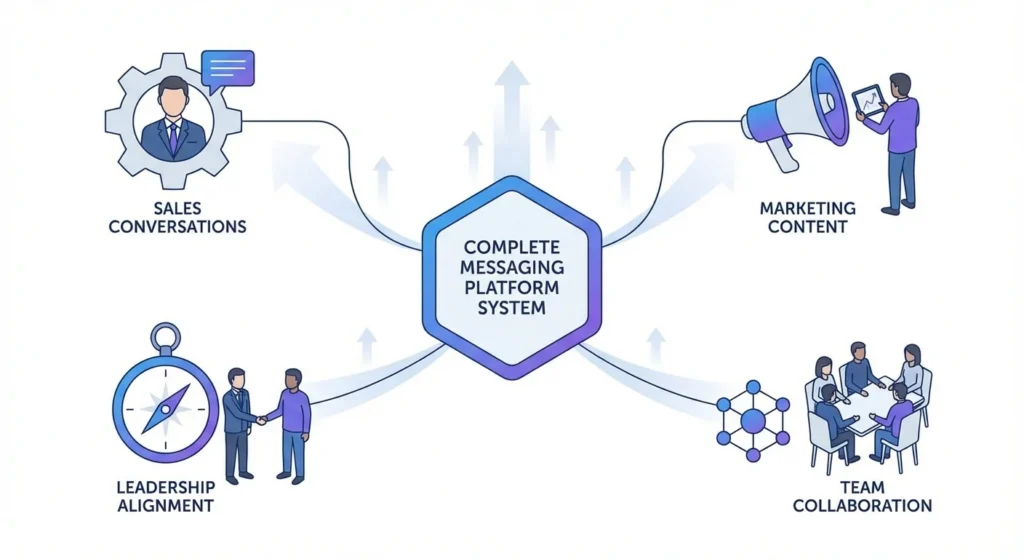
Most companies can’t explain what they do consistently.
Ask ten people for a 90-second pitch and you’ll get ten different answers. Marketing tells one story, sales tells another, leadership frames it differently. By the time a prospect has talked to a few people, they’re more confused than when they started.
A messaging platform fixes this. It’s not a tagline or a value proposition slide. It’s the source code for how your entire company talks about who you are, what you do, and why you matter.
When it’s done right, it becomes the foundation for everything: sales conversations, content programs, recruiting pitches, leadership alignment. When it’s skipped or done poorly, you end up with fragmented messaging that makes it harder to grow.
This guide walks through how to build one that actually works, starting with the core components and extending into the supporting materials that make it usable across teams.
What you’ll learn:
- The three core components every platform needs (category, niche, differentiators)
- How to layer in audience and Jobs to Be Done to understand when people buy
- Why tone of voice and origin story make the platform stick
- How to run this as a collaborative process, not a solo writing project
- How different teams apply the platform once it’s built
What is a messaging platform (and who needs one)?
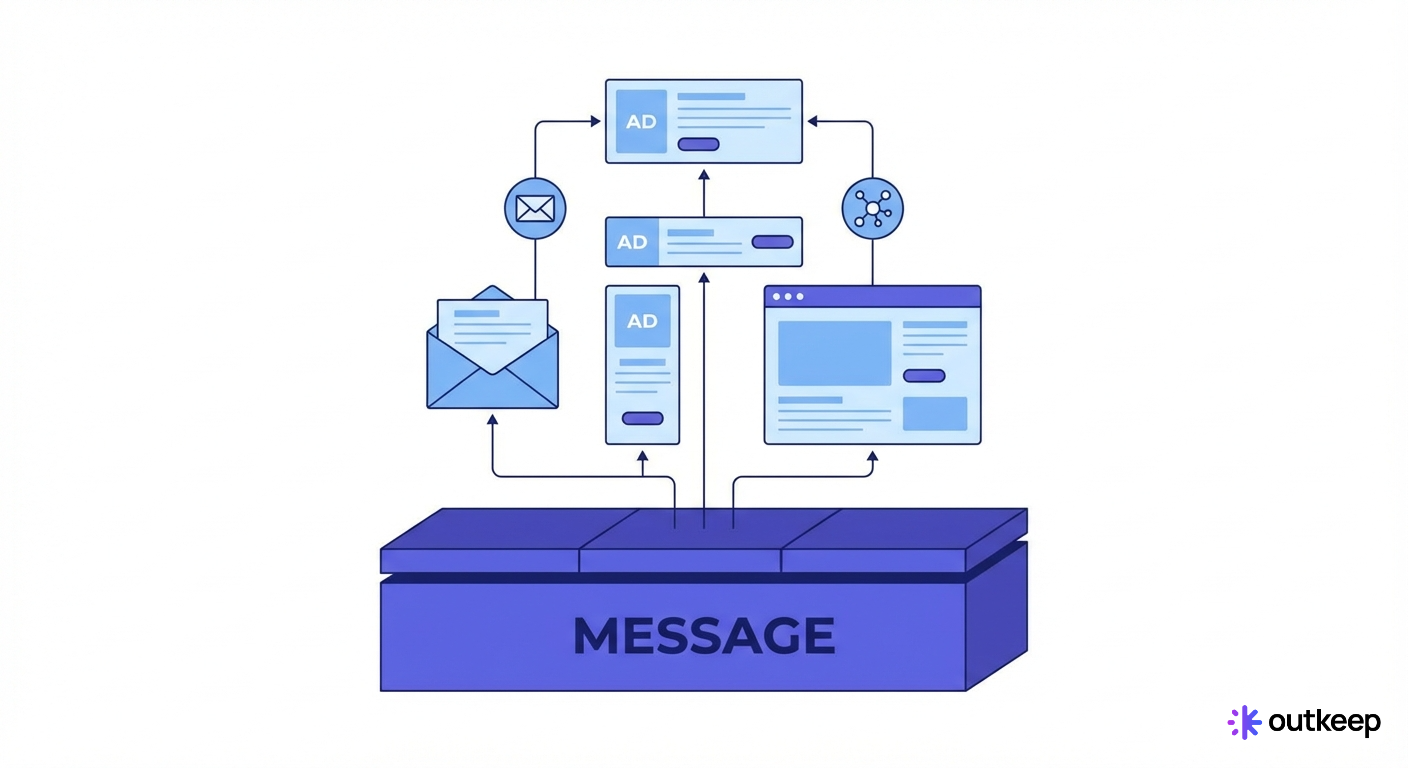
A messaging platform is a shared manual for how your company explains itself. It captures the language and ideas that define you: what category you’re in, who you serve, what makes you different, why you exist, and how you talk.
It’s meant to be the single source of truth so that everyone from sales to marketing to leadership is drawing from the same core story, even if the specific words change by context.
You need one if you’re at the stage where inconsistent storytelling is slowing you down. If prospects walk away confused instead of engaged, if your sales team is making up positioning on the fly, if your content doesn’t sound like it’s coming from the same company, or if new hires can’t explain what you do without stumbling, you have a messaging problem.
The platform is how you fix it.
It’s especially critical for B2B companies running real marketing and sales motions. You can’t build a coherent content program, testing framework, or omnichannel strategy unless you first know who you are. The platform is that foundation.
What it is:
- A shared manual for how you explain who you are and what you do
- The source code for first impressions, outreach, sales conversations, proposals, recruiting
- Written in the customer’s voice: plain-spoken, useful, true
What it’s not:
- Final headlines, ad copy, or website copy
- A one-time deliverable you file away
- Aspirational language about who you wish you were
The platform should describe who you really are, in language that holds up when a salesperson is on a call or a prospect is reading your website. If it doesn’t feel true, it won’t work.
Start with the core: category, niche, and differentiators
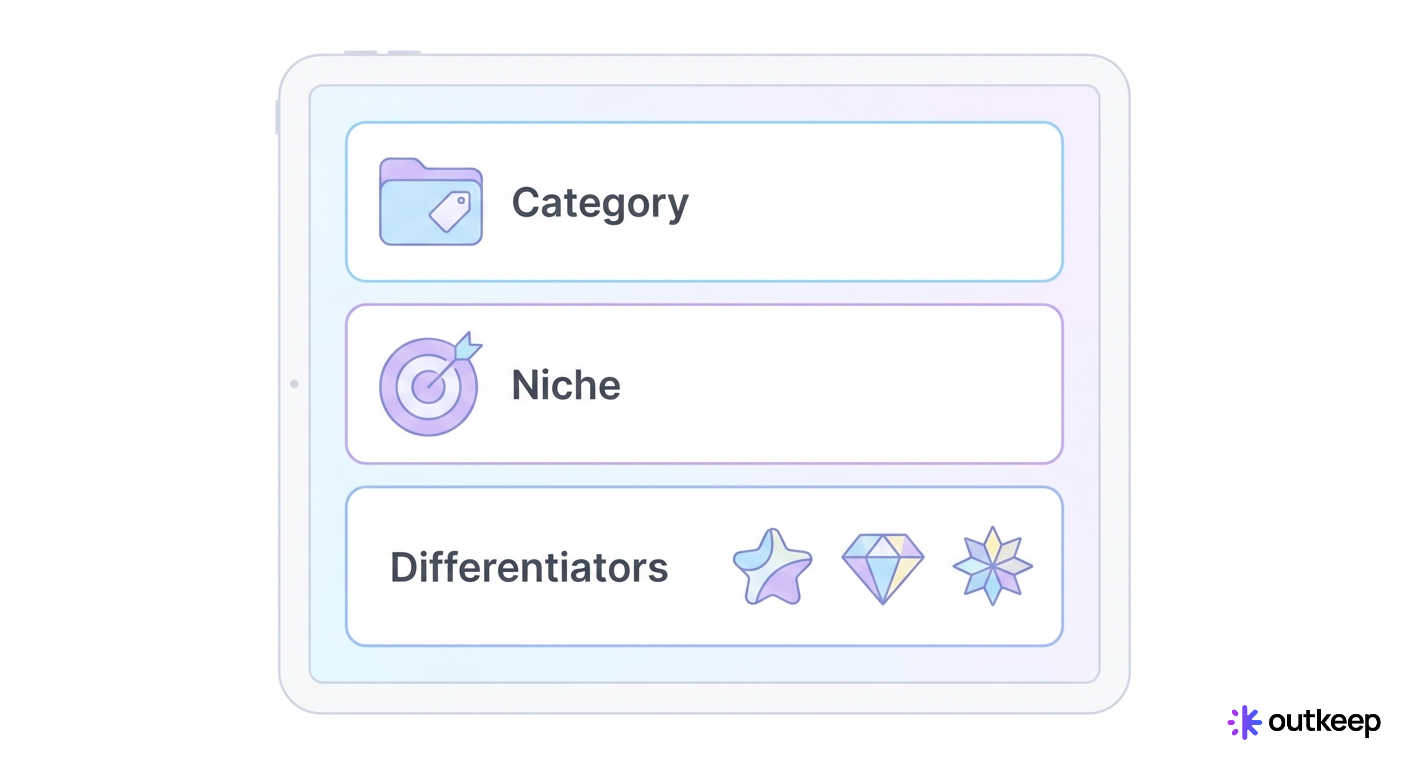
The entire platform builds from three core components that should fit on a single page: category, niche, and differentiators. When these are clear, the rest of your messaging becomes much easier. When they’re not, everything downstream feels like guesswork.
Category: how prospects file you mentally
Your category is how you position yourself at the highest level. It’s the first thing a prospect needs to understand so they know they’re in the right place and the conversation can move forward. If they don’t immediately grasp what type of company you are, they’ll tune out.
The practical advice here is simple: almost never try to invent a new category. Most things have been done. Anchor to something familiar. If you tell someone at a conference “we’re an audience platform” and their reaction is “what is that?”, you’ve lost orientation. What you probably needed to say was “we’re a contact database company” or something similarly understood.
When you choose your category, think about the real alternatives in the buyer’s mind. If your offering is a service but the main competitive alternative is software, it might make sense to anchor closer to the software category because that’s where the decision actually happens. The goal is immediate clarity, not clever positioning.
Good category statements:
- 5 to 10 words
- Immediately recognizable
- Passes the “conference test” (people don’t look confused)
- Passes the “CFO filter” (a smart outsider unfamiliar with your jargon would understand it)
If a prospect hears your category and their follow-up sounds like confusion rather than “tell me more,” you’ve set it wrong.
Niche: the territory you own inside that category
Once the category is clear, the niche breaks the rules and clarifies what’s different about you. It’s the second sentence that narrows the focus and tells prospects exactly where you fit.
Your niche should define the segment or territory you own inside the broader category. It provides focus and differentiation. It also helps prospects self-select. In sales, yes is great, no is also good, but maybe is terrible. A well-articulated niche lets the wrong buyers opt out quickly.
For example, you might say you’re a SaaS product in a defined category, and then immediately specify: “We serve enterprise companies with 1,000+ employees.” If a company has 250 employees, you actually want them to walk away. That clarity is valuable.
To be clear, we’re talking about niche in terms of audience and market focus, not necessarily a narrow or “niche” product. The product can be broadly applicable. Your chosen niche is about who you choose to serve and how you show up for them.
Good niche statements:
- 75 to 100 words
- Clarifies the specific territory you own
- Forces self-selection (wrong buyers should recognize it’s not for them)
- Guides where you spend time, energy, and resources
Differentiators: your defensible uniques
Your differentiators are what set you apart in ways that are hard to copy. These should explain why customers choose you, what competitors can’t easily match, and how you stand apart in ways that last. Most frameworks call these your “3 uniques.” You can have three or four, but the point is to capture the most defensible positions you hold.
If a competitor could say the same thing with a straight face, it’s not a true unique. Generic claims like “we have highly trained people” mean nothing because anyone can say that. But if you have a proprietary eight-week training program developed by award-winning practitioners, every employee goes through it, and it uses your own framework, now you’re getting closer to something defensible.
What you’re looking for is your “only.” If a prospective buyer asks “why would I go with you instead of your competitor?”, your differentiators should answer that question. It’s not easy to find a real “only” these days. It takes serious thought. But that’s the bar: something about your approach, model, proof, or delivery that is genuinely distinctive and verifiable.
Good differentiators:
- One to two sentences each
- Contain specific, verifiable details
- Pass the “competitor test” (they couldn’t claim it credibly)
- Answer “why would I choose you over the alternative?”
These three components (category, niche, uniques) should stack cleanly on a single page. Put them back to back and you should be able to clearly articulate who you are.
Layer in audience and when they actually buy
Around the core, you need supporting components that make the platform usable in real channels and conversations. The first is your audience, standard ideal customer profile work. The second, and often more powerful for messaging, is understanding when your audience buys, based on Jobs to Be Done theory.
Audience: who you serve
This is the ICP work most marketers already know how to do. Capture who you serve in one or two slides: best-fit account attributes, primary titles, secondary influencers, industries, context. Keep it practical. This is meant to guide targeting and day-to-day decisions.
When your audience buys: Jobs to Be Done
JTBD, popularized by people like Bob Moesta, focuses on the underlying job the customer is trying to accomplish, beyond the surface-level action. The classic example: a man isn’t really trying to “buy flowers.” The job is “make my partner happy,” and flowers are one way to accomplish that job.
In your context, you want to understand what job your buyers are really trying to get done when they buy from you. JTBD breaks this into four core elements that you can capture visually as a 2×2 grid:
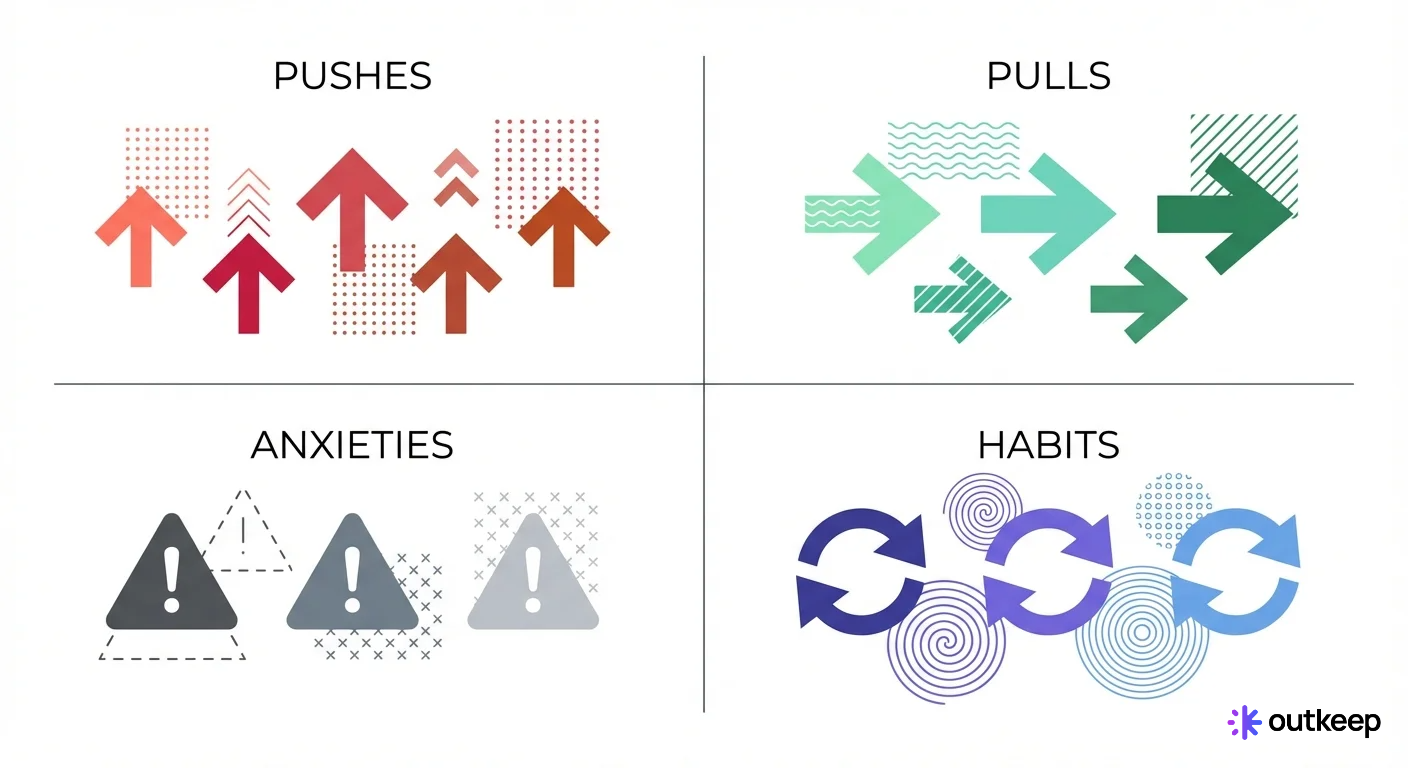
Pushes: What’s driving action. Something making the current situation intolerable. Example: “Our current process is broken and causing errors.”
Pulls: What they want that they don’t currently have. The aspiration or desired new state. Example: “We want to eliminate manual work and free up our team’s time.”
Anxieties: What they fear could go wrong with change. Example: “If I spend money on a new solution and it fails, it’ll hurt my reputation internally.”
Habits: What keeps them stuck in the status quo. Example: “We’ve always done it this way,” or “Instead of fixing the root problem, we just throw more people or another agency at it.”
You find these by interviewing customers and internal teams in structured ways. Once you understand all four elements, you can bake them into how you speak to customers. In a strong messaging platform, they’re not an add-on. They shape your core story, your objection handling, your offers, and your content themes.
Deliverable:
- One slide: who our audience is (ICP)
- One slide: when our audience buys (JTBD 2×2 grid)
These should directly inform everything from your sales conversations to your email sequences.
Make it stick: origin story and tone of voice
At this point your platform answers what category you’re in, where you fit within it, why you’re different, who you serve, and when they buy. You still need two things that make it memorable and usable: why you exist, and how you talk.
Origin story: why you exist
This is a short, memorable explanation of how and why the company came about. It doesn’t have to be a literal founder story, but it often is, and it’s usually worth interviewing the founders to get it right.
Ideally you can fit this on one slide: a concise narrative that people can remember and retell. Often it’s tied into your name or brand. For example, if your brand name implies “outlasting” competitors or “staying out front,” your founding story should reinforce that idea.
Everyone in the company should know this story well enough to answer basic questions about why the company is called what it’s called, who started it, and what they were trying to solve. In practice, you’ll be surprised how often people at all levels have no idea.
Tone of voice: how you talk
Tone of voice is usually captured in three to five attributes. These should be personal, specific, and actually useful for someone writing on your behalf. It often helps to define them as sliders: for example, “humble vs. outspoken,” “peer/practitioner vs. authoritative contrarian,” “practical vs. visionary,” “formal vs. informal.”
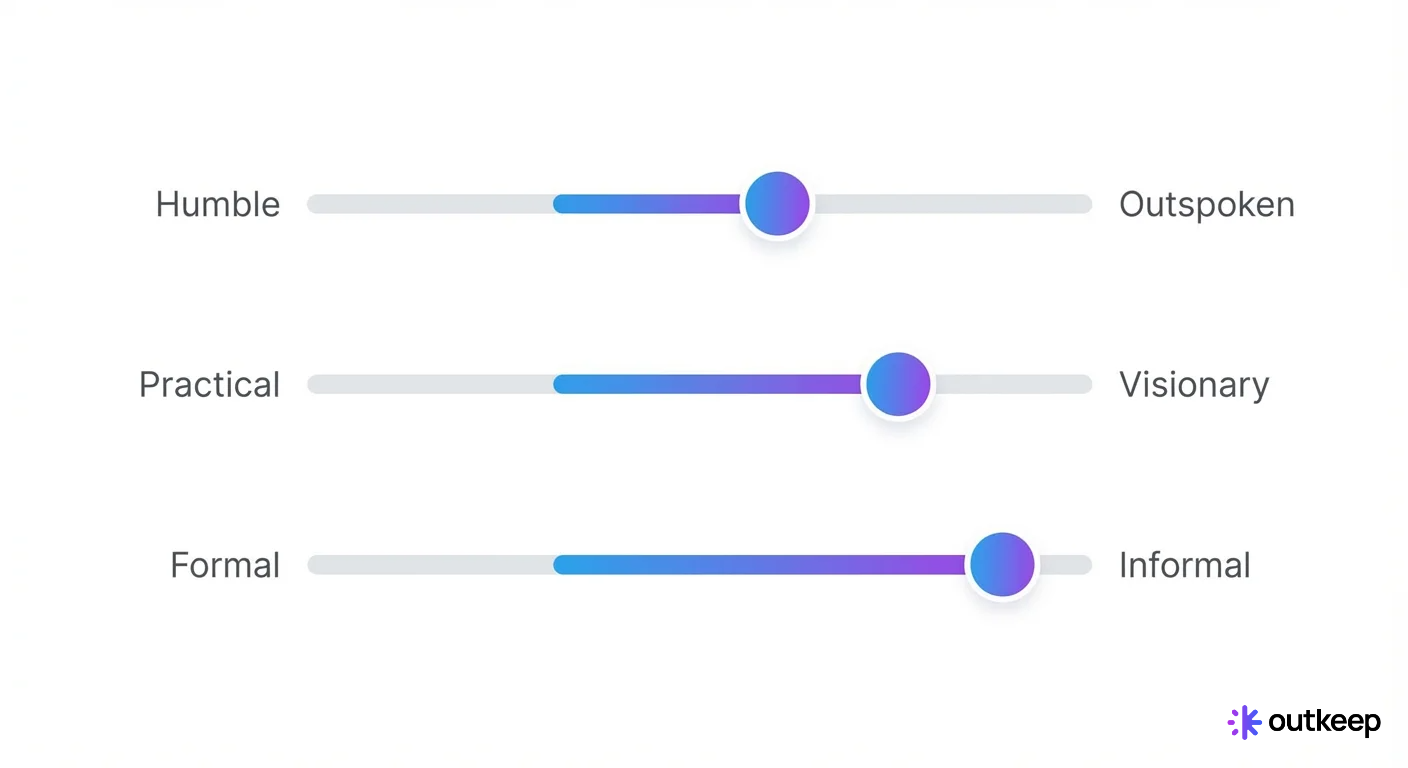
You then choose where you want to land on each dimension. You might decide you want to be “confident but humble,” or “practitioner-level, human, and direct.” Whatever you choose, you stick to it.
A writer should be able to look at those tone attributes and understand how to sound like you. You can also add a few notes on how this translates in practice (how you show up in meetings, how you treat people, how you prepare), but you’re usually aiming to keep this to a single, very clear slide.
Deliverable:
- One slide: origin story, concise and retellable
- One slide: tone of voice with 3 to 5 slider attributes and brief usage notes
How different teams use the platform
The platform is there to define how your company talks about who you are, what you do, and why you matter. It’s not meant to be copy-pasted word for word into every asset. It’s the foundation and the source code. Every channel, every team, and every message should trace back to it, but each function applies it differently.
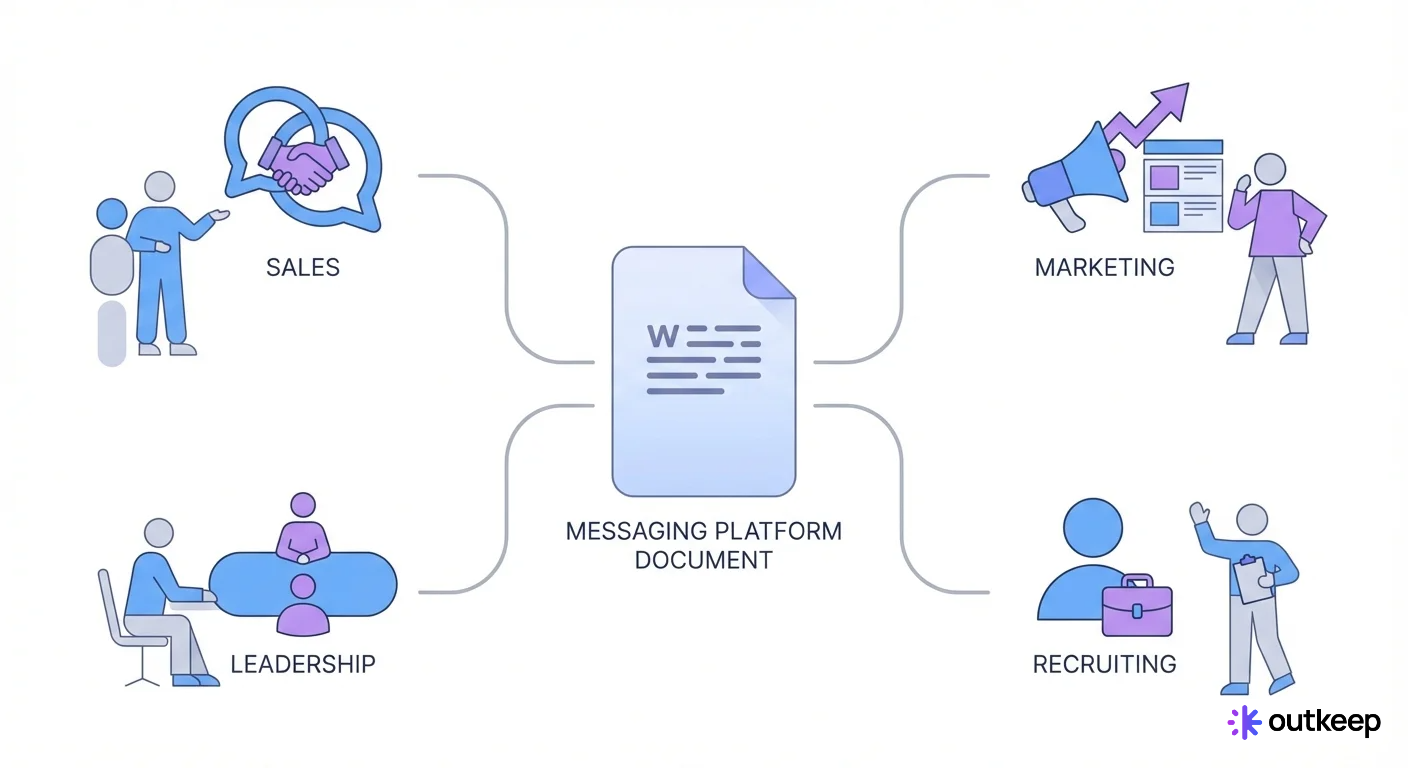
Sales uses this language as the base for conversations, proposals, and presentations. It keeps the story simple, consistent, and in plain English. The platform often doubles as a sales language guide.
Marketing translates the platform into ideas, content, SEO strategy, email sequences, and ads. The words on the page may change by audience and channel, but the meaning, the ideas, and the tone should stay consistent.
Recruiting and culture use the platform to describe the company internally and externally. It shapes how you talk about your mission, your values, your work. It also becomes a screening tool: candidates should recognize the story and tone, and you can select for people who resonate with it.
Leadership and strategy use the platform to align decisions, priorities, and growth plans. As you think about where and how you scale, you stay anchored to your chosen category, niche, and audience, instead of chasing every shiny object.
The platform also provides concrete focus. Each piece is there to help you concentrate on a core market and a core narrative, making it clearer where to spend time, budget, and content effort (and just as importantly, where not to).
Build proof behind each unique
Around the core messaging, you’ll need supporting materials. Each unique should be backed by proof points, case studies, metrics, and client stories that reinforce and substantiate the claim. Without proof, your differentiators collapse into generic claims in the market.
And you’ll need this per product. Product-level messaging is a separate layer of work, built under the umbrella of the company-level platform. Once you’ve nailed the overarching platform, product messaging becomes much easier: you’re simply applying the same logic and tone to each product, clarifying its specific role and message in the bigger story.
When done right, you end up with clean tiers of messaging (from company to product to feature) that all line up.
Run it as a collaborative process, not a solo project
This work is hard, and it’s nearly impossible to do well sitting alone at your desk. It can absolutely be done in a week or two, with five to ten well-run sessions or interviews, but it has to be collaborative. Treat it as a series of conversations and workshops to pull the truth out of the team.

A basic approach might look like this:
Get the right people in the room. Leadership team, plus a few people from sales and marketing who are close to customers.
Start with a clear statement of purpose. Why you’re there, why this is important, and what you’re trying to accomplish.
Use worksheets to get people thinking. For example: What are the three biggest growth opportunities for the company? What are the three biggest risks? What are the five things we do best right now?
Have everyone share a real client story. What the client was trying to do, what you did for them, and why it mattered. The more connected the participants are to real customers, the better the messaging will be.
Then work through each core piece in order:
Category first. Discuss the real alternatives in the market, draft candidate categories, and stress-test them. A good filter: would a CFO or a smart outsider unfamiliar with your jargon understand what you mean? You can usually cover this in 30 to 60 minutes.
Uniques next. Spend an hour or so brainstorming what truly sets you apart. A good format is sticky notes: everyone writes down ideas individually, you put them on the wall, cluster them into themes, and then refine those themes into 3 to 4 core differentiators.
Audience and JTBD. Who you’re for, who you’re not for, what industries and buyer roles you focus on. Once that’s clear, layer in Jobs to Be Done. Put pushes, pulls, anxieties, and habits onto the wall, grouped by theme.
Niche last. By this point, you’ll have your category, your audience, your JTBD view, and your draft uniques laid out. Now you can define the specific territory you want to own. This often takes a couple of hours.
Expect the first pass to be rough
The output from day one will feel raw, generic, uninspiring, incomplete. That’s normal. The first pass is supposed to be rough. After you’ve been in a room together for a half-day or day (or after a few shorter sessions), the primary goal is to capture the raw ideas and consensus points, not to wordsmith them into final form.
Between sessions, assemble what you have into a simple one-pager: draft category, draft niche, draft uniques, audience, and JTBD grid. Just getting it on paper in one place sparks much better thinking. People can see it as a whole, and their brains start to refine and sharpen it.
Then you move into refinement. It’s useful to spend time reviewing three to five key competitors: their websites, their tone, their stated categories and positioning, their headlines. This gives you a reality check and helps you avoid sounding identical.
In a second session or day, redline everything. Spend 30 minutes tightening the niche, 30 minutes on the uniques, 30 minutes on the category if needed. This is where you edit hard, strip away fluff, and push for specificity and honesty. If there’s time, you can also start on tone of voice and begin integrating that into the platform.
Think of it as a two-step process: a first draft to get the skeleton in place, and a second round to refine, sharpen, and humanize it. Don’t get discouraged that the first version feels bland. That’s expected.
Facilitation tips that matter
The person running this process should behave as an unbiased facilitator, not as the owner of the message. If you’re the marketer leading this for your own company, your job is to steward the process and capture what people actually say, not to impose your own favorite wording. It helps to have a dedicated scribe or use transcription so you don’t end up rewriting reality as you remember it.
Throughout the process, have people say the statements out loud. Let each person articulate the category or niche in their own words. This helps you hear what’s natural, what’s confusing, and what actually sticks.
It also helps to define, up front, who the ultimate decider is. If disagreements arise, someone gets the final vote (often the CEO or another senior leader). And one important dynamic rule: whoever has the strongest voice in the room should speak last. If the CEO speaks first, everyone else’s answers will subtly align to whatever they said. To avoid that, have others share or write their answers first, and hold the strongest voice back until the end.
Don’t build anything else until this is done
One final point: don’t rewrite sales material, stand up an email program, or spin up a content flywheel without this foundation. Without a clear messaging platform, all of that becomes fragmented and inconsistent. With it, everything else snaps into place much more quickly and coherently.
The platform is not the end goal. It’s the source code that makes everything else possible. Once you have it, you can build programs on top of it with confidence that the story will hold up as you scale.
FAQ
What’s the difference between a messaging platform and a brand guide?
A brand guide covers visual identity, logo usage, and design standards. A messaging platform covers the language and ideas that define who you are, what you do, and why you’re different. The messaging platform is what informs the words, the brand guide is what informs the look and feel.
How long does it take to build a messaging platform?
With a structured process, you can get a solid first version in a week or two through five to ten collaborative sessions. The first draft takes a day or two of workshop time. Refinement takes another round or two. Plan for 10 to 15 hours of core team time total.
Should we hire someone to do this or build it internally?
Both work. The key is that whoever runs it needs to act as an unbiased facilitator, not the owner of the message. Internal marketers can absolutely lead this, but they need to steward the process and capture what people actually say rather than impose their own language. External facilitators can help if you need neutral ground or lack internal facilitation skills.
What if our leadership team can’t agree on the messaging?
Define a clear decider upfront (usually the CEO). If disagreements come up, that person gets the final vote. Also, have the strongest voice in the room speak last so others don’t automatically align to them. Most disagreements resolve when you stress-test the language out loud and against real customer scenarios.
Can we skip this and just write better website copy?
You can try, but without a clear messaging platform, your copy will likely feel generic or inconsistent. Different writers will frame things differently. Sales will tell a different story than marketing. You’ll end up rewriting everything every time someone new joins or a new campaign starts. The platform is what makes all of that easier and more coherent.
How do we know if our category is right?
Use the “conference test” and the “CFO filter.” If you tell someone at a conference what you are and they look confused, your category is wrong. If a smart outsider unfamiliar with your jargon wouldn’t understand it, your category is wrong. You want immediate clarity, not clever positioning.
What if we can’t find true “uniques” or differentiators?
Push harder. Most companies settle for generic claims too early. Look for specific, verifiable details about your approach, model, proof, or delivery. If a competitor could say the same thing with a straight face, keep digging. The bar is finding something only you can credibly claim, and it takes serious thought to get there.
Do we need to redo this every year?
No, but you should revisit it regularly. Treat it as a foundational asset you refine as the company evolves. If your market position shifts, your audience changes, or you add major new capabilities, it’s worth a refresh. Most companies review and tighten their platform once or twice a year.
How do we get the team to actually use this once it’s built?
Make it accessible and practical. Share it as a one-pager or short deck, not a 40-page document no one reads. Walk sales through it. Use it in onboarding. Reference it when reviewing content or campaigns. The more you apply it in real decisions, the more it becomes the operating system everyone defaults to.