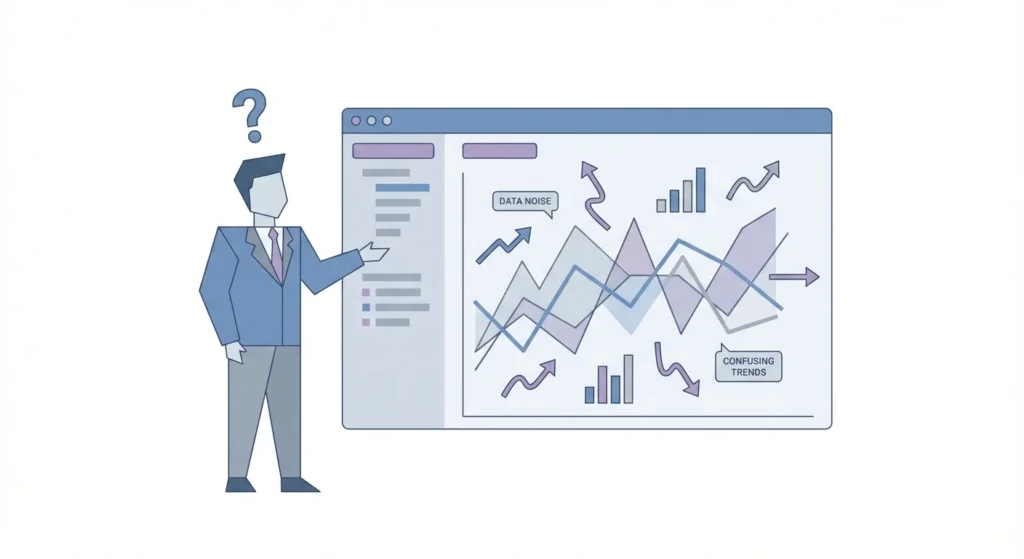
Most B2B teams are drawing hard conclusions from very noisy data. The average buyer journey is 272 days, but weekly reporting treats every fluctuation like proof of something. Meanwhile, opens are mostly bots, clicks include security scans, and “traffic is up” rarely connects to pipeline movement. The result is months of optimizing the wrong metrics while revenue stays flat.
Key takeaways
TL;DR
- Long cycles matter: Average B2B buyer journey is 272 days (151 to become a lead, 120 to close), so treat week-to-week metrics as directional instead of outcomes.
- Three cumulative fits: Person-market fit (trust in Bob/Sally), message-market fit (brand stands alone), product-market fit (clear offer with urgency). Most companies think they have product-market fit but only have the first two.
- Opens = deliverability: Email open rates are bot-heavy and mainly tell you if you’re reaching inbox. Promotions tab is fine.
- Clicks are engagement: After bot filtering, click-through rates show real interest. Use sender tests to diagnose if trust is tied to individuals or the brand.
- Engaged sessions = real signal: In GA4, engaged sessions filter out most bot noise and show genuine human interest better than raw traffic.
- High engagement + no conversions = influencer trap: If people read everything but don’t buy, you’re a respected publisher without product-market fit. Fix the offer.
- Swim out to engaged prospects: In complex B2B, you can’t rely on inbound alone. Use engagement intelligence for targeted outbound.
Core framework
The Three Market Fit Stages
Most B2B teams think they have product-market fit. Usually they have the first one or two. These stages are cumulative — you need all three to build a go-to-market that scales.
Stage 1
Person-Market Fit
Founder or leader-led trust. Prospects buy from Bob or Sally, not the company.
Bob’s emails outperform Pipeline dries without founderStage 2
Message-Market Fit
Brand recognized on its own. People say “I read an article from Acme Corp,” not “Bob said…”
New senders perform comparably Prospects use your phrasingStage 3
Product-Market Fit
Clear offer, clear urgency. Prospects know what you sell, when they’d buy, and why from you.
Buying-intent page visits Conversions without founderAll three are required simultaneously. Person-market fit without message-market fit is a fragile business. Message-market fit without product-market fit is an influencer with good press. Only all three together produce a go-to-market that compounds.
1. Start by Acknowledging the Cycle Time You Are Operating In
In complex B2B, the lag between exposure and revenue is long enough that teams start treating noisy leading indicators like they are proof. LinkedIn recently reported an average B2B buyer’s journey of 272 days — about 151 days from exposure to someone identifying as a lead, then another ~120 days to close. That means you can do a lot of “good work” for months before revenue shows up.
What It Is
The cycle time problem creates a specific kind of organizational damage: teams start celebrating activity metrics as outcomes because the real outcomes take too long to arrive. Weekly reporting amplifies this. Every dip or spike in opens or traffic gets interrogated as if it means something, when usually it doesn’t.
How to Test It Quickly
Look at your own funnel timestamps:
- Median days from first known touch to lead creation
- Median days from lead creation to closed won
- Percentage of pipeline where the first touch was 90+ days ago
If those numbers are remotely close to the 150 plus 120 shape, you cannot treat week-to-week fluctuations in opens, clicks, or traffic as outcomes.
What to Do with the Result
Set expectations internally that you are managing a sequence. Early signals are for direction only. The job is to reduce noise, then connect each layer of signal to the next layer of behavior. Your reporting should separate deliverability health, engagement, consideration, and conversions — not mix them into one dashboard.
2. Person-Market Fit: When Trust in Bob or Sally Drives the Deal
Person-market fit is when deals are driven by trust in a person — often the founder, sometimes a small leadership group. Prospects are buying from Bob or Sally, not from Acme Corp. You can get surprisingly far this way — I have seen businesses scale to $5M, $35M, even over $100M on essentially founder or leader-led trust — but it is fragile and it does not truly scale.
What It Is
Person-market fit is both an asset and a liability. The asset: trust moves fast when it’s personal. The liability: the business has no resilience when the trusted person is unavailable, distracted, or departs. All of your credibility is concentrated in one node.
How to Test It Quickly
Run the blunt tests:
- If Bob or Sally are not in the sales cycle, can you still reliably close deals?
- If you took Bob’s name off the article and sent it as Acme Corp, would anyone still read it?
- If emails “from Bob” materially outperform emails from anyone else, is the trust attached to the person more than the company?
What to Do with the Result
If person-market fit is carrying you, treat it as a foundation to build on, not a strategy to rely on. Keep leveraging the trusted faces, but stop letting one individual be the only path to credibility. Start building repeatable messaging and repeatable proof that does not require the founder to improvise every pitch. Build a bench. If the only “voice” that works is one person, your go-to-market is operationally brittle.
3. Message-Market Fit: When the Brand Has a Brain People Recognize
Message-market fit sits on top of person-market fit. This is where the brand stands on its own, people start to use your language, and they connect Acme Corp to a coherent set of themes, problems, and point of view. They say “I read an article from Acme Corp,” not “Bob said…” This is a big milestone, but it does not automatically translate into revenue. You can be well known, highly respected, and still not sell much if the product and offer are not clear and compelling.
What It Is
Message-market fit is about institutional trust replacing individual trust. Think Gartner: you may not know which specific analyst wrote the report, but you trust Gartner to have hired credible analysts. The institution carries the weight, not just the person.
How to Test It Quickly
Use practical substitution tests:
- Swap senders. Introduce a new sender (for example, your CTO) that the list has not heard from before. If click-through stays strong, you have more brand-level trust.
- Vary the “from line,” reply-to name, and even headshot in the template. If performance collapses without the founder name, you are still personality-driven.
- Listen for language adoption. Are prospects repeating your phrasing and themes back to you, and attributing it to the company?
The media analogy is useful here. Some institutions lead with the institution (The Economist used to do this — the author is “The Economist”). Others are columnist-driven. In scalable B2B, you cannot rely on a single columnist.
What to Do with the Result
Build what was called a “Mount Rushmore” strategy: multiple trusted faces under a single trusted brand. Brand-level trust that stands even when the faces change. Consistent tone of voice, frameworks, and way of explaining what you do, so the market experiences “a company brain” instead of individual opinions.
4. Product-Market Fit: When People Know What You Sell, When They Would Buy It, and Why
Product-market fit is when prospects not only know who you are and what you stand for, but they also know what you actually sell, when they would buy it, and why they would buy it from you. They recognize your specific product or service as the logical solution to a clear pain they feel, with enough urgency to move. This is the layer that often gets confused with the other two.
What It Is
The clearest sign of missing product-market fit: very smart people get invited to speak, publish columns, show up on podcasts, the market loves them — but nobody buys, because most people still do not know what they actually sell. Awareness without a compelling offer is a common trap.
How to Test It Quickly
Ask questions that force specificity:
- Can a prospect who has never met Bob or Sally explain what you sell after one website visit?
- Do people consistently reach buying-intent pages (pricing, contact, demo) and take conversion actions?
- In sales calls, do prospects arrive already understanding the product and the “when to use it,” or do you spend the first half of the call clarifying what you even do?
What to Do with the Result
If product-market fit is the missing layer, you usually have two levers. First, offer design: make the offer more compelling against real urgency (compliance is the obvious high-urgency example), or rethink packaging and business model. Second, clarity and friction: even a good offer will not convert if the website and funnel fail to communicate value, differentiation, and the first step. This is also where you need to be honest upstream. Marketers often do not own the core offer — they execute it. Sometimes the right answer to leadership is: “We have strong person- and message-market fit. We do not yet have product-market fit. The offer is not resonating.”
5. Read Email Opens as Deliverability (and Stop Worrying About Promotions)
Open rate is fundamentally a deliverability metric. It tells you whether you are making inbox and whether your list is healthy — but it does not tell you whether humans are reading. Modern email ecosystems are bot-heavy. Apple Mail, Gmail, and others prefetch and cache emails. A large portion of “opens” are bots fetching images and detonating tracking pixels. Promotions tab in Gmail is not a bad outcome. Promotions is inbox. It is also less disruptive for prospects.
What It Is
The problem with treating opens as engagement is that you end up optimizing for a metric that measures bot behavior. If your open rate drops, the most common cause is a deliverability or list hygiene issue — not that your subject lines got worse or your content stopped resonating.
How to Test It Quickly
Use opens the way they actually work — as a baseline and a trend:
- When you start mailing a segment, note the baseline open rate.
- Monitor relative change over time.
- If you are used to 40% and you drop to 20%, you likely have a deliverability problem.
- If you drop from 40% to 35%, it is a yellow flag to investigate.
- If you fall from 40% to 5–10%, you are largely not getting delivered.
Keep the nuance in mind: that original 40% might have been 37% bot-driven and 3% human. If it drops, the human component can go to near zero without the top-line number looking catastrophic. Also, ignore “inbox hacks” aimed at getting you from Promotions to Primary. Filters re-learn. Spam is the real red flag, and that sends you back to fundamentals: list hygiene, permission, sending patterns, content, SPF, DKIM, DMARC.
What to Do with the Result
Treat opens as a health check. Build internal reporting language that calls it what it is — deliverability and list health. Aim for steadiness within a healthy band (often roughly 25–60% depending on audience mix). Stop framing Promotions placement as failure. Promotions is inbox, end of story. If you hit spam or see steep declines, fix fundamentals before you debate creative.
Signal types compared
Four Layers of Email Signal — Ranked by Reliability
Not all signals are equal. Each layer tells you something specific. The closer you get to actual behavior, the more it means.
Opens
Deliverability check. Mostly bots. Use as trend, not engagement.
Clicks (filtered)
First real engagement layer. Noisy, but filterable. Useful for sender tests.
Engaged Sessions
GA4 sessions with time, scroll, or multi-page depth. Strong proxy for real human interest.
Conversions
Pricing, demo, contact, form submits. Proof of product-market fit.
6. Use Clicks (After Bot Filtering) as Your First Real Engagement Layer
“The goal of an email is a click.” You are not going to close a complex B2B deal in the body of an email. The email’s job is to get someone to click through to wherever the real persuasion happens — a landing page, a resource, an event, or a person. Clicks are also noisy. Security and spam-filter bots detonate links to check for malicious content, sometimes clicking every link (sometimes even the unsubscribe link). The good news is it is easier to filter bot clicks than bot opens, and most decent platforms have heuristics for this.
What It Is
Once bot filtering is applied, clicks become your first window into whether someone actually cared enough to act. Click-through rate after filtering is directional engagement — it won’t tell you if they read your email, but it tells you if something in it was compelling enough to move them.
How to Test It Quickly
Make clicks usable, then use them diagnostically:
- Turn on bot filtering — accept it will never be perfect.
- Look at click-through rate as directional engagement once filtering is applied.
- Run sender-level A/B tests: if “from Bob” consistently wins, you are seeing strong person-market fit. If a new sender you introduce still performs, you are closer to message-market fit.
- Watch for patterns like “great opens, great clicks, no downstream behavior” — a warning that content is working but the commercial path is not.
What to Do with the Result
Operationalize clicks as the handoff metric. Email and ads are there to drive clicks — that is their job. Landing pages and sales conversations are where conversion happens. Report clicks alongside what happened after the click; otherwise you will over-credit the channel and under-diagnose the funnel.
7. Tie Email to Web Behavior with UTMs, Engaged Sessions, and Conversion Behaviors
Measurement ladder
Walk One Campaign All the Way Down
If you stop at clicks, you’re still guessing. Every layer filters out more noise and tells you something more specific.
Send Volume
10,000 emails sent — starting point
Opens
Deliverability check only — do not use as engagement signal
Clicks (bot-filtered)
~120 filtered clicks — directional engagement
Sessions (raw)
~100 sessions from UTM traffic — expect bot noise (~25%)
Engaged Sessions (GA4)
~26 engaged sessions — real human interest
Conversion Behaviors
Pricing pages, demo requests, contact forms — PMF proof
Watch the negative signals too. Heavy traffic to careers pages from a campaign is a common “looks like engagement” trap that is not buyer intent.
If you stop at clicks, you are still guessing. Every link in your email should have proper UTM parameters at a minimum (source, medium, campaign, often content or creative). Ideally you also pass an identifier that lets you tie a specific person to their session in your analytics and/or CDP. Even then, sessions are noisy. Roughly 25% of website traffic is also bot-driven. In GA4, “engaged sessions” are a better proxy for real human interest than raw sessions.
What It Is
Engaged sessions in GA4 are sessions that meet engagement thresholds — time on page, scroll depth, multiple pages visited, or conversion events. That filtering matters. It removes most of the drive-by and bot traffic and leaves you with sessions where something real happened.
How to Test It Quickly
Channel comparisons give context:
- Direct is usually high on engaged sessions — they came on purpose.
- Referral is typically high — trusted third-party source.
- Organic often looks good — they searched and clicked.
- Email and ads are usually the lowest, and ads are often the weakest of those two.
What to Do with the Result
Make “engaged sessions per channel, tied to conversions” the metric leaders actually understand. It reduces bot noise. It lets you compare channels on quality and volume. It forces the right split in accountability: email and ads drive clicks, landing pages and sales drive conversion. If you pick one KPI to watch for traction in complex B2B, engaged sessions per channel plus conversion behavior is a cleaner North Star than leads or MQL counts in isolation.
8. Diagnose the Common Failure Patterns, Then Decide What to Change Next
The classic misread in long-cycle B2B is celebrating activity that does not translate into consideration or conversion. The most common pattern looks like this: open rates are strong (you are getting delivered), click rates are strong (people are interested enough to act), engaged sessions are strong (real humans are reading and exploring), and conversions are near zero. No demos. No pipeline movement. No deals. That is often person-market fit plus message-market fit without product-market fit. People like you. They think you are smart. They consume the insights. But the offer is not compelling enough to move them.
What It Is
The influencer trap. You have become a respected publisher without becoming a vendor of something people urgently want to buy. The engagement is real. The problem is upstream of marketing — the offer itself.
How to Test It Quickly
Pressure-test the commercial path, not the content:
- Can a buyer quickly understand what you sell and what the first step is?
- Are your calls to action clear, and do they reduce friction?
- Does the first step feel safe, or does it feel like a mountain?
Two stats help frame why this matters: Sixth Sense reported that 92% of buyers go into a buying process with a preferred vendor already in mind. Another commonly cited stat is that roughly 81% of the sale happens online or outside of direct contact with the vendor. By the time they talk to you, they have already done most of the work themselves. If your site does not clearly explain what you do, how you compare, and why you are safe to choose, you lose even when awareness is strong.
Failure pattern diagnostic
The Influencer Trap — and How to Get Out of It
The most common late-stage GTM failure: everything looks healthy until you check the one metric that matters.
What looks healthy
✓Open rates stable — you’re reaching inbox
✓Click rates strong — content is compelling
✓Engaged sessions strong — real humans exploring
What’s actually broken
✗Conversions near zero — no demos, no pipeline
✗Buying-intent pages barely visited
✗Offer isn’t resonating — PMF is missing
The interventions
Fix 01: Rework the offer — not the subject lines. CRO on buying-intent pages, not content.
Fix 02: Reduce anxiety. Stack micro-yeses — make the first step feel safe, not like a commitment.
Fix 03: Swim out. De-anonymize traffic, route engagement intelligence to sales for informed outbound.
What to Do with the Result
Pick the intervention that matches the failure:
- If engagement is high but conversions are low: rework the offer and packaging, not the subject lines. Do conversion-rate optimization on the pages people actually hit. Turn the mountain into a molehill — create a simple, low-risk first step that still moves the needle.
- If the issue is friction and anxiety: systematically reduce anxiety points like “I do not know who you are,” “I do not understand your product,” “If I recommend you and it goes badly, my job is at risk.” Stack micro yeses that lead to the macro yes of a signed deal.
- If inbound is not enough: swim out to engaged prospects. De-anonymize traffic at the account level with ABM tools, and where allowed, identify individuals. Route that engagement intelligence to sales so they can do targeted, informed outbound.
- If you are creating engaged visitors but they are not converting: retarget them. Drop them into deeper nurtures that move them from awareness to consideration.
The Bottom Line
Don’t celebrate the wrong things.
Opens are not engagement. Promotions is inbox. Clicks without bot filtering are misleading. Sessions without engagement are noise. High engagement without meaningful conversions means you’re a good publisher — not necessarily a business with product-market fit.
Context on Outkeep’s Approach
Outkeep spends a lot of time inside real B2B email programs, looking at how deliverability, engagement, and downstream web behavior connect — or fail to connect — to pipeline. That operator vantage point makes it easier to separate “busy metrics” from signals that actually indicate consideration and buying intent.
The distinction between person-market fit, message-market fit, and product-market fit is not academic. We operate inside programs that have all three, and programs that only have one. The difference in what’s possible downstream is significant.
FAQ for Modern B2B Email Programs
What is the fastest way to tell if email open rates mean anything?
Open rates are mainly a deliverability and list health check. Use them directionally over time — baseline versus trend. If your rate drops sharply (say, 40% to 5–10%), you likely have a deliverability problem. A gradual drift is a yellow flag to investigate. What open rates tell you about human engagement is minimal — bots prefetch and cache email images at scale.
Is the Gmail Promotions tab bad for B2B email?
No. Promotions is inbox. Many users expect marketing email there, and it is often less disruptive than showing up in Primary. Ignore any tool or tactic that promises to move you from Promotions to Primary — filters re-learn, and the attempt can damage your sender reputation. If you end up in Spam, that is the real problem, and it sends you back to fundamentals.
Are clicks a reliable engagement metric in B2B email?
Clicks are more reliable than opens, but they still include bot activity from security scanners and spam filters. Use bot filtering and treat click-through rate as directional engagement. The most useful thing you can do with clicks is run sender-level A/B tests — they reveal whether trust is attached to a person or to the brand, which is a meaningful diagnostic for where you are in the market fit progression.
What are “engaged sessions” in GA4, and why should I care?
Engaged sessions are sessions that meet engagement thresholds — time on page, scroll depth, multiple pages visited, or a conversion event. They are a better proxy for real human interest than raw sessions, which include bot noise. Roughly 25% of website traffic is bot-driven. Engaged sessions filter most of that out. For measuring the quality of traffic from email campaigns, it is a much cleaner North Star than raw session counts.
What website behaviors indicate product-market fit in a long-cycle B2B motion?
Repeated visits to buying-intent pages (pricing, contact, demo), deeper product exploration, case study consumption, and conversion actions like demo requests, chat starts, or replies are stronger indicators than top-line traffic. If you see high engaged session volume but very low buying-intent page visits, the awareness is working but the offer or funnel is not communicating value clearly enough.
What does it mean if engagement is high but conversions are near zero?
Often you have person-market fit and/or message-market fit, but not product-market fit — or your site and funnel are not clearly communicating the offer. In practice it looks like being respected as a publisher, without being chosen as a vendor. The fix is usually in the offer or the conversion path, not in the content or email program itself.
How do I know if my go-to-market is person-driven or brand-driven?
Run a sender substitution test. Introduce a new sender — your CTO, a senior team member, someone the list hasn’t heard from — and compare click-through performance to your usual sender. If performance collapses without the familiar name, trust is concentrated in the individual. If performance holds, you are closer to brand-level message-market fit. This single test is often the most revealing diagnostic available without any additional tooling.
Do unsubscribes hurt deliverability?
Unsubscribes themselves are not automatically harmful. They can actually protect your sender reputation by giving disinterested recipients a clean exit instead of marking your email as spam. Deliverability problems typically surface through spam placement, steep open-rate declines, and poor list hygiene — not unsubscribe rates. A clean, easy unsubscribe process is good list management.