TL;DR
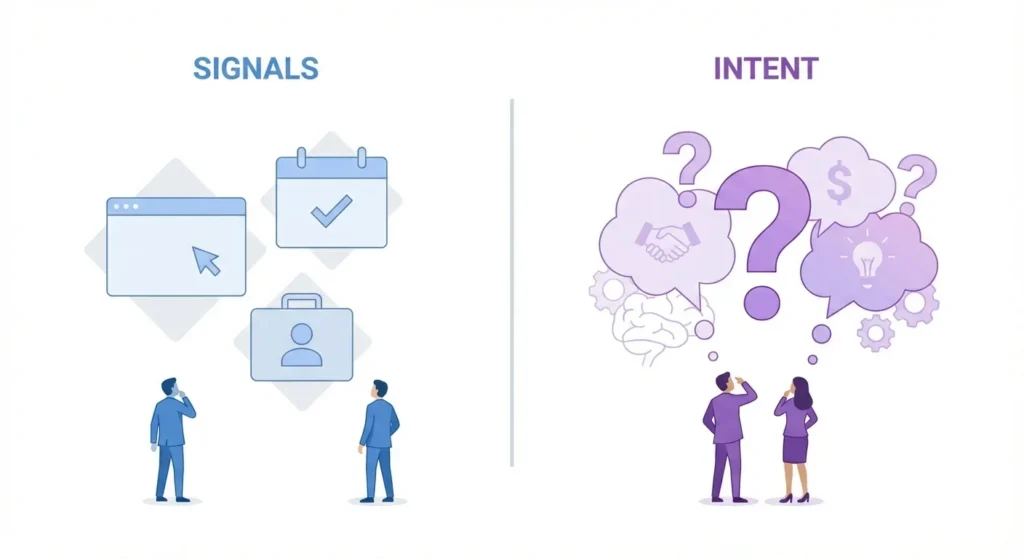
Signals are observable facts: someone visited a pricing page, attended your webinar, or their company posted new roles. Intent is the inference you draw from those facts: they might be evaluating vendors or entering a buying cycle.
Most “intent data” vendors sell you the interpretation layer, not the raw behaviors. In high-consideration B2B, this often creates false confidence because the buyer’s process is more complex and less observable end-to-end.
Three signal types matter:
- Research signals show information gathering (high noise, directional only)
- Behavioral signals show engagement with your brand (requires existing awareness)
- Event signals explain “why now” behind momentum and change (most reliable triggers)
Data ownership determines accuracy:
- First-party: highest accuracy, often lagging
- Second-party: contextual but limited scale
- Third-party: broad coverage but ambiguous and noisy
Core principle: Use signals to help at the right time, not to pounce. Event signals work for personalization because they’re public. Keep behavioral and research signals mostly internal to inform your actions without exposing your tracking.
You can read this straight through or treat each section as a standalone reference when evaluating intent tools, building scoring, or tuning outbound.
Core Framework
Signals are facts. Intent is inference.
Most “intent data” vendors sell the interpretation layer, not the raw behaviors.
Signal
Observable fact
Something you can directly record or verify. No interpretation needed.
Examples
Intent
Your inference
A conclusion drawn from one or more signals. Probabilistic, not certain.
Examples
What this means operationally
When you buy “intent data” you’re usually buying the interpretation layer — a model’s conclusion about what might be happening, without visibility into the underlying behaviors.
Treat it like a directional hint, not a deterministic trigger. Use signals to help at the right time, not to pounce.
1. Why does intent behave differently in high-ACV deals?
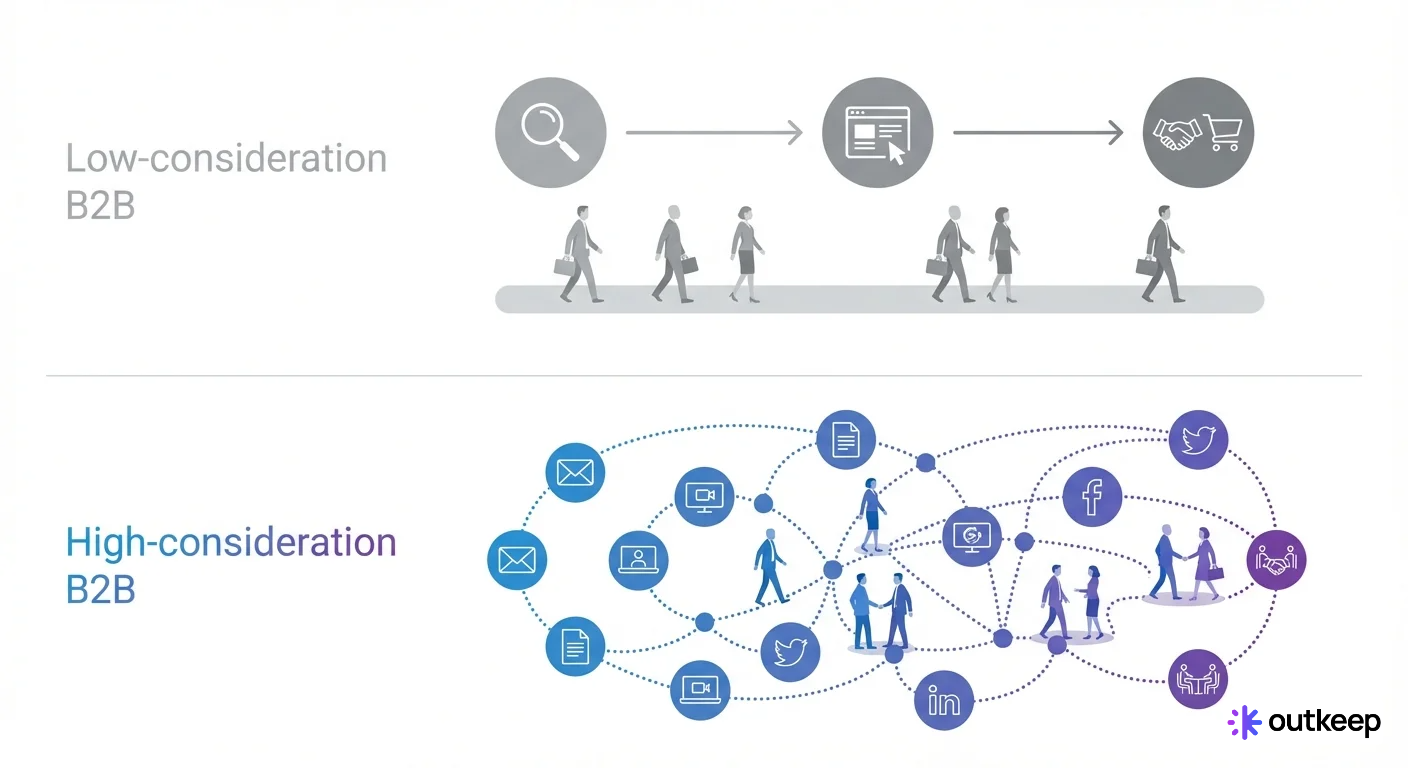
In complex B2B sales, buyers rarely move in a clean sequence like search → website → form fill → sales call. The journey is longer, distributed across more channels, and a lot of it happens before anyone is identifiable.
Why it matters
A lot of what gets sold as “intent data” can look useful in lower-consideration purchases. In long-cycle B2B, the same data often creates false confidence because the buyer’s process is more complex and less observable end-to-end. You end up optimizing for a simplified version of reality.
How to use it operationally
- Treat “intent” as a probabilistic input, not a deterministic trigger.
- Design your system so signals inform prioritization and sequencing, not instant hand-raise assumptions.
- Assume most signals you see will be top-of-funnel or mid-funnel, unless they are clearly first-party and repeated.
Watch-outs
- If your motion treats a single spike as bottom-of-funnel demand, you will create noise for sales and degrade trust with prospects.
- If you expect attribution to be clean, you will over-rotate on whatever is easiest to measure, not what is most true.
2. What is the difference between a signal and intent?
Signals are observable facts. Intent is the inference you draw from one or more signals.
A few concrete examples of signals:
- Someone visited a pricing page.
- Someone attended your webinar.
- A company posted three new roles related to your category.
- Your brand was mentioned on Reddit or LinkedIn.
Intent is what you conclude from those facts, for example: “They might be evaluating vendors,” or “They might be entering a buying cycle.”
Why it matters
When you buy “intent data,” you are usually buying the interpretation layer, not the raw stream of behaviors. The output often looks like “Acme Corp is surging on Topic X.” Without the underlying behaviors, you are effectively buying a model’s story about what might be happening.
How to use it operationally
- When evaluating any intent product, ask whether you are getting signals, or an inference.
- If you only get an inference, treat it like a directional hint and use it to adjust attention, not to justify aggressive outreach.
- If you can access concrete signals, you can build your own view of intent with more control and better alignment to your market.
Watch-outs
- “Surge” language can mask uncertainty. It can sound precise while being fundamentally probabilistic.
- If you cannot see what the model observed, you cannot validate it, and you cannot reliably build operating playbooks around it.
3. What are research signals, and how noisy are they?
Signal Types
Three types. Very different reliability.
Understanding which type a signal belongs to shapes how aggressively you should act on it.
Information gathering
Indicates what a company is learning about. High volume, high noise. Doesn’t tell you ‘why.’
Low
High
Low
Sources
Engagement with you
Requires existing awareness. Useful for known demand, but often lagging — buyer may be 30–70% through their process.
High
Med
High
Sources
The “why now”
Closest thing to a real buying trigger. Reflects organizational momentum and strategic change.
Best
Low
Best
Sources
Event signals win for high-ACV. They explain why you, why us, why now, and they’re public and expected, so using them doesn’t feel like surveillance. Anchor account prioritization here first.
Research signals indicate what a company is learning about. Typical examples include reading articles on a topic, researching a product category, comparing vendors, downloading reports, or searching technical documentation. Platforms like Bombora, G2 (buyer intent modules), ZoomInfo, Demandbase, and others surface these kinds of signals.
Why it matters
Research activity does not reliably mean “new buying cycle.” It means someone, somewhere in that company’s orbit, is gathering information. In complex markets, that “someone” could be:
- a student
- an analyst
- a competitor
- a current customer trying to use what they already bought
Research signals tell you “what,” but usually not “why.”
How to use it operationally
- Use research signals as broad market direction, not as a reason to pounce on an account.
- Use them to help with account prioritization only when paired with stronger context, especially event signals.
- Use them to inform content strategy and market awareness, for example, noticing tailwinds in topics that correlate with increased engagement.
Watch-outs
- Topic taxonomies can be extremely broad and vague, sometimes tens of thousands of categories. Many vendors don’t give you an easy way to search through them.
- Without context, “research” is easy to misread as “evaluation.”
4. What do behavioral signals actually tell you?
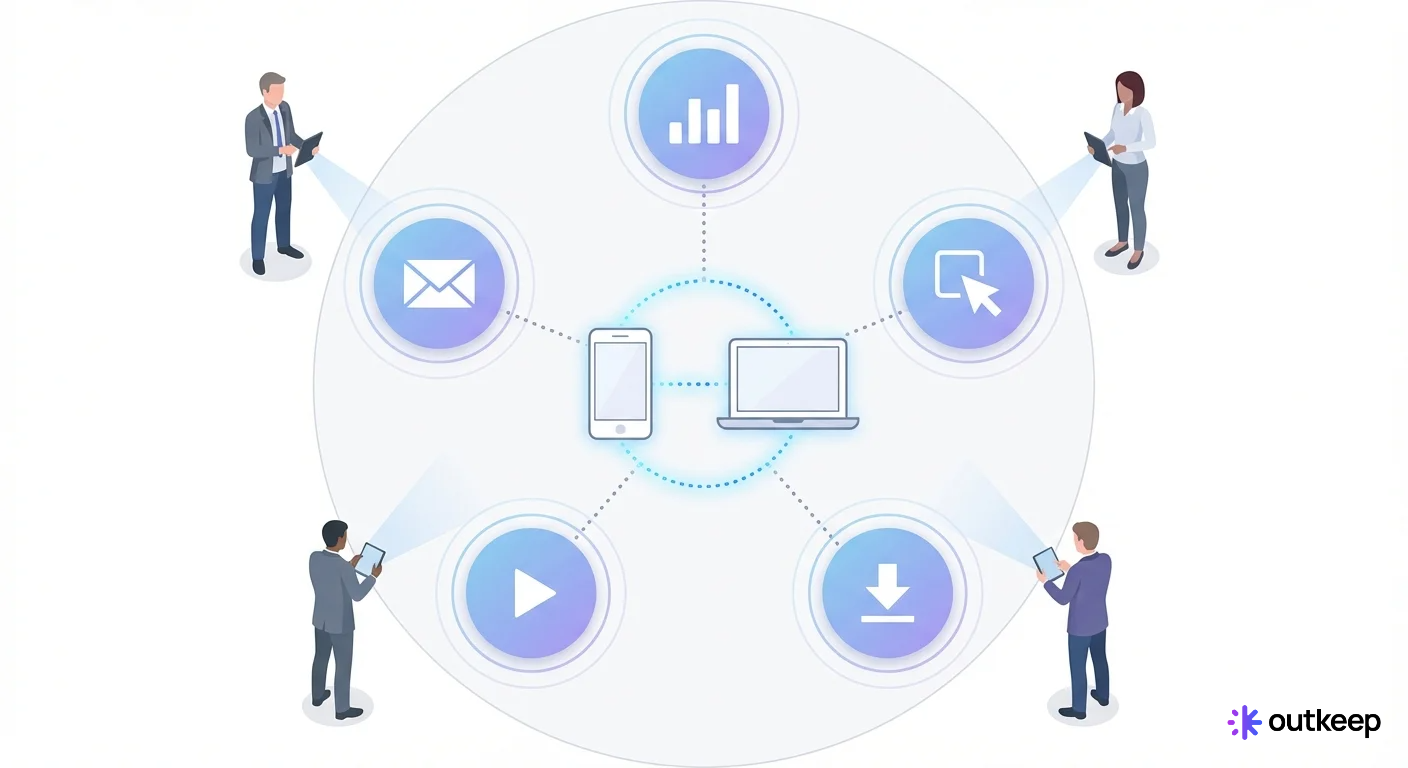
Behavioral signals are how people interact with your company specifically, usually via assets and systems you control.
Examples include website visits, email engagement, webinar attendance, downloads, ad clicks, product usage, and CRM interactions.
These typically come from your marketing automation, CRM, CDP, and analytics stack like HubSpot, Marketo, Snowflake, dbt-based models, product analytics tools, and similar systems.
Why it matters
Behavioral signals imply awareness. You only see them once someone already knows you exist and engages with your brand.
That makes them very useful for understanding known demand and shaping nurture, but it also means they are not a complete view of the market.
Behavioral signals are also often lagging. By the time a buyer is generating strong first-party behavior, they may already be 30 to 70 percent through their buying process.
How to use it operationally
- Use behavioral data to segment and sequence known accounts: what they engaged with, what they ignored, and what they are repeatedly returning to.
- Treat repeated, high-friction behaviors as stronger cues, for example returning to pricing, implementation docs, or product detail pages.
- Use behavioral signals to decide the next helpful step, not just the next sales step.
Watch-outs
- Referencing behavioral visibility in outbound can trigger a “Big Brother” reaction, even if you are right.
- Behavioral activity without an organizational “why now” can still be curiosity, internal enablement, or passive awareness.
5. Which event signals explain “why now”?
Event signals often explain why research and behavior are happening. They are the “why now.”
Examples include executive hires, job changers, spikes in hiring for specific roles, job postings, funding announcements, product launches, acquisitions, new tech adoption, and competitive mentions in public communities like Reddit or LinkedIn.
These are typically captured with tools like BuiltWith, Crunchbase, Clay, BirdDog, LinkedIn (for hiring and role changes), and social listening platforms that track brand and category mentions.
Why it matters
Event signals are often the closest thing to a true buying-cycle trigger you can observe from the outside.
They indicate organizational momentum and strategic change, meaning the company is investing in something. That investment is frequently the reason your category becomes relevant.
Tools that focus on direct, clear event-based triggers tend to be more valuable than broad third-party intent platforms, especially when they surface concrete signals like competitor mentions, technology adoption, or discrete organizational moves.
Clay’s pretty good at surfacing these in real time, which matters because third-party intent often arrives days or a week after the activity actually happened.
How to use it operationally
- Anchor account prioritization in event signals, especially when you have a defined list of target accounts.
- Use event signals to structure outreach around “why you, why us, why now.”
- “Why you” is a specific reason you reached out.
- “Why us” is your relevance to that reason.
- “Why now” is often best supported by an event.
- Use event signals for personalization because they are public and expected, they make you look prepared, not like you are tracking private behavior.
Watch-outs
- Do not treat every event as a sales trigger. Some events explain relevance, but do not imply timing.
- Event signals still need mapping to action, otherwise they become just another alert stream.
6. What are you buying when you buy B2B intent data?
First-, second-, and third-party describe who owns the data, not what kind of signal it is.
- First-party signals: you collected them directly, for example web activity tied to known identities, email clicks, webinar attendance, product usage, CRM activity.
- Second-party signals: someone else’s first-party signals shared with you, usually via a trusted partner, sponsorship, ecosystem relationship, or within your own organization across products and teams.
- Third-party signals: aggregated across the internet by external vendors, then modeled into intent categories and scores.
Why it matters
Data ownership determines accuracy, context, and how “actionable” the signal is.
- First-party is usually the most accurate and relevant, but often arrives late.
- Second-party is often high-fit and contextual, but limited in scale and frequently expensive.
- Third-party has broad coverage, but is ambiguous, noisy, sometimes delayed, and often opaque.
A common failure mode is assuming broad coverage equals truth. In practice, broad coverage often equals broad ambiguity.
How to use it operationally
- Build your core operating model on first-party and second-party wherever possible.
- Use third-party as a background layer for directional prioritization, then require confirmation from stronger sources before changing rep behavior or campaign sequencing.
- Be opinionated about which topics and categories matter. Out of 40,000 possible “intent categories,” most businesses only need a small handful that map to real buying triggers.
Watch-outs
- Third-party categories can be comically vague. “Pricing” activity might be relevant, or it might be someone pricing blinds for a new office while logged into a work browser.
- Many third-party systems deliver a black-box score or “surge” without exposing underlying behaviors. That makes validation difficult and makes it hard to coach a team on consistent usage.
- Delayed delivery matters. If the “surge” arrives a week after the activity, it is often not actionable in the way teams expect.
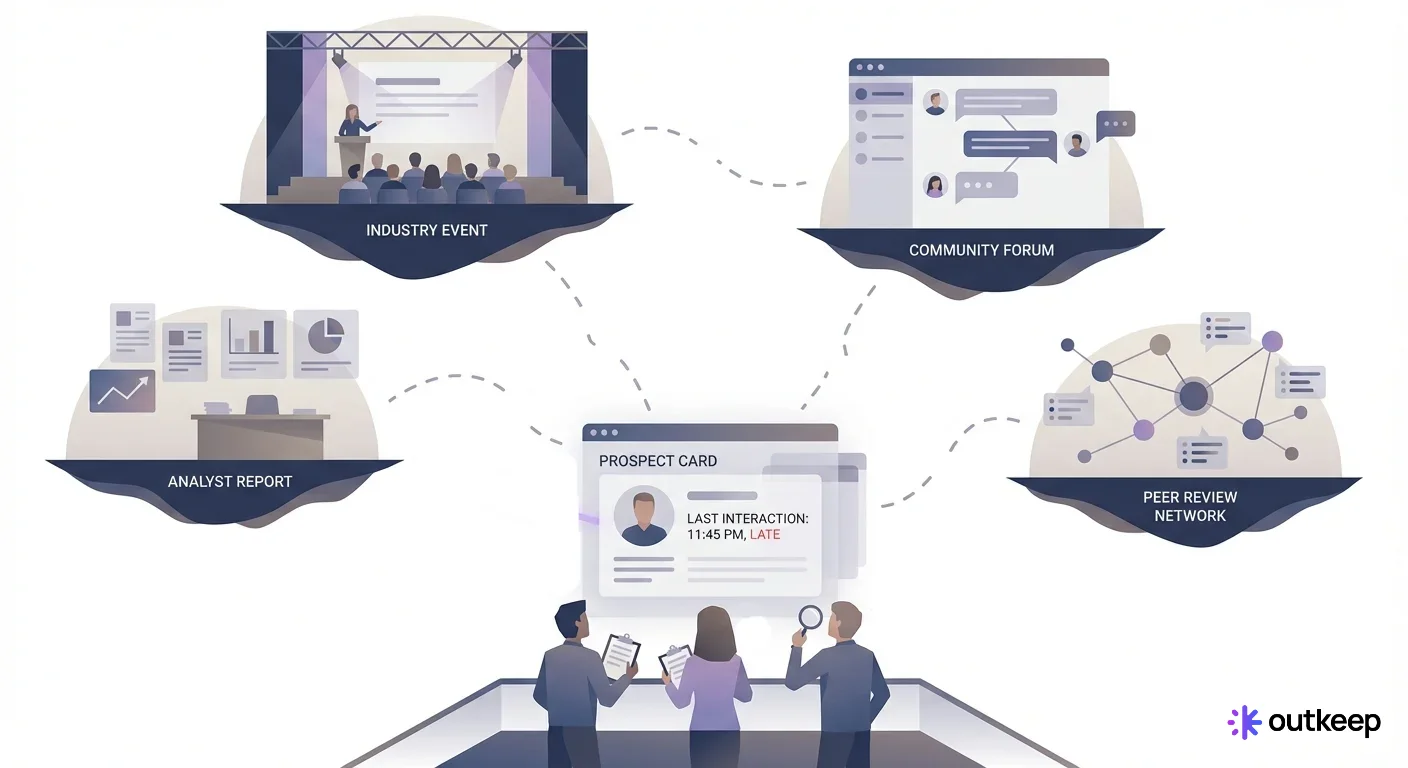
Attribution used to be easier when the path was more linear and identifiable. Now, much of the buyer journey is anonymous and distributed: communities, peer conversations, conferences, forums, analyst conversations, and private sharing. Buyers often show up in your CRM late.
Why it matters
First-touch and last-touch attribution are mostly broken for complex deals. The job is less about proving causation and more about building a coherent, repeatable “best guess from multiple signals” that improves prioritization and buyer experience.
How to use it operationally
- Treat signals as directional markers, not definitive proof.
- Combine multiple signals into a unified view, then weight them deliberately. Not all signals are equal.
- Decide in advance what you will do when a signal fires, for example, light-touch education, deeper nurture, personalized outreach, or direct sales engagement.
Watch-outs
- If you try to force precision where the market is inherently probabilistic, you will end up optimizing reporting, not revenue.
- If you map top-of-funnel signals to bottom-of-funnel actions, you will burn trust. A third-party spike on “CPQ” is not a reason to ask for a demo.
7. How should you act on a signal without burning trust?
Signals are inputs to better timing, better relevance, and better assistance. They are not permission to “close somebody based on signals.”
Why it matters
High-consideration buyers are managing risk, internal alignment, and timing. When you over-interpret weak signals, you push the buyer into a sales conversation they did not ask for. That is where you get the creepy reaction, or you get ignored.
How to use it operationally
- For outreach and personalization, prefer public event signals. Funding, hiring, product launches, tech adoption, acquisitions, competitive mentions. These are fair game and expected.
- Keep research and behavioral signals mostly internal. Use them to decide what to send, what to prioritize, and when to follow up, without exposing your tracking.
- Calibrate actions to funnel reality:
- Top-of-funnel signals → education and guidance
- Mid-funnel signals → deeper nurture and de-risking content
- Bottom-of-funnel signals (usually first-party, repeated, explicit) → direct sales engagement
Watch-outs
- Even if you “nail it,” explicit references to browsing and inferred intent can still feel like surveillance.
- If your team treats every alert as urgent, the system becomes an interruption engine, not a decision engine.
The uncomfortable truth about third-party intent for high-ACV deals
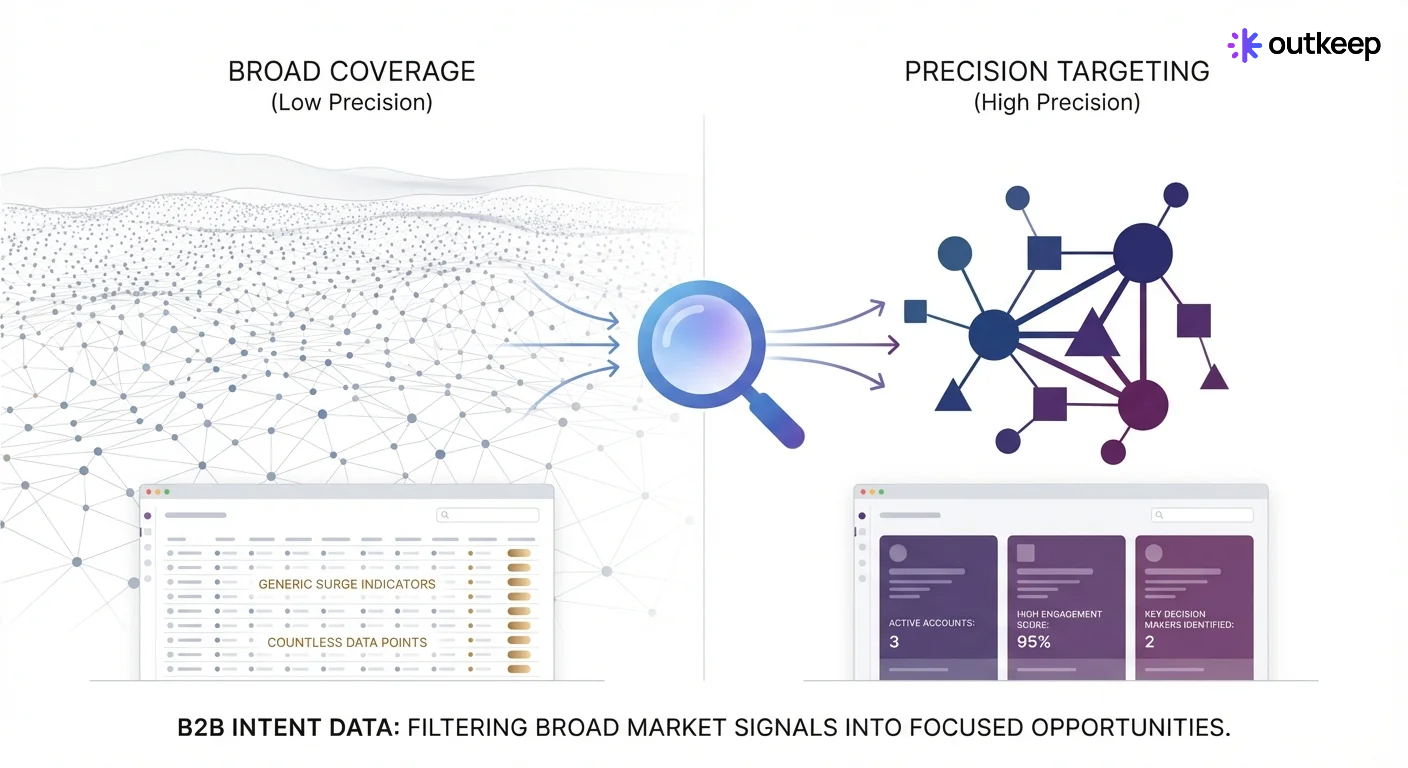
Here’s the reality: the intent market is very noisy and often a waste of money for high ACV, long sales cycle products. It ballooned into a huge industry, but as it has become ubiquitous and more obviously imprecise, its marginal value has dropped.
Many vendors participate in this game: Bombora, Demandbase, G2, BuiltWith, ZoomInfo, Apollo, and others. Most of them now have some “intent” product.
The upside is broad market coverage, you can see activity across a big chunk of your total addressable market.
The downside is that it is heavily modeled, low-precision, and often delivered as a black-box “intent score” or “surge” without exposing the underlying signals. It becomes a very wide net, difficult to interpret in a way that leads to smart action.
With tens of thousands of intent categories, poorly defined topics, and black-box models, a lot of “intent” data is closer to noise than signal.
You can easily make your go-to-market motion worse by layering in noisy data that distracts reps, misguides campaigns, or leads you to chase false positives.
Context on Outkeep’s Approach
We spend time on signals vs. intent because we operate in the same high-consideration, long-cycle environment as our customers, and we see how quickly noisy data can distort priorities. Our perspective comes from building and using event-based and first- and second-party oriented workflows where the underlying signal is concrete and explainable.
FAQ for Modern B2B Email Programs
1) What’s the difference between a signal and intent in B2B marketing?
A signal is an observable event, for example a pricing page visit, webinar attendance, or a job posting. Intent is the inference you draw from one or more signals, for example that a company might be evaluating a category.
2) When I buy “intent data,” what am I usually buying?
Most of the time you are buying the interpretation layer, such as “Company X is surging on Topic Y,” not the raw behaviors. That means you are buying a model’s probabilistic conclusion, often without visibility into the underlying activity.
3) Which signal types are most useful for complex deals?
Event signals tend to be the most useful because they explain “why now” and often reflect real organizational momentum. Behavioral and research signals are useful, but usually more directional and easier to misinterpret.
4) Are first-party signals always the best?
They are usually the most accurate and relevant, but they can be lagging indicators. By the time you see strong first-party behavior, the buyer may already be well into their process.
5) What are second-party signals, and why do teams pay for them?
Second-party signals are someone else’s first-party data shared with you, often via partners, sponsorships, events, ecosystems, or internal cross-sell between product lines. They can be high-fit and contextual, but typically limited in scale and often expensive.
6) Do third-party intent signals hurt more than they help?
They can help with broad coverage and directional prioritization, but they are often ambiguous, noisy, delayed, and opaque. In high-consideration motions, they are easiest to misuse when treated as proof of demand or used to justify aggressive outreach.