Paid advertising speaks the language of finance. ROAS, CPM, CPC, CPL, customer acquisition cost. A CFO can open the dashboard, read every number, and understand exactly what the money bought. Email speaks a different language: opens and clicks, neither of them detailed, almost never carrying a cost. So one channel gets scrutinized, resourced, and defended, and the other gets treated like the intern’s task.
That gap is a measurement problem, not a value problem. We have seen companies spend hundreds of thousands a year on LinkedIn ads while their email program runs on a $12,000 platform contract that nobody pays attention to, because email is harder to measure and a pain to maintain. The moment you force both channels onto the same dashboard, using the same metrics, the comparison gets uncomfortable for paid.
Our numbers here are directional, drawn from client experience rather than a sample size we would defend to the grave. But they are consistent enough to act on. Done well, email almost always outperforms paid, often by 3X to 9X for the same outcome. This is the short version of why, and what to do about it.
TL;DR
- Paid is measured in finance language a CFO understands; email is measured in opens and clicks nobody costs out. That asymmetry, not value, is why email gets underfunded.
- Put both channels on one dashboard using the same metrics: CPM, cost per click, cost per lead, cost per engaged web visitor.
- Use platform cost as the baseline for both sides. Add agency, data, or content costs only if you add them to both, or you will overcomplicate it.
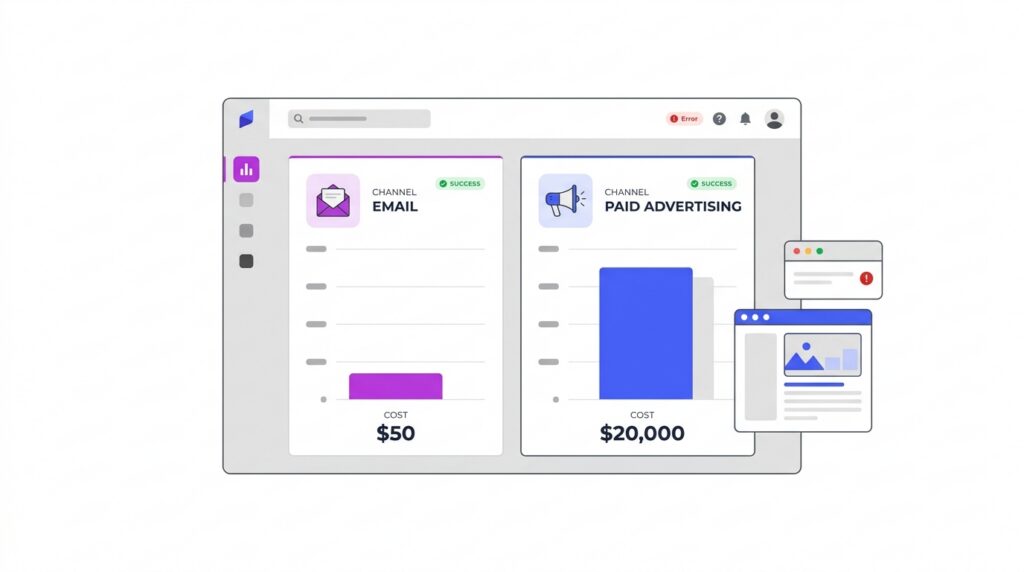
- Cost per engaged web visitor runs around $3.50 via email versus roughly $20 via paid in our clients. Same outcome, a fraction of the spend.
- Email and paid are an AND, not an OR. Email finds engaged, qualified hand-raisers, and you feed those into paid custom audiences to shorten the cycle and lift deal size.
- Resource email like a real channel. Trained owner or partner, 30 to 90 day measurement windows, viewed on aggregate.
1. Email gets neglected because it does not speak finance
The reason email gets underfunded is that it never learned to talk to the CFO. Every paid metric correlates to money. ROAS, CPM, CPC, cost per lead, lifetime value. The dashboard is clear and the spend is variable and substantial, so finance asks for reporting and the channel earns its scrutiny. Email reports opens and clicks, both notoriously unreliable thanks to bot activity, and neither carries a dollar figure. In ten years of B2B programs you rarely see anyone attach a real cost to an email metric.
Why it matters:
When a channel cannot be read in financial terms, it gets read as optional. Email then becomes the mysterious, high-maintenance thing teams avoid, which is exactly backwards given the cost difference. Ad platforms also make it very easy to build a list, spend your budget, and measure the result, even when the spend is ineffective. Email requires more maintenance and offers murkier reporting, so people see it as the lesser channel when the economics say the opposite.
How to fix the framing:
- Stop reporting email in open-and-click language alone. Translate it into the same cost-based metrics paid already uses.
- Trace email-driven actions through to a revenue event. If a meeting, signup, or conversion came from email, report it, including last-touch attribution alongside other models for a holistic view.
- Treat email as a trained discipline with a real owner, an agency, or a partner. It is a scalable, high-ROI channel, not a throwaway task.
Watch-outs:
- Open rates measure inbox placement more than interest, so do not build the financial case on them.
- Attribution is hard in B2B, and the “other” bucket usually outweighs everything. Accept directional clarity over false precision.
Why email gets underfunded
One channel speaks finance. The other speaks opens and clicks.
Budget follows what a CFO can read. That vocabulary gap, not performance, is why email stays the smaller line item.
Paid advertising
Reads as a financial asset
Every metric ties back to spend, so finance scrutinizes it, resources it, and defends it.
Reports in
Reads as optional
No dollar attached, plus heavy bot noise, so it floats outside the budget conversation.
Reports in
The fix is not better performance. It is translating email into the same cost-based metrics paid already uses.
2. The same dashboard, built on platform cost
To compare the two honestly, assign email a cost and run it through the same metrics as paid. The cleanest baseline is platform cost, because that is essentially all a paid platform reports anyway. You are paying, say, $850 a month for HubSpot Marketing Hub, $6,000 a month on LinkedIn ads, and $3,000 a month on Google paid search. Those are straightforward budgets. From there you can build effective CPM (program cost divided by delivered emails times a thousand), cost per click, cost per lead, and revenue per registration the same way on both sides.
Why it matters:
Parity is where the gap becomes obvious. In long sales-cycle B2B, the metric we trust most is cost per engaged web visitor, defined as someone who triggered an event, hit multiple pages, or spent more than ten or twenty seconds on the site. With proper UTM tracking you can pull 90 days of visits by channel, divide spend by visits, and then divide again by Google Analytics engaged visitors. Across our clients, cost per engaged visitor runs around $3.50 via email and closer to $20 via paid. Run the impression math and the story repeats: a $6,000 month buys roughly 33,000 LinkedIn impressions, while sending 7,500 emails a week for four weeks to the same matched list produces about 30,000 sends for a fraction of the cost.
How to run it:
- Start with platform cost on both sides. Layer in data, agency, or content costs only if you do it symmetrically.
- Map email metrics to their paid equivalents: effective CPM, cost per click, cost per lead, cost per engaged visitor.
- Use engaged web visits as the shared conversion metric in long-cycle B2B, sourced from UTMs and Analytics.
Watch-outs:
- Convoluting one side without the other breaks parity. The inputs to both programs are often identical anyway, since the content you run as ads is usually the content you already have for email.
- Measure on aggregate over 30, 60, or 90 days. Do not judge the comparison on a single send or a single ad. Let them cook.
Same metric, both channels
Cost per engaged web visitor
Spend divided by engaged visitors (someone who triggered an event, viewed multiple pages, or stayed 10 to 20 seconds), sourced from UTMs and Google Analytics. Directional, from client programs.
~$3.50
per engaged web visitor
~$20
per engaged web visitor
Same outcome, a fraction of the spend. A $6,000 month buys roughly 33,000 LinkedIn impressions. Sending 7,500 emails a week for four weeks to the same matched list produces about 30,000 sends for a fraction of the cost. Measure on aggregate over 30 to 90 days.
3. Email and paid are an AND, and email should drive the spend
The point is not to pick a winner. It is to run both, with email sharpening paid. Email does not always reach the inbox, and not everyone is on LinkedIn, so running both gets you better surface coverage. Attribution tools like LinkedIn and Zen ABM consistently show that prospects who saw both ads and email have larger first deal sizes, higher lifetime value, and shorter sales cycles. Awareness compounds. People who already know you spend more and decide faster.
Why it matters:
The sequencing can run the other way from how most teams do it. Instead of buying paid traffic to find engaged users, start with your TAM, engage it cheaply through email, and let the hand-raisers reveal themselves. Then upload those engaged, qualified contacts as custom audiences in your paid channels and amplify. You are now spending paid dollars on people who already fit the criteria and already raised a hand, which is where paid actually earns its premium. The email data informs the spend, and the whole thing snowballs.
Operator moves:
- Use email as the cheap top-of-funnel engagement layer, then promote engaged contacts into paid custom audiences.
- Build always-on programs in both channels rather than treating them as a campaign you switch on and off.
- Put email and paid on the same team or in close coordination. Splitting them is why paid gets all the budget and scrutiny.
Watch-outs:
- A well-built email program (right nested lists, right policies, right procedures) can run close to autopilot at four to six times less than a comparable monthly ad spend, but only if someone owns it.
- Do not let email default to junior, throwaway status. It deserves the same focus you give the ad channel, because for the effort you put in, you get more out.
Email sharpens paid
Run the cheap channel first, then amplify with paid
Not email or paid. Email finds the hand-raisers cheaply, then paid spends only on people who already fit.
Send to your full addressable market for a fraction of paid’s cost.
Opens, clicks, and repeat site visits reveal who raised a hand.
Upload the qualified contacts to LinkedIn or Google so paid spends only on warm, fitting accounts. Larger first deals, higher LTV, shorter cycles.
Context on Outkeep’s Approach
Outkeep operates inside long-cycle, high-consideration B2B programs where email is the owned channel that has to keep working for years. We spend time on measurement, deliverability, and program structure because the value of email is real but invisible until you express it in terms a finance team already trusts.
The numbers in this piece are directional, pulled from what we see across client programs rather than a statistically defensible study. They are consistent enough that we build on them, and we would rather state them plainly than pretend email and paid live in separate universes. They do not. They belong on the same dashboard.
FAQ for Modern B2B Email Programs
How do I compare email and paid advertising on the same dashboard?
Assign email a cost, starting with platform cost, and run both channels through the same metrics: effective CPM, cost per click, cost per lead, and cost per engaged web visitor. Keep the cost inputs symmetrical so the comparison stays fair.
What is cost per engaged web visitor and why use it?
It is channel spend divided by engaged visitors, where an engaged visitor triggered an event, viewed multiple pages, or spent more than ten to twenty seconds on your site. In long sales-cycle B2B it is a more meaningful conversion proxy than opens or clicks, and you can pull it from UTM tracking plus Google Analytics.
Is email really cheaper than paid in B2B?
In our client experience, cost per engaged visitor runs around $3.50 via email versus roughly $20 via paid, and email often delivers the same outcome for 3X to 9X less. These figures are directional rather than statistically validated, but they are consistent enough to act on.
Should I run email or paid?
Both. They are an AND, not an OR. Email and paid together give better surface coverage, and prospects exposed to both tend to have larger first deals, higher lifetime value, and shorter sales cycles.
How does email make my paid spend more efficient?
Engage your TAM through email first, identify the qualified contacts who raise their hand, then upload them as custom audiences in your paid channels. You spend paid dollars on people who already fit and already engaged, which shortens the cycle and lifts deal size.
How long should I measure before judging the comparison?
On aggregate over 30, 60, or 90 days, never on a single send or a single ad. Let the programs run long enough to produce stable numbers before you draw conclusions.