This guide is for senior B2B marketers running go-to-market for high-consideration products, typically $25K ACV and up, with sales cycles measured in months or years. It focuses on building an orchestrated surround system across channels, not disconnected tactics. The core constraint is that you cannot fully optimize one channel before turning on others, and you should not start anything you are not willing to maintain. Use this as a sequencing and operating guide, then apply your own ICP, assets, and measurement stack.
1. Build the “bonfire” mindset before you build the channels

Purpose
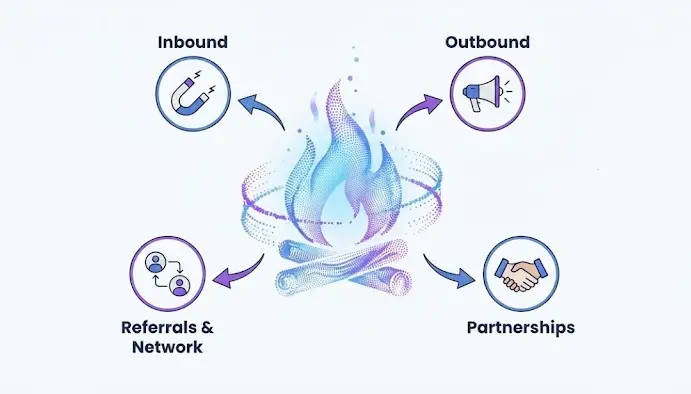
High-consideration B2B buying decisions are tied to job risk, defensibility, and organizational change. That means you win through trust, repeated exposure, and long-term brand recognition, not short-term promotions. The goal is an always-on “bonfire” with occasional “fireworks” spikes, not a series of one-off launches.
Implementation
- Align internally on what “surround sound” means for your category: omnipresent, multi-channel, and consistent over time. Think of it as having 8 channels working for you 24/7, like 8 BDRs that are always on.
- Treat this as a perpetual system across the whole buying journey, not a 6-week sprint.
- Use the four-legged stool framing to avoid single-channel dependency:
- Inbound
- Outbound
- Referrals and network
- Partnerships
- Accept the reality that by the time prospects reach out, they have often already done most of their research, commonly cited in the 50–80% range. Your job is to be visible and credible during that research window.

Signals to watch
- Event interactions where people say, “I know you, I get your emails,” or “I read your blog,” or “I’ve seen your stuff on LinkedIn.”
- “Make-you-famous” effects, where familiarity reduces friction and prospects self-select when timing is right.
- Increases in direct traffic and branded search over time, especially when you keep channels on.
Common mistakes
- Relying on one channel to carry the entire go-to-market motion, whether that is events, paid ads, email, or LinkedIn outreach.
- Treating “fireworks” as the strategy, for example spending 80% of budget on events because the attendance feels guaranteed.
- Expecting transactional behaviors in a non-transactional context, like assuming a promotion or offer will materially change outcomes.
2. Choose 3–5 channels, then sequence them without paralysis
Purpose
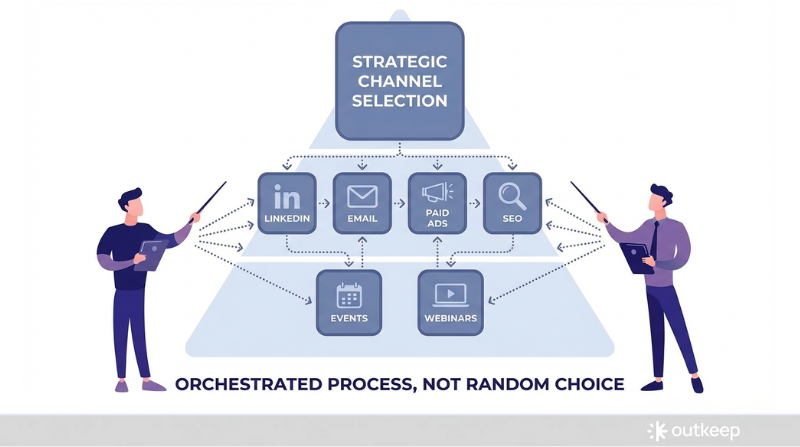
You do not need every channel and every format, but you do need multiple channels operating in concert. In practice, there is usually a minimum of three channels running in parallel, with others tested and scaled based on signal. The channels are not siloed, each plays a distinct role.
Implementation
Pick your initial core mix based on where your ICP already pays attention. A common high-consideration core looks like:
- Organic social (often LinkedIn in B2B)
- Paid social plus retargeting
- SEO and organic search
- Events and webinars (as spikes layered on top)
Use this sequencing to avoid over-perfection:
- Start with organic social because it is cheap and fast for signal.
- Port winners into paid social to buy reach and repetition.
- Port winners into email, testing subject lines, modules, and CTAs.
- Build retargeting around proven content and offers.
- Fold in SEO and content strategy aligned to what is already working.
- Layer events and webinars using the same messages and assets.
Design a minimum viable surround framework rather than trying to launch everything at once.
Do not try to fully optimize one channel before turning on the others. You will get stuck in over-analysis and never build the multi-touch system the market actually responds to.
Signals to watch
- Topic and angle engagement in organic social, which becomes the “cheap/fast” indicator of message resonance.
- Lower effective costs and higher engagement as you iterate and keep channels on, for example the same $6K spend generating 30 clicks in month one versus 300 clicks in month six after testing and optimization.
- Retargeting performance improving once you are driving consistent top-of-funnel engagement.
Common mistakes
- Turning on a channel “to see if it works” with no plan to operationalize it beyond the test.
- Treating channels as separate programs with separate narratives, rather than one system with shared messages and assets.
- Building your mix around internal preferences instead of audience behavior, for example doing webinars because leadership likes webinars.
3. Commit to runway, most channels need 90 days minimum, often 6–12 months
Purpose
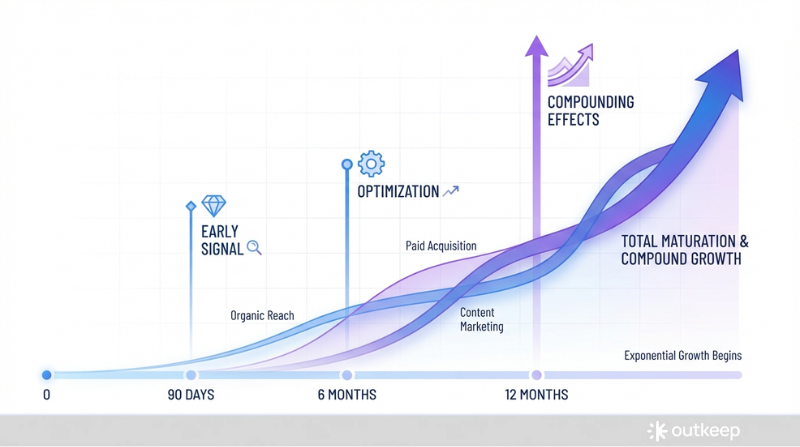
Long sales cycles require patience because brand effects compound and buyers need many touches to remember you. Early performance often looks weak, even when the system is working. If you turn channels off before compounding starts, you teach yourself the wrong lesson.
Implementation
Make a clear operational commitment up front:
- Minimum 90 days to get meaningful signal in most channels
- More realistically 6–12 months for the compounding effect, especially with 9-month sales cycles
Apply the “don’t start anything you’re not willing to maintain” rule to:
- Channel launches (newsletters, podcasts, LinkedIn series, webinar cadence)
- Reporting cadence (do not agree to daily executive reports unless you plan to do them forever)
Assume it takes many touches to be remembered. The old numbers were 7, then 12, now you will hear 20s or 30s in noisy markets. Plan channel frequency accordingly.
Life is too short to work for a CEO who wants meetings in two weeks from a brand new program and then micromanages every metric along the way. Set expectations early and hold the line.
Signals to watch
- Impressions matter early, even when CTR is poor. Those impressions are telling the market you exist and planting familiarity.
- Improvement curves over time, where cost and performance both trend better as creative and platforms optimize.
- Increased downstream responsiveness to outbound and events as the “always-on” exposure builds familiarity.
Common mistakes
- Judging programs two weeks into the first ad campaign based on booked meetings.
- Killing channels after 4–6 weeks because the sales cycle cannot possibly reflect the impact yet.
- Measuring the program purely by short-term direct response, while ignoring long-term lift in familiarity and conversion efficiency.
4. Run a real testing system, “two-by-two” multivariate, then scale winners everywhere

Purpose
The discipline is simple: test, test, test, then scale. You learn what your audience responds to across channel, format, and message, then you double down. Testing is how you avoid guessing, and how you prevent channels from going stale.
Implementation
Use a practical multivariate structure:
- One core asset or CTA (guide, webinar, workshop, consult, etc.)
- Two copy variants (headline, value prop, hook, framing)
- Two imagery or creative variants (visual, format, structure)
- This gives multiple combinations quickly, and you can expand from there.
Focus on changes that matter in B2B:
- Headline, value proposition, offer framing, imagery, and structure tend to move the needle.
- Button color usually does not.
Once a combination hits, port it across channels:
- Organic social post themes become paid social ads
- Paid winners become email subject lines and modules
- Email winners become landing page framing and retargeting ads
- The same messages show up in webinars, events, and follow-up sequences
Keep creative and content fresh. Ads get stale, content gets stale, regimes change, and audiences tune out repetition without novelty.
Signals to watch
- Engagement benchmarks that indicate resonance, not just curiosity clicks.
- CTR trends by channel and by creative variant, to understand what the market is responding to.
- When a message works in one channel and continues to work when ported to another, that is usually real signal.
Common mistakes
- Testing too many variables at once, so you cannot tell what caused the lift.
- Optimizing tiny UI details instead of the core message and offer.
- Finding a winner in one channel and failing to scale it into the rest of the system.
5. Treat audience and data quality as the foundation, “garbage in, garbage out”
Purpose
If you are talking to the wrong audience, nothing else matters. You can do everything right tactically and still get silence. Audience definition, list hygiene, and sales and marketing collaboration are not “ops work,” they are core go-to-market work.
Implementation
Define and document your ICP with specificity:
- Company profile and constraints (size, industry, region)
- Roles involved (researcher vs buyer)
- Problems they actually have, and the language they use
Build content-audience match:
- Speak to real pains and desired outcomes
- Avoid writing for the widest possible audience, it dilutes signal
Collaborate with sales on list and audience curation:
- If sales says “bad lead,” treat it as an upstream audience and list process issue
- Use sales-provided lists, tooling, and manual research to curate the right people
Prefer matched audiences over lookalikes and audience expansion in high-consideration B2B:
- Broad expansion often floods you with unqualified leads, wrong company size, wrong role, wrong industry
- Upload tightly defined matched audiences into LinkedIn and Meta, then refine with filters
Avoid over-narrow ABM that traps you under the streetlight:
- Do not be like the person looking for their keys under the streetlight because that is where the light is good, when they actually dropped them in the parking lot
- Pursue your top 100 “must win” accounts if needed
- Maintain a broader universe, 1,000 to 2,000 contacts or more, so you get scale and leave room for surprise wins
- Do not reshuffle everything every week around “the 100 accounts of the quarter”
Signals to watch
- Sales acceptance rate and downstream conversion quality, not just form fills.
- Audience saturation and coverage. In many high-consideration markets, your real addressable audience is thousands to tens of thousands of accounts, which is feasible to reach consistently.
- Improved lead quality when you switch from expansion audiences to matched audiences.
Common mistakes
- Celebrating engagement from the wrong people, for example job seekers who will never buy but make your email open rates look fantastic.
- Treating list hygiene as optional, then blaming channel performance for predictable audience mismatch.
- Over-reliance on a single founder’s voice as proof of message-market fit, when the rest of the brand does not perform.
6. Measure deeply, report wisely, and keep leadership out of the weeds
Purpose
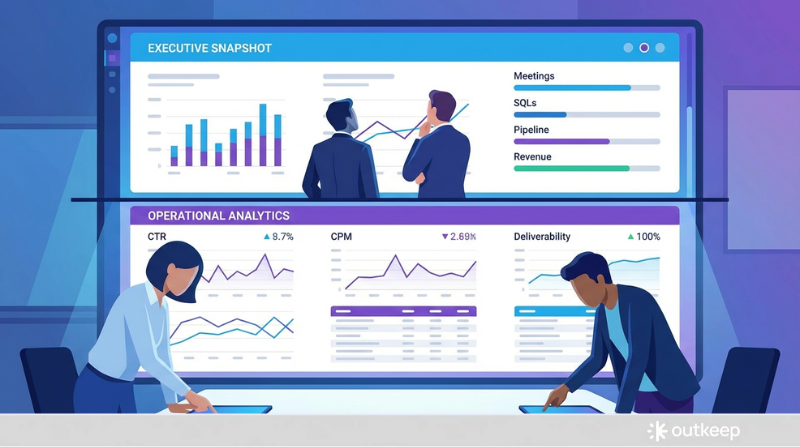
Marketers need operational metrics, but executives need a simple scorecard. If leadership scrutinizes every channel and campaign at a granular level, you lose the space to test and scale. The stance is: measure deeply under the hood, report on aggregate.
Implementation
Internally track channel-specific operational metrics:
- Opens, clicks, impressions
- CPM, CTR, CPC
- Cost per lead, cost per meeting
- Deliverability and sender reputation signals for email
Externally report a rolled-up scorecard tied to commercial milestones:
- First-time appointments or meetings
- SQLs
- Opportunities created
- Pipeline generated
- Revenue and CAC over time
Use realistic efficiency benchmarks to sanity-check spend:
- CPM: LinkedIn often $500–$1,500 is relatively efficient for high-consideration B2B
- CPM: Meta often under $500 can be efficient
- CPM: if you are consistently above ~$1,500 in any channel, you are probably overspending
- CTR: 2% is okay, 5–8% is strong, with variation by format and audience
Understand full-funnel math so CAC is not mysterious:
- Digital CPL often ~$75–$125 in B2B
- Conference leads can be $250–$1,000 fully loaded
- Cost per meeting often gravitates around ~$1,200 when you include tools and labor
- CAC in the tens of thousands can be normal in large B2B, and only makes sense when tied to LTV, gross margin, and payback
Signals to watch
- Email engagement trends because low CTR and low engagement can hurt deliverability.
- Ad platform performance because low CTR impacts ad quality scoring, cost, and placement.
- Improvements in funnel efficiency, leads to meetings to opportunities to closed-won, as you tune message and audience.
Common mistakes
- Reporting vanity metrics to executives as if they are board metrics.
- Forcing every channel to justify itself on the same short-term metric.
- Failing to implement UTM discipline and then arguing about attribution based on opinions.
7. Make channels feed each other, including events, so you get compounding instead of a collage
Purpose
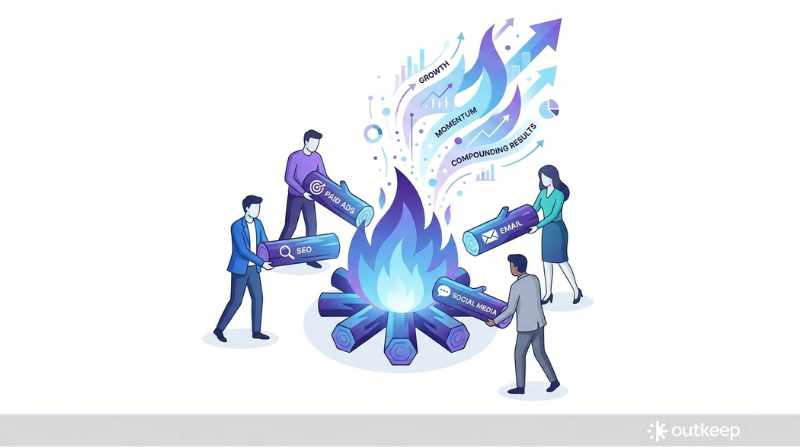
Omnichannel works when it is one system. Each channel plays a distinct role, and the outputs of one become inputs to another. This is how you get a coherent bonfire, not a collage of disconnected experiments.
Implementation
Assign roles to channels, then connect them operationally:
- SEO builds credibility, validation, and inbound discovery
- Paid ads create reach and repetition
- Email deepens trust, continuity, and narrative over time
- Social proves you are real humans at a real company, consistently showing up
- Retargeting tightens the web after first engagement, so you do not lose high-intent visitors
- Events are fireworks, legitimacy, and humanization points
Treat visibility as multi-person, not single-person:
- Avoid concentration risk where the brand becomes “all about Bob” or “all about Sally”
- Build a “Mount Rushmore” of four or five recognizable people across roles
- Use peer-to-peer presentation in email and ads when possible, real names and faces help
Extend event value for the long tail:
- If 2,000 people attend and you talk to 20, the other 1,980 do not need to vanish
- Do not rely on 30–45 days of BDR follow-up as the entire post-event plan
- If you spend $30,000–$70,000 on an event, budget additional spend to keep that audience warm for the next year via email, retargeting, organic social, and content
Use tracking discipline as the connective tissue:
- Google Analytics plus UTM parameters on all links
- Carry UTMs into CRM where possible
- Track at the account level, not just contact level, because the first engager is often a researcher and the deal may close with someone else
Signals to watch
- Multi-touch influence patterns, where one person engages early and another becomes the buyer later.
- Returning event attendees and repeat familiarity, people recognizing your team year after year.
- Lower outbound friction because prospects feel like they already know you.
Common mistakes
- Treating event spend as complete once the booth closes, instead of investing in year-round nurture.
- Running channels as isolated “mini programs” with separate messages and separate lists.
- Ignoring account-level attribution and losing the story of how deals actually progress.
Context on Outkeep’s Approach
Outkeep operates in the day-to-day of B2B email and multi-channel execution, where list quality, message resonance, and operational discipline matter more than one-off tactics. The perspective here comes from repeatedly building always-on programs that have to perform across long sales cycles, with real measurement and real constraints.
FAQ for Modern B2B Email Programs
What is “surround sound” marketing in high-consideration B2B?
It is an always-on, multi-channel presence where email, social, paid, SEO, retargeting, and events reinforce each other over time, so buyers keep seeing you during long research cycles.
How long should I run a new channel before deciding if it works?
A practical minimum is 90 days, and in many long-cycle B2B environments it is more realistic to expect 6–12 months for compounding effects and pipeline maturation.
Are matched audiences better than lookalikes on LinkedIn for B2B?
For tight ICPs and high-consideration deals, matched audiences are usually superior because they preserve precision. Lookalikes and audience expansion can introduce a lot of poor-fit leads.
What CPM and CTR benchmarks are reasonable for B2B paid social?
In many high-consideration B2B cases, LinkedIn CPMs around $500–$1,500 are considered relatively efficient, and Meta CPMs under $500 can be efficient. A 2% CTR is often okay, and 5–8% is strong, with variation by audience and format.
Do I need to optimize one channel before turning on others?
No. If you wait to fully optimize one channel before activating others, you usually end up in paralysis. The practical approach is to run multiple channels in parallel and port winners across them.
How should I report marketing performance to executives without getting micromanaged?
Measure deeply internally, but report a simple scorecard externally, focused on meetings, SQLs, opportunities, pipeline, and revenue. Keep channel-specific operational metrics for the marketing team.
How do I get more ROI from conferences and events?
Treat events as fireworks layered on top of an always-on system. Capture the broader attendee list and keep it warm for the next year through email, retargeting, and content, instead of stopping after 30–45 days of outbound follow-up.