Executive Summary
This guide gives senior B2B marketers a practical operating system for turning audience signals into scalable content programs. The core framework: start with cheap channels to learn what works, then scale only what earns it.
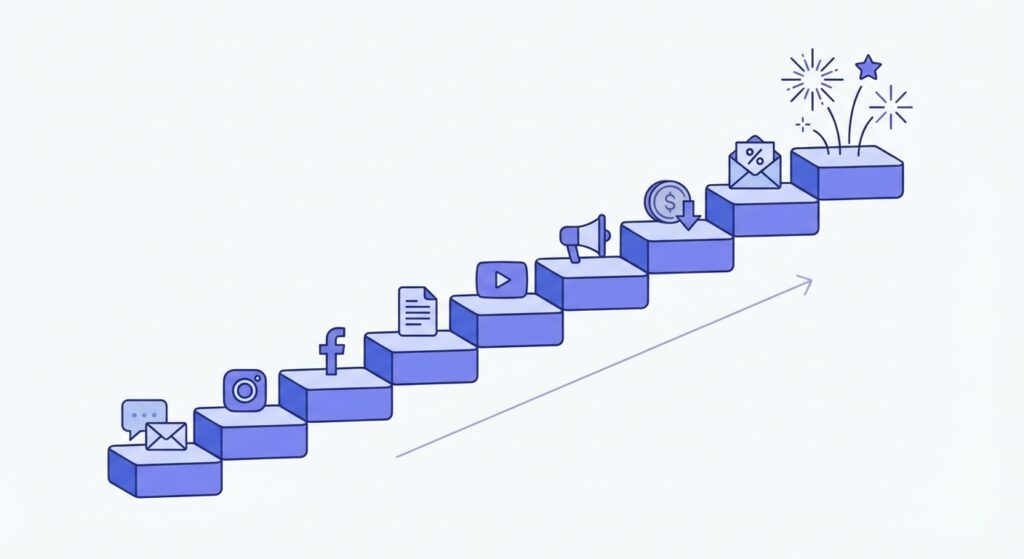
The 9-step ladder:
- Prerequisites – Basic messaging and audience definition before testing
- Multiple themes – Run 2-3 concurrent workstreams to avoid bottlenecks
- Clear hypotheses – Define goals per channel, avoid vanity metrics
- Organic social – Use personal accounts as your cheapest test surface
- Lightweight content – Graduate winners to blogs/articles (hours, not weeks)
- Email validation – Weekly owned-channel testing with segmented lists
- Paid amplification – Scale after 4-6+ weeks of signal, commit in months
- Heavy assets – Build “fireworks” only after repeatable pull across channels
- Operating model – Design sustainable cadences with slice-by-slice learning
Key principles: Treat every execution as structured learning. Use each channel as a test surface. Focus on engagement from the right audience, not just volume. Plan for 6-12 months of momentum building.
Common failure modes to avoid: Killing channels too early, over-investing before validation, chasing metrics from wrong audiences, trying to be everywhere at once.
This guide is for senior B2B marketers who already run multi-channel programs and want a practical operating cadence for turning real audience signals into email, paid, and bigger content assets. It focuses on using every channel in your stack as a test surface, starting with the lowest-cost, lowest-friction touches and only scaling what earns it. You can read it straight through as a 6–12 month program, or use each numbered section as a standalone SOP. The goal is to reduce guessing by treating execution as structured learning.
1. Set the prerequisites so testing is not “making it up completely”
Purpose
Create enough shared structure (messaging, voice, audience) that your tests produce interpretable signal, not random variation.
How to run it
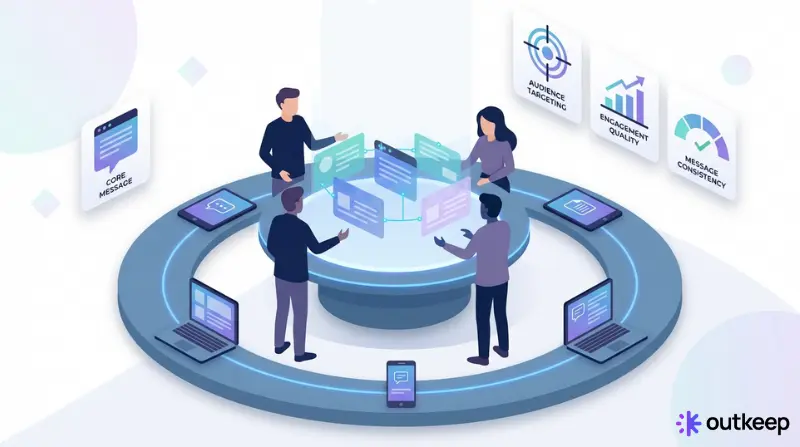
Establish a basic messaging platform before you “test everything”:
- Positioning and key messages
- A few core problems you solve, and the language you use to describe them
- A short tone of voice guideline, so posts and emails do not feel like different companies
Define a basic audience definition that is usable in execution:
- Who is in-bounds (roles, industries, buying context)
- Who is out-of-bounds (students, job seekers, peers you cannot sell to)
Decide who is allowed to publish on behalf of the company:
- In B2B, people engage with people more than brands, so plan for a “Mount Rushmore” of internal thought leaders, usually 2, 3, 5, maybe 10 people
- Give them the same messaging foundation, then let them experiment within it
Choose your initial channels based on where your audience lives:
- LinkedIn and X are common in B2B
- Some segments are meaningfully elsewhere (Instagram for real estate, Reddit for certain communities, Meta or TikTok for specific categories)
Signals to watch
- Consistency of language across posts and emails, especially “what we do” and “who it is for”
- Evidence that engagement is coming from the audience you defined, not adjacent crowds
Guardrails
- Do not start with heavy assets, paid, or big production until you can state your positioning and tone of voice in plain language.
- If you cannot describe who you want engaging, you will optimize for the wrong audience by accident.
2. Keep 2–3 themes in motion (or 6–8 in larger orgs), avoid long sequential series
Purpose
Maintain a steady drumbeat without creating bottlenecks, subject-matter expert fatigue, or an audience experience that requires “connecting the dots.”
How to run it
Avoid long sequential “series” like an 8-week run on one topic:
- The subject-matter expert gets fatigued and becomes the bottleneck
- The audience almost never connects the dots week over week
- The cliffhanger model rarely works in B2B because there is too much time between touches and too much noise in between
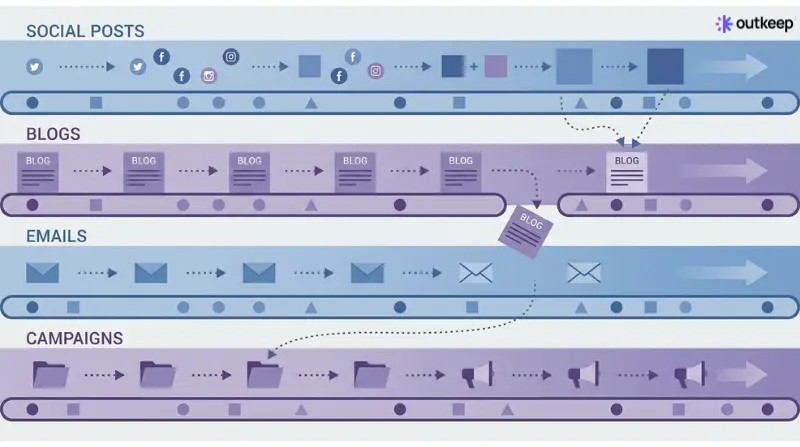
Run multiple workstreams concurrently:
- For smaller teams, keep 2–3 themes moving at any time
- For larger organizations, 6–8 or more can be realistic
Let different themes sit at different rungs of the ladder:
- One theme might be testing as social posts
- Another might be graduating into a blog and email
- A third might be under paid amplification
Keep the “drumbeat” consistent, even when fidelity varies:
- A social post can be a test surface
- A blog can codify a winner
- An email can validate with owned audiences
- Paid can amplify what has earned it
Signals to watch
- Whether you can sustain the cadence without one SME becoming the gating constraint
- Whether themes produce repeatable pull, not one-off spikes
Guardrails
- Do not require the audience to remember “Part 2” to understand “Part 4.”
- Do not run so many concurrent themes that you cannot evaluate signal clearly.
3. Define goals and hypotheses per channel, so tests do not devolve into vanity metrics
Purpose
Make every touch a structured learning event by tying execution to a clear goal and a hypothesis you can evaluate.
How to run it
Write a goal and a hypothesis for each test:
- Goal: what you are trying to learn or achieve
- Hypothesis: why you think this message, offer, or format will perform
Treat vanity metrics as contextual, not useless:
- Email opens are a valid goal if you are testing subject lines or preheaders
- Otherwise, opens are directional, content to audience fit comes first
Separate “engagement” from “buyer-relevant engagement”:
- It is easy to inflate metrics with the wrong segment (students, job seekers, peers, personal network, influencers)
- A post with 75 likes from friends is less valuable than one with 12 likes from the exact buyers and influencers you want

Signals to watch
Choose metrics that match the rung and the goal, for example:
- Organic social: engagement from in-market buyers, net-new qualified traffic
- Web content: time on page, scroll depth, multi-page sessions, bounce rate trending down
- Email: opens (when testing subject lines), click-through rate, unsubscribes, spam complaints
- Paid: cost per qualified click, engagement from the right segment, impression patterns over time
Guardrails
- Avoid overcomplicated testing that changes too many variables at once. Small variable changes, one or two at a time, are easier to learn from.
- Always keep room for a wildcard variation that breaks your own pattern, because outliers often surface new winners.
4. Use organic social as the cheapest test surface (and evaluate “who,” not just “how many”)
Purpose
Validate topics, angles, and formats quickly with effectively zero distribution cost, then use winners to feed the rest of the system.
How to run it
Operate through personal accounts first, brand accounts second:
- In B2B, personal accounts almost always outperform brand accounts
- Use a Mount Rushmore group to post regularly, supported by shared messaging
Use X for punchy, high-frequency testing if you have the audience there:
- 15–20 posts per week per person is a reasonable operating range
- Look back weekly to identify winners, then elaborate
Port winners to LinkedIn with appropriate format changes:
- LinkedIn posts often need more context and sometimes an image
- 2–7 posts per week per person is a typical range, publish enough to separate signal from noise
Consciously separate “feeding the algorithm” from buyer outcomes:
- Personal posts can raise overall engagement and reach
- Do not confuse that lift with business-relevant resonance

Signals to watch
- Who is commenting, sharing, saving, and engaging, not just raw likes
- Whether engagement is coming from the buyers and influencers you care about
- Whether follower growth or virality is pulling the right audience, follower growth alone is not the goal
Guardrails
- Do not lock yourself into rigid frequency rules. Use the data to find your ceiling, it is fuzzy and audience-dependent.
- Do not “kill” social too early. Early results are often noisy, and you need enough volume to learn.
5. Graduate winners into lightweight content (hours or days, not weeks)
Purpose
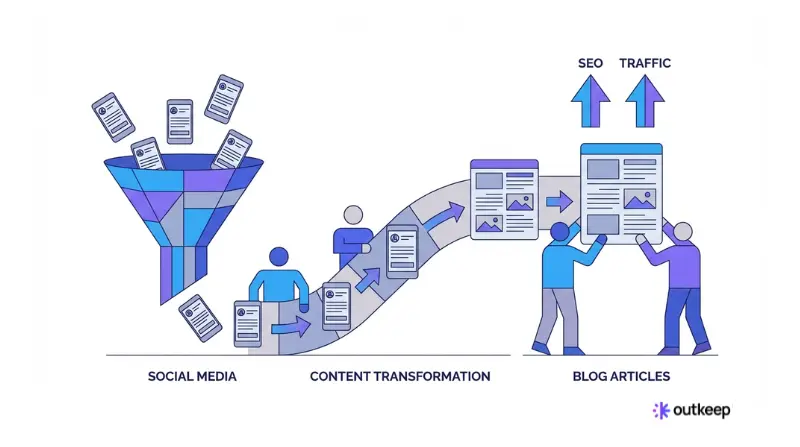
Codify winning ideas into reusable assets you can link to from social and email, and that can also serve SEO over time.
How to run it
Define “lightweight content” narrowly:
- Blogs, short articles, quick guides, checklists
- Minimal design lift
- Built from expanded posts, interviews, or transcripts
Use lightweight content to:
- Codify what is working into a durable asset
- Create something “meatier” to link from social and email
- Feed SEO and organic traffic
- Create modular pieces you can repurpose across formats
Set a healthy cadence without publishing for quotas:
- At least one blog or article per week is a common baseline
- Larger orgs may go to one per day, or one per market per week
- If only one topic is working, write one strong blog, do not add noise just to say you published
Signals to watch
- Qualified traffic from social and search
- Time on page and scroll depth trends, early content might get “4 seconds,” then you tune toward 30 seconds, then 90 seconds
- Multi-page sessions and bounce rate trending down as fit improves
Guardrails
- Do not get paralyzed by polishing. In discovery mode, consistency matters, and sometimes the piece you thought was mediocre resonates most.
- Balance quantity and quality. The point is a consistent drumbeat that produces learnings.
6. Run email as a weekly owned-channel test, one idea and one CTA per send
Purpose
Validate which topics perform with your owned audience, deepen engagement, and create a reliable weekly distribution habit.
How to run it
Use segmentation that maps to real differences in audience needs:
- By vertical, role, or another meaningful split (manufacturers, healthcare, marketers, wealth managers, etc.)
Cadence:
- One email per week per segment is a strong default
- One every other week can work
- Rarely more than two per week
Structure:
- One core idea per email
- One clear call to action
- Ungated web content, no forms, no friction
- Plain language, peer-to-peer tone, no selling, lead with value
Prefer driving to web content over PDFs:
- Many audiences are fatigued by PDF downloads, test formats, but do not default to PDFs

Signals to watch
If testing subject lines or preheaders: open rate is a valid goal (directional)
Otherwise prioritize:
- Click-through rate as the primary “did this land?” signal
- Unsubscribes and spam complaints as trust and relevance indicators
- List composition, make sure you are not mixing buyers with job seekers, students, or irrelevant segments
Practical guardrails that are often reasonable:
- Open rate > 25%
- Click-through rate > 2%
- Bounce rate < 0.2%
- Unsubscribes < 0.2%
- No spam complaints
Guardrails
- Email is more consequential than organic. You get one meaningful shot per week with most lists, respect that constraint.
- Do not waste cycles on trivial changes like button color. The big levers are message clarity, value, and trust.
7. Use paid amplification after 4–6+ weeks of signal, and commit in months, not weeks
Purpose
Scale proven content, not guess with budget, and build familiarity over the length of your sales cycle.
How to run it
Graduate to paid when you can look back across social, content, and email and see consistent winners with the right people.
Treat paid as an accelerator, not your discovery engine:
- You can short-circuit if budget constraints force it, but the default is to validate cheaply first
Start with multiple creative variations:
- 5–7 ad variants minimum
- Use a 2×2 matrix:
- Two message or angle variants
- Two design concepts
- Add a couple more distinct treatments and at least one wildcard that breaks your rules
Plan refresh cadence:
- LinkedIn shelf life is often 14–30 days before decay
- Refresh on that cadence instead of waiting for performance to fall apart
Set expectations and timelines:
- Early: higher impressions, lower clicks as you warm the audience
- Commit for months, not weeks, 90 days minimum, often up to six months, aligned with your sales cycle
- Accept lurkers, many will never click but will recognize you later
Signals to watch
- Segment quality and intent indicators, not just clicks
- Cost benchmarks as directional references (context-dependent):
- CPM: $500–$1,500
- CPC: $75–$125 or better
- Trendlines across creative refreshes:
- Winners get more budget
- Losers should die fast, do not get emotionally attached
Guardrails
- Do not cut campaigns before the cycle has time to play out, especially in high-consideration B2B.
- Avoid changing too many variables at once if the goal is learning, use small changes plus a wildcard.
8. Build “fireworks” assets only after repeatable pull, and use partners as multipliers
Purpose
Invest in heavy assets when they no longer feel like bets, because the topic already proved itself through the ladder.
How to run it
Define fireworks as high-investment, high-attention assets:
- Webinars
- White papers
- Original research reports
- Event programming
- Deep multi-thousand-word guides and POVs
- Conference speaking programs and abstracts
- Major partner co-marketing campaigns
Treat the earlier rungs as the “bonfire,” steady burn, steady learning:
- Organic, lightweight content, email, paid
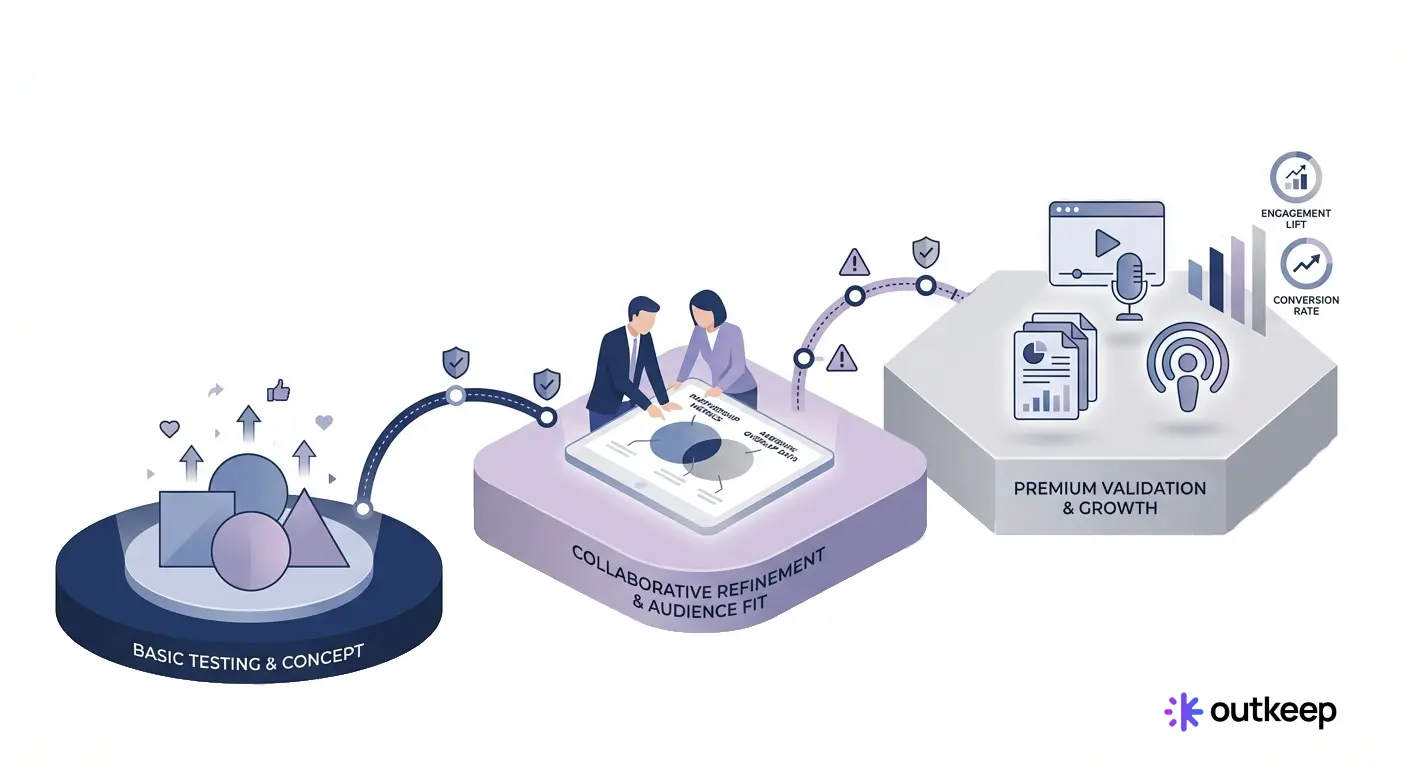
Promote a topic to fireworks only when it is a known winner:
- Proven on organic
- Performs as lightweight content
- Performs in email
- Delivers under paid amplification
Keep format testing inside validated topics:
- Webinars vs whitepapers vs podcasts, test the format, but do it after the topic is validated
Use partners intentionally:
- Co-created assets often perform at least 2× better because you tap their audience and credibility
- Collaborations create intrigue and expand reach, especially with well-known industry individuals or brands
Plan for approvals and real costs:
- Designers, writers, analysts, statisticians
- Partner MDF
- Legal, customer approvals
- SME time and coordination overhead
Signals to watch
- Repeat demand signals across channels, not one-time spikes
- Partner-driven lift in attendance, registrations, and downstream engagement
- Evidence the asset is shaping perception with the right audience, not just collecting registrants
Guardrails
- Do not build fireworks to “create demand” for an unproven topic. Use earlier rungs to de-risk.
- Do not rely on a single SME. Keep concurrent workstreams so production does not stall.
9. Design the program as a long-term operating model, baseline cadence plus slice-by-slice learning
Purpose
Make the flywheel sustainable by committing to volumes and frequencies, then treating every execution as structured learning over 6–12 months.
How to run it
Define your baseline drumbeat first, then layer testing onto it:
- Social posts per week per person
- Lightweight pieces per week or month
- Emails per segment per month
- Ad refreshes per month or quarter
- Fireworks assets per quarter or year
Operate “slice by slice,” so you do not get overwhelmed:
- Take one campaign and slice it up
- Learn from each slice, then adjust the next slice
Expect the bottleneck to move over time:
- Early: open rate might be the problem
- Then: click-through rate becomes the problem
- Then: time on site and multi-page sessions become the problem
- Keep calibrating as constraints shift
Use starting points, then follow your data:
- Test an extra email in a week and watch unsubscribes and traffic
- Post more or less and watch reach, engagement quality, and interaction relevance
- Adjust frequency based on audience tolerance and signals
Signals to watch
- Whether each channel is producing learnings tied to the goal, not just activity
- Whether you are scaling only what has earned it, and deprioritizing what has not
Guardrails
Avoid common failure modes:
- Killing a channel too early because early numbers look weak
- Over-investing in production or paid before any real validation
- Confusing activity with learning, doing lots of things without clear goals
- Chasing inflated metrics from the wrong audience
- Trying to be everywhere at once instead of focusing on scalable winners
Commit to months, not weeks. Early results are noisy and often misleading, momentum compounds over time.
Context on Outkeep’s Approach
Outkeep’s team spends a lot of time inside real B2B content and email programs, where small execution decisions and measurement choices compound over quarters. That operator exposure is why the guidance here focuses on using cheap channels for learning, then scaling only what has earned it.
FAQ for Modern B2B Email Programs
Do email opens still matter?
Yes, when the goal is testing subject lines or preheaders. For most other email goals, opens are directional and should not be the primary success metric.
Do unsubscribes hurt deliverability?
High unsubscribes are a relevance and trust signal, and they can correlate with deliverability issues if you are repeatedly sending misaligned content. A low, stable unsubscribe rate is a useful guardrail.
Should B2B newsletters drive to PDFs or web pages?
In many programs, driving to ungated web content performs better than PDFs because it removes friction and audiences are often fatigued by downloads. It is still worth testing formats, but web content is a strong default.
How often should a B2B company email its list?
A common operating cadence is one email per week per audience segment, with two per week as an occasional ceiling. The right frequency depends on list composition, content quality, and unsubscribe and complaint signals.
What is a practical way to segment a B2B email program?
Segment by meaningful differences like vertical (manufacturing vs healthcare), role, or market, then send the best-performing idea or asset for that segment each week. Avoid mixing buyers with students, job seekers, or irrelevant audiences.
What should I measure in email if I am not testing subject lines?
Prioritize click-through rate, unsubscribes, spam complaints, and downstream engagement with the linked content (time on page, scroll depth, multi-page sessions). These tend to reflect content to audience fit more directly than opens.