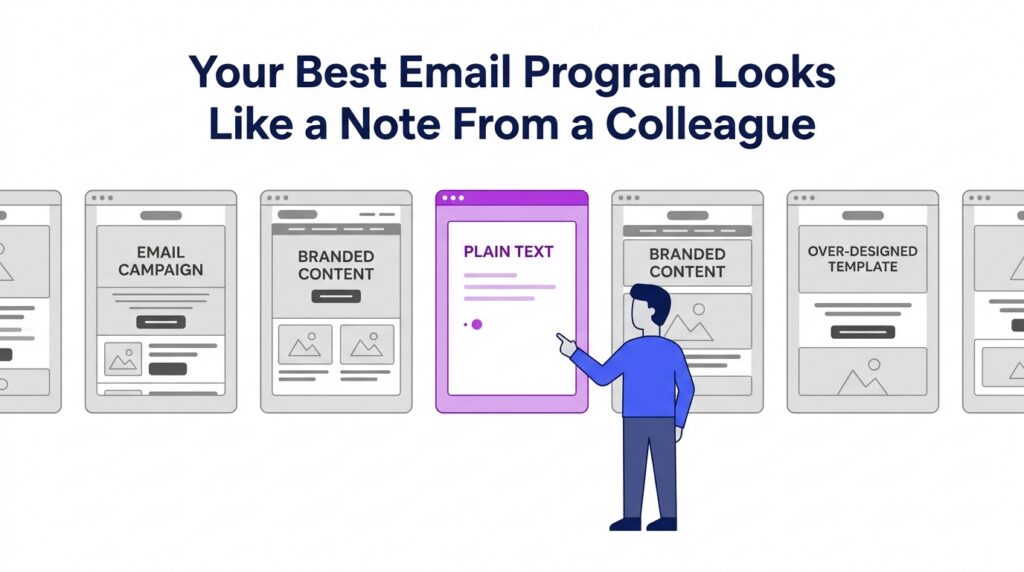
Most B2B email fails at the format decision, and the format decision fails because teams make it about design instead of intent. They build the branded newsletter, add the buttons, drop in a header banner, and then watch opens slide. The winning move in 2026 is quieter than any of that. It is a plain-text email from a real person, with a point of view and no ask, that looks like something already expected in the inbox.
This is the short version of the playbook. Three decisions carry almost all the weight: which program to run, how to format it, and how long to wait before you ask for anything. Get those right and the rest is detail.
TL;DR
- Peer-to-peer email is the highest-ROI default: low effort, no sales ask, safe to send warm, cold, or to current customers.
- Newsletters are opt-in only and polarizing. They are the least-liked thing to be surprised by, so never send one to someone who did not sign up.
- Nurtures fire on real signal and lead with proof. They are high effort and must never overlap with sales outreach to the same person.
- Plain text wins. Buttons, header banners, and heavy HTML mostly cost you open rate. Reserve images for webinar and podcast headers.
- Single CTA beats multi-CTA by roughly 300% more clicks. Bad AI personalization is worse than none.
- Trust compounds slowly. Plan for around 30 touches, and 15 to 20 peer-to-peer emails, before real engagement shows up.
1. Which email program should you run?
There are four email programs worth running, and their only real difference is where they sit between pure value and a direct sales ask. Newsletters are curated aggregations for opted-in subscribers. Peer-to-peer email is a top-of-funnel value note from a real person. Nurtures are triggered, proof-heavy sequences that nudge toward the product. Sales outreach is one-to-one contact for hand-raisers already in a buying cycle.
Why it matters
The program you can start with today and send to almost anyone is peer-to-peer. It is the lowest effort if you already produce weekly content, it carries no sales ask, and it holds low unsubscribe rates because it reads like a colleague being helpful rather than a company selling. Newsletters and nurtures are more advanced, and each carries risk that peer-to-peer does not.
How to use it operationally
- Start with peer-to-peer if resources are tight. It is the biggest bang for the buck and works warm, cold, or to current customers.
- Send newsletters to opted-in subscribers only, from a credible individual, on a single topic, using tools like Substack, Beehiiv, or a LinkedIn newsletter.
- Trigger nurtures on real signal (a stalled demo signup, a conference contact, sustained engagement), run them one to two emails a week for four to six weeks, and lead with case studies and ROI proof.
- Reserve sales outreach for warm hand-raisers, and never lead cold. Cold-first is luck, not a repeatable program.
Watch-outs
- Never add a sales ask to peer-to-peer. Spam complaints and unsubscribes spike the moment you do.
- Never run a nurture and sales outreach against the same person at once. That overlap is the one that actually causes damage.
- Do not let current customers fall into a sales sequence by accident.
The four programs at a glance
Four email programs, ranked by risk and effort
Every program sits at a different point between pure value and a direct sales ask. That position decides the effort, the audience, and the risk.
| Program | Funnel position | Effort | Sales ask | Send to |
|---|---|---|---|---|
| Newsletter 1–4×/month |
Top, opt-in | ●●●●● High |
None | Opted-in only |
| Peer-to-peer Weekly to monthly |
Top of funnel | ●●●●● Low |
None | Warm, cold, customers |
| Nurture 1–2×/wk, 4–6 wks |
Mid, consideration | ●●●●● Highest |
Soft | Signal-triggered |
| Sales outreach 1:1 as warranted |
Bottom, buying | ●●●●● Medium |
Direct | Hand-raisers only |
Start with peer-to-peer if resources are tight. It is the lowest effort, carries no ask, and is the only program you can send warm, cold, or to current customers without much risk.
2. Should B2B email be plain text or designed?
Across every program, the format that works looks like a normal email, not a campaign. Buttons are mostly gone. The main reason to use any HTML is basic structure like bullets. Header banners, logos up top, and heavy color quietly cost you, and images can drop the open rate.
Why it matters
Plain-text-style emails get better open rates and read as human, which is the whole game in B2B. This is not retail. Nobody is selling shoes, and retail-grade HTML does not translate. The sender identity matters as much as the body: a real name, a real reply address, and a specific subject line, because specific beats clever most of the time.
How to use it operationally
- Default to plain text or light HTML. Use HTML only for simple formatting, not design.
- Use one CTA. A single call to action pulls roughly 300% more clicks than competing CTAs.
- Reserve images for one case: a webinar or podcast header showing the speakers and event details. That single ad-like image performs.
- Keep logos in the footer, where they read as familiar, and out of the header.
- Skip AI personalization unless a human is doing it well. Around 90% of personalization is bad, and wrong data reads as lazy in one line.
Watch-outs
- Multi-CTA newsletters often are not worth the effort once you account for the click penalty.
- Gimmicks and GIFs drive unqualified meetings. A thoughtful gift can work inside an existing relationship, but out of the blue it reads as junk.
- A gimmick strategy does not scale, because you would need a unique one for every contact.
3. How long before an email program shows results?
The number of touches it takes to earn attention has climbed, and most teams still plan against the old number. The rule of thumb went from 7 to 12, and it now sits around 30 before you reach a real level of impressions.
Why it matters
This decides when you are allowed to ask for anything. In a peer-to-peer motion, expect 15 to 20 emails with real engagement before a contact is ready for a nurture. Real engagement is generous: someone who received 20, opened 5, and clicked 3 is interacting meaningfully. Email carries this patience well because it is by far the cheapest and easiest channel to maintain, which is why 93% of marketers use it for content distribution.
How to use it operationally
- Plan for about 30 touches of total impact, using email alongside other channels rather than expecting it to work alone.
- Wait for 15 to 20 engaged peer-to-peer sends before moving someone into a nurture.
- Run non-conflicting programs in parallel: peer-to-peer two or three times a month, a newsletter once a month, nurtures and sales outreach in the background.
Watch-outs
- The only overlap that reliably hurts is a nurture running into sales outreach. Separate those and stop worrying about the rest.
- Do not read a newsletter open like peer-to-peer engagement. Newsletter interest usually needs a site visit to count.
- Asking at touch three burns a contact you could have earned by touch twenty.
By the numbers
The math behind the 2026 playbook
Patience and restraint are not soft advice. The numbers back them.
~30
touches to earn real attention, up from the old 7 and the more recent 12.
15–20
engaged peer-to-peer emails before a contact is ready for a nurture.
+300%
more clicks on a single CTA than on an email splitting attention across many.
~90%
of personalization is bad. If a bot is doing it, skipping it is the safer call.
93% of marketers use email for content distribution, because it is by far the cheapest and easiest channel to maintain across all 30 of those touches.
Context on Outkeep’s Approach
Outkeep spends its time in deliverability, sending reputation, and email programs that stay healthy over years. That focus is why this guide leans toward plain text, real senders, and patience. Those choices protect the one asset an email program cannot buy back once it is spent, which is trust with a real market.
We recommend peer-to-peer as the starting point because it returns the most for the least risk, and holds up across warm, cold, and current-customer audiences. When a team asks where to begin, that is the honest answer.
FAQ for Modern B2B Email Programs
Which email program should a small B2B team start with?
Peer-to-peer email. It is the lowest effort if you already produce content, carries no sales ask, and is safe to send warm, cold, or to current customers.
Are newsletters still worth doing in B2B?
Only for opted-in subscribers, and only with a real voice and consistent curation. They are polarizing and the least-liked thing to be surprised by, so they need an audience-acquisition mechanism and a credible figurehead behind them.
Should I use HTML or plain text?
Default to plain text or light HTML for basic structure like bullets. Heavy design, banners, buttons, and color generally cost open rate, with one exception: a single header image for a webinar or podcast.
Is AI personalization a good idea?
Usually not. Around 90% of personalization is bad, and if a bot is doing it, skipping it is safer than getting it wrong. Wrong or stale data reads as lazy immediately.
How many touches does it take now?
Plan for roughly 30, up from the old 7 and the more recent 12. Use email alongside other channels, since it is the cheapest and easiest channel to maintain.
How do I keep sales and marketing emails from overlapping?
The only overlap that reliably causes damage is a nurture running into sales outreach to the same person. Turn off frequent programs during active sales outreach. Peer-to-peer and newsletters can usually keep running.