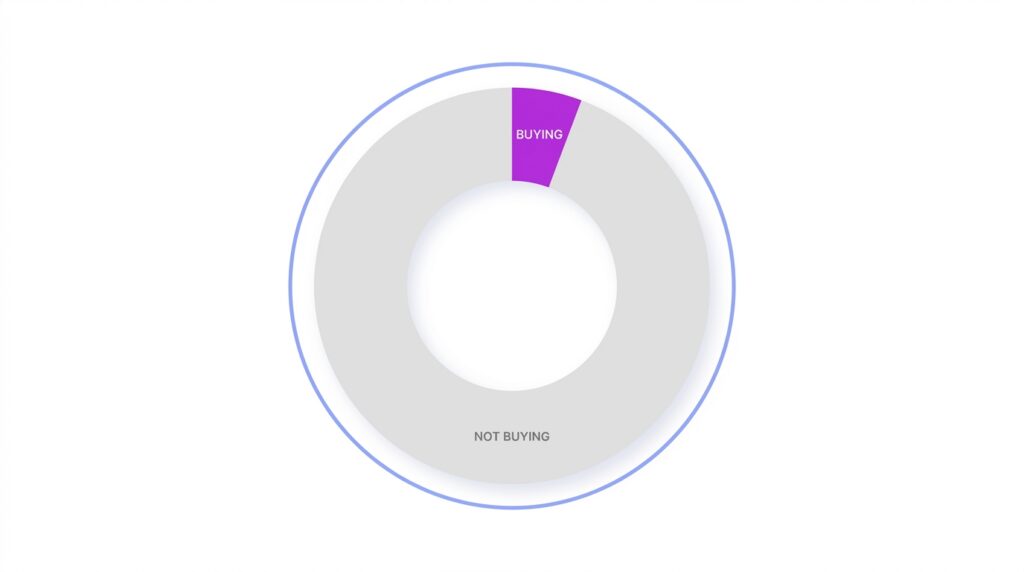
The 95-5 rule, popularized by John Dawes of the Ehrenberg-Bass Institute, is simple: at any given moment, roughly 95% of your market is not buying, and only 5% is. For the last decade, B2B marketing took that as a targeting instruction and pivoted hard toward the 5%. Find who is in market, buy the intent data, chase the signals, run the retargeting, spend the budget there.
That reading gets the rule backwards. The point of the 95-5 rule is not to find the 5% faster. It is that you have to be present for 100% of your market, the 5% buying now and the 95% who are not, because the 95% are where buying decisions actually get made. By the time a buyer enters the 5%, the shortlist is usually already written, and you are either on it or you are not.
This matters most in high-consideration B2B: consultants, long-term partners, infrastructure, mission-critical tools, anything around $25K a year or more. If you sell a $39-per-seat dev tool, someone might try you at the moment of need. Everyone else has to know you well before the trigger fires.
TL;DR
- The 95-5 rule means about 95% of your market is not buying right now and 5% is. The lesson is to market to 100%, not to aim everything at the 5%.
- When the 95% finally enter the market, 80 to 90% already have a shortlist, and roughly 90% buy from it. Influence happens before the buying trigger, not during it.
- Marketing only to the 5% means competing for the leftover 1-in-10 deals where you were not already known.
- This is an AND, not an OR. Keep converting the 5%, but fund awareness for the 95% concurrently. Starting at a 50-50 split is reasonable.
- Use channels that compound cheaply for the 95%: email and LinkedIn thought leader ads. Keep signals and intent for the 5%, sourced from first-party data first.
- Coverage of 100% is always-on work: clean matched lists, leading indicators, and 9 to 12 months before it proves out.
Two ways to read the rule
The 95-5 rule is not a targeting instruction.
Most teams read it as “find the 5% faster.” The point is to be present for 100% of the market, because the 95% is where the decision gets made.
The common reading
Aim everything at the 5%
Buy the intent data, chase the signals, run retargeting, point the budget at whoever looks in-market right now.
The 95-5 reading
Market to 100%
Keep converting the 5%, and fund always-on awareness for the 95% at the same time. It is an AND, not an OR.
The 95% are next quarter’s 5%. The awareness you build while they are not buying is what puts you on the shortlist when they are.
1. The 95-5 Rule Is About Where Decisions Get Made
Buying decisions in high-consideration B2B are made in the 95%, long before anyone shows up in the 5%.
Harvard Business Review, 6sense, TrustRadius, and the B2BMX conference have all landed on the same finding in the last 6 to 12 months: when the 95% finally enter the market, 80 to 90% of them already have a shortlist, and roughly 90% buy from a vendor on it. That shortlist formed during all the quarters they were not in market, while most vendors were ignoring them and pouring budget into the 5%.
The shortlist math
By the time they are in-market, the decision is mostly made.
What HBR, 6sense, TrustRadius, and B2BMX converged on over the last 6 to 12 months.
80-90%
of buyers already have a shortlist when they enter the market.
~90%
buy from a vendor that was already on that shortlist.
~10%
is your win rate if you start marketing at the buying trigger.
Why it matters
If you start marketing when a buyer is already buying, you are playing for the 1-in-10 chance that you displace someone they already trust. Sales teams have a name for the rare win there: a bluebird. Once or twice a year a buyer with no bias and no history in your category lands in front of you, and you catch it without trouble, the perfect storm of right product, right time, right price, right person. The only other late path is a personal referral, and referrals are the least consistent way to grow. Companies ride the founder’s Rolodex to $5 million, a rare few to $65 million, and then the network stops carrying them. Reliable growth comes from being known across the 95% before the trigger.
How to use it operationally
- Treat the 95% as the pipeline for the next several quarters, not as an audience to ignore until they raise a hand.
- Audit your spend against one question: what are we doing to build trust and presence with buyers who are not in market yet?
- Keep cold outbound honest about its role. It can find who is in market, but with no existing reputation it can damage the relationship instead of starting one.
Watch-outs
- The shortlist carries your champion’s internal reputation. Switching vendors at the one-yard line makes them look uncommitted, so it almost never happens.
- A bluebird in week six will convince leadership the channel is easy. It was luck, and it resets expectations to an impossible bar.
2. Market to 100%: Keep the 5%, Fund the 95%
The fix is not to abandon the 5% and chase the 95%. It is to cover all of it at once.
The 5% still needs the conversion machinery: signals, intent, retargeting, the demo path. The mistake is running only that, with nothing reaching the 95% who are not buying yet. A due diligence list we recently saw from a sophisticated institutional investor led with exactly this gap. One of the first questions was: how do you market to the 95% that is not in market, and how do you create inevitability, trust, and presence? That question had never appeared on a diligence checklist before. The market is now scoring companies on whether they cover 100%.
Why it matters
The 95% and the 5% are not separate audiences. The 95% are next quarter’s 5%, and the awareness you build now is what puts you on the shortlist later. Run both layers and they feed each other: awareness tells you who is engaging, and your conversion and retargeting campaigns get tighter because they are aimed at people who already know you. Run only one and you either build a brand that never converts or chase conversions from people who have never heard of you.
How to use it operationally
- Run awareness and conversion concurrently. You do not have to swing the whole budget. If you sit at 80/20 conversion-heavy today, start at 50-50 and adjust from there.
- Fund the 95% with channels that compound cheaply: email compounds at a better and cheaper rate for engagement, and LinkedIn thought leader ads earn dramatically more organic engagement at far lower distribution cost.
- Keep signals and intent for the 5%, but pull them from first-party data first, then from audiences that already know you. Use them to move accounts between ad groups, never as the starting point.
Watch-outs
- Do not read the 95-5 rule as permission to cut conversion spend to zero. The 5% still has to be captured when it shows up.
- Generic lookalike audiences and default platform filters burn budget across both layers. Know exactly which companies you are reaching.
- Starting from third-party intent alone means starting where 80% of the decision is already done.
3. Covering 100% Is Always-On Work
Reaching all of your market is a perpetual operation, not a campaign you switch on and measure in a quarter.
Knowing exactly who you are marketing to and where they live is the whole game. At a past company we sold into global cold warehousing, the companies that move food around the world in refrigerated trucks, containers, and warehouses. Only 20 or 30 were viable customers, plus a couple hundred regional players. They were barely on LinkedIn, hard to reach by email, and part of a closed, tight-knit community of frenemies with their own annual conference and association. Wholesale distribution has an association for everything, including one just for rubber belts and tires. Groups like that buy from referred vendors and from the people who show up for the cocktail hour. The channel mix changes by segment, but the rule of always being in front of them while they are not buying applies even harder.
Why it matters
Covering 100% takes time, and the clock fights you. Every quarterly framework, OKRs, SMART goals, Rocks, V2MOMs, runs on roughly 90 days, and in long-cycle B2B that is less than one sales cycle. Buyers typically need 150-plus days and 30 to 50 impressions before they convert. Measure a 90-day-old awareness program on conversions and it will look dead while it is working, and killing it resets the compounding to zero. Most teams that fail here fail because leadership demanded impossible results on an impossible timeline.
How to use it operationally
- Build and clean matched lists continuously, loaded into every ad and email platform. People retire and change jobs, so pruning is a weekly or monthly habit, never a one-time setup.
- Agree on leading indicators with leadership before spending: impressions beating benchmarks, the right companies visiting the site, engaging ad groups, and opening and clicking emails. Treat hand-raises, RFPs, and webinar registrations as lagging indicators.
- Commit to 9 to 12 months and keep core awareness campaigns always-on. Tinker with audiences, spreads, and allocations, but do not turn them off.
Watch-outs
- The awareness numbers will look boring until they work. Impressions and click-throughs excite nobody in month two.
- Getting leadership to commit to only a quarter can be a death kiss. Sometimes the honest move is to say you cannot help on those expectations.
Context on Outkeep’s Approach
Outkeep exists to help companies outlast their competition: build reputation, and turn that reputation into revenue in a trustworthy, respectful, and thoughtful way. That is 100% coverage by definition, the patient work of staying present across the 95% so you are already on the shortlist when a buyer joins the 5%. We spend our days inside the email programs and matched-audience infrastructure that make that coverage real.
FAQ for Modern B2B Email Programs
What is the 95-5 rule in B2B marketing?
Popularized by John Dawes of the Ehrenberg-Bass Institute, it holds that about 95% of your market is not actively buying at any given time, and only 5% is. The strategic takeaway is to market to 100% of your market, because the 95% is where future buying decisions and shortlists are formed.
Does the 95-5 rule mean I should stop targeting in-market buyers?
No. The 5% still needs conversion campaigns, intent data, and retargeting. The rule says to add always-on awareness for the 95% alongside that, not to replace one with the other. It is an AND, not an OR.
How should I split budget between awareness and conversion?
Run both concurrently. If you are heavily weighted toward conversion today, a 50-50 starting split is reasonable, then adjust as leading indicators show what is compounding. Keep core awareness campaigns always-on regardless of quarterly pivots.
Why is marketing only to the 5% so risky?
Because 80 to 90% of buyers already have a shortlist when they enter the market, and about 90% buy from it. If you were not building awareness during the 95% phase, you are competing for the rare 1-in-10 deal where the buyer had no prior preference.
Which channels work best for reaching the 95%?
Channels that compound cheaply: email and LinkedIn thought leader ads both earn strong engagement at low distribution cost with measurable benchmarks. Pair them with clean, matched target-account lists so you know exactly which companies you are reaching.
How long before an awareness program shows results?
Plan for 9 to 12 months. Buyers typically need 150-plus days and 30 to 50 impressions before converting, so a program judged at 90 days on conversions will look like a failure even while it is working. Agree on leading indicators with leadership up front.