94% of B2B marketers in LinkedIn’s B2B Marketing Benchmark agreed trust is the most important factor in building a B2B brand. Nobody says which trust. Every article on trust in B2B marketing means the buyer’s confidence in you (the buying committee knowing where you fit), and the word has quietly absorbed two other problems that share none of the same tactics.
We did not go to HubSpot’s UNBOUND this year, but we read the catalog. We counted roughly 16 trust sessions out of 200-plus, the biggest theme after AI. Then we read them, and about half were not about buyers at all. They were about teams trusting their data, and about getting AI to trust your brand.
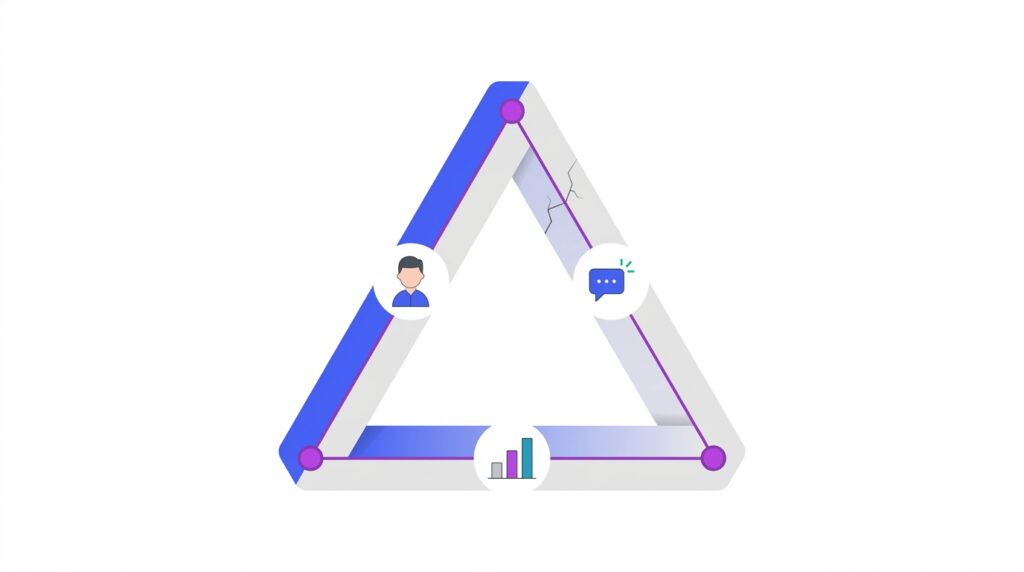
That gives three jobs: getting a buyer to believe you, getting your team to believe your numbers, and getting a machine to cite you. I call it the Trust Triangle. (Outkeep sells infrastructure for an owned audience, arguably a trust product too, so we are not standing outside this.)
TL;DR
- “Build trust” is three jobs with no shared tactics. Name the job before picking the tactic.
- Internal trust runs on choosing, comparing and explaining the right numbers, including the distorted ones.
- Machine trust runs on specific, checkable content. Inflated claims are short-lived.
- Buyer trust runs on fundamentals, visible humans and de-risking the buyer’s career.
- Machine trust feeds buyer trust, buyer trust feeds internal trust, internal trust funds both.
- Machine trust recovers fastest and buyer trust slowest.
One word, three jobs
“Build trust” means three different things now.
Different owners, different tactics, different clocks. Name the job before you pick the tactic.
Choosing, comparing and explaining the right numbers, including the distorted ones.
Owner: RevOps and data, interpreted by marketing
Specific, checkable, structured content. FAQs, an entity page, human sending volumes.
Owner: content, SEO and deliverability
A good product, a peer-to-peer voice, visible humans and a de-risked decision.
Owner: marketing and brand
1. Getting your team to believe your numbers
Internal trust is where marketers spend the most hours, and nobody puts it in a trust article.
Who owns it
RevOps, go-to-market engineering and data own the pipes, and marketing owns the interpretation. Internal trust is what lets you say “the data is accurate, and it means sales or product needs to change something.” Start with ethical data: show the good and the bad, and never nudge the numbers.
What it actually takes
- Measure everything, share what resonates with leadership, never what merely looks good
- Compare: paid social at $17 a click next to email at $4.50, or 10 webinar attendees growing to 40
- Speak in ratios and dollars, because executives work in margins
- Explain your attribution model as a 1-3-1: the problem, three options, your pick
- Export the data and build your own views in Claude instead of fighting the HubSpot report builder
Where it goes wrong
Clean data still lies. Proofpoint suppresses open data, Barracuda inflates clicks, and Microsoft Defender opens hard then stops, so a program can swing from 70% opens to 15% overnight and mean nothing. Keep opens in the deliverability view and out of the board deck. And life is too short to work for a CEO who does not believe in marketing.
2. Getting a machine to cite you
Machine trust is an LLM deciding whether to surface you, and an AI inbox deciding whether to show your email.
Who owns it
Content and SEO for citations, deliverability for the inbox. SEO took six to nine months. Some teams now get cited by AI in days.
What it actually takes
Run content for AIs and content for humans through one content workstream:
- FAQs, executive summaries and question-style H2s
- An entity page answering every question about you, which no human reads and every LLM does
- Appearances in comparison lists alongside your peers
- For AI inboxes like Fyxer and Google’s: mail the four real buyers at a 2,000-person company, not 700 people
Where it goes wrong
The rule: don’t sling claims, keep it to the facts. Be bold with claims you can defend. Any trick or countermeasure buys a nice pop and nothing long term.
3. Getting a buyer to believe you
Buyer trust is the one everybody writes about, and it breaks slowest and costs the most.
Who owns it
Marketing and brand, on a clock of quarters and years. Trust is earned by doing the right thing with a good product. It is also 100% a marketing angle, done deliberately.
What it actually takes
Have a good product, don’t over-promise, know when you cannot help a customer, and let reputation snowball through plays that turn reputation into real consideration. Then sound human: build in public like HubSpot’s co-founders, skip the guru and car-salesman voice, use jobs to be done, and de-risk the buyer’s career.
Where it goes wrong
There used to be no such thing as bad press. Callaway pulled an ad with Good Good this summer and apologized. Being labeled an AI slop producer sits in search results long after the moment, and overusing AI can raise your citations while readers decide you stopped caring.
Why it is a triangle
The three share no tactics and still run as one loop. Machine trust feeds buyer trust, because unsure buyers ask a machine first. Buyer trust feeds internal trust, because pipeline makes the numbers believable. Internal trust funds both, because the brand budget is the first line cut. Break one side and the other two degrade on a lag.
The trust loop
No shared tactics. One loop.
Each side feeds the next. Break one and the other two degrade on a lag.
Unsure buyers ask a machine first. If you are not cited, you are not considered.
Pipeline shows up, and the numbers start telling a story leadership recognizes.
If leadership stops believing the numbers, brand and content are the first lines cut.
Most teams are failing at one side and blaming another. Whichever side you are worst at is probably why the other two underperform.
| Job | Who owns it | How fast | Feeds |
|---|---|---|---|
| Your team believes the numbers | RevOps, interpreted by marketing | Medium, breaks quietly | Funds the other two |
| A machine cites you | Content, SEO, deliverability | Fast and unstable | Buyer trust |
| A buyer believes you | Marketing and brand | Slow, measured in quarters | Internal trust |
If your answer is all three, it is none of them yet. Which side of your triangle is broken, and which one have you been blaming instead?
Context on Outkeep’s Approach
Outkeep works on two sides of this triangle daily. Deliverability is machine trust in its oldest form, and email metrics are the clearest case of distorted numbers in B2B. The third side is why the business exists: an owned audience is buyer trust you get to keep.
FAQ for Modern B2B Email Programs
What does trust mean in B2B marketing?
Three jobs: a buyer believing you, your team believing your numbers, and a machine citing or delivering you. Name which one before building a plan.
How do you get leadership to trust marketing data?
Report fewer numbers, always with a comparison, in ratios and dollars, and explain the decisions behind them.
Why are B2B email open rates unreliable?
Security gateways like Proofpoint, Barracuda and Microsoft Defender distort opens and clicks before anyone analyzes them. Treat opens as a deliverability signal.
What is an entity page?
A long page answering every factual question about your company, written for LLMs to read and cite.
How do you get cited by AI tools?
Publish structured, factual content: FAQs, summaries, question headings, an entity page and comparison lists. Skip inflated claims.
Which kind of trust recovers fastest?
Machine trust recovers fastest, internal trust next and buyer trust slowest, which makes buyer trust the most expensive to lose.