You can build awareness all day. The weekly email, the SEO and GEO work, the retargeting, the LinkedIn thought leadership, the Mount Rushmore strategy of turning your team into recognized voices. Do it well and you become a media outlet for your market. But awareness is not opportunity, and reputation does not pay.
Here is where most programs break. A prospect clicks something, and the company hands that faint signal to a junior BDR or an outside agency to run sequences and calls. The ask, almost immediately, is a meeting. Most of the time the person is nowhere near ready. They are lurking in the inbox, watching, forming an opinion.
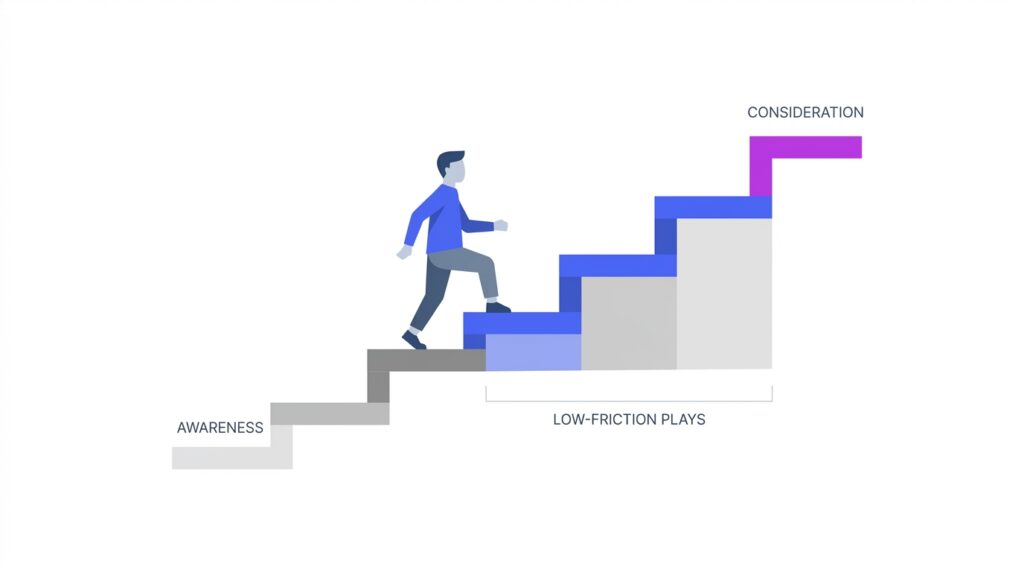
The move that works is a smaller ask, not a bigger one. Between passive awareness and “take a meeting” sits a ladder of lower-friction plays that let a buyer experience your expertise and step one rung down the funnel without feeling sold to. Here are seven, ordered from lowest friction to highest.
Two ways to follow a signal
The problem is the size of the ask.
A faint signal does not mean a buyer is ready to meet. Match the ask to their actual readiness.
The default move
Jump straight to a meeting
Hand the click to a junior BDR or an agency and run sequences and calls. High friction, and the person is rarely ready.
The lower-friction move
Offer the next small step
Give them a play from the ladder that lets them experience your expertise on their own terms, without feeling sold to.
Two assumptions. The table-stakes awareness engine is already running, so these plays convert attention you have already earned. And you already have some access to these people. This is not a cold start.
TL;DR
- Awareness is not interest. Do not jump from a click straight to a meeting ask.
- Give buyers self-service tools (calculators, templates) so they feel your expertise without talking to you.
- Run events as a ladder: webinar, then podcast, then roundtable, then in-person.
- Add short, marketing-run email drips triggered by behavior, with no hard sales CTA.
- Send a personalized landing page and video to recreate the first meeting early.
- Use direct mail and gifting at the right moment. It works, and it is cheap.
- Build a community or advisory board. Almost no one does.
- Best move: feature the prospect as a guest, so they are showcased, not sold to.
The friction ladder
Seven plays, lowest friction to highest.
Each rung asks a little more of the buyer and offers a little more in return. Start low, climb only as the relationship earns it.
Run them in sequence or concurrently. No one knows in advance which rung a given audience will climb, so try several and let the market tell you.
1. Self-Service Experiences and Freebies
Let someone experience your expertise without ever talking to you.
Interactive tours, ROI calculators, utilities, trials, tools, frameworks, templates, playbooks, checklists. Each one is self-guided, valuable on its own, and asks for nothing but attention.
Done right, it does the job an initial consultation would do. Minus the calendar invite, and minus the guard that goes up the moment a prospect senses a sales call.
Years back we ran a cost-per-invoice calculator on a client site at a company called Paystream. It worked extremely well. People happily entered ten data points to get a benchmark against their industry and a view of the savings they could generate.
The point is to replace what an initial consultation would feel like. If you can create something that resembles the dialogue and the expertise without the prospect having to talk to you, that is what a self-service experience, demo, or tour should be.
How to use it operationally
- Build one asset that resembles a first consultation: a benchmark tool, an ROI calculator, an interactive tour, a diagnostic checklist.
- Keep the input light and the payoff concrete. Ten fields for a personalized benchmark is a fair trade.
- Give real things away. Frameworks, templates, and playbooks earn trust because they cost the prospect nothing and prove you know the work.
- Use completion as your signal, not just the click.
Watch-outs
- Do not bury the value behind an aggressive form. The point is to reduce friction, not relocate it.
- Keep it self-guided. The moment it requires a conversation to get value, it stops being low-friction.
2. Webinars and Peer Events
Events are a friction ladder in themselves, so know exactly which rung you are asking someone to climb.
At the bottom is the digital webinar. Camera off, no participation required, just show up and listen. A step up is the podcast, similar in commitment but heavier in production.
Above that is the roundtable: a smaller facilitated group with cameras on and an expectation to participate. Lower attendance, higher engagement. At the top are in-person formats, executive dinners, briefings, and hosted happy hours.
Cost tracks the ladder almost exactly. A digital webinar is your cheapest format. A podcast is next, since it demands far more post-production. The roundtable follows, and in-person sits at the top. The jump to in-person is not small, and that belongs in the plan.
Events, rung by rung
Know which rung you are asking for.
Cost, friction, and reward all climb together. Pick the format that matches how warm the audience is.
Camera off, no participation required. Just show up and listen.
Similar commitment for the guest, heavier lift to produce.
Cameras on, expected to participate. Lower attendance, deeper connection.
Dinners, briefings, a ballpark suite, a putt-putt night. Expensive, but still low-friction when the invite is fun and they are already in town.
The jump to in-person is not small. Do not commit to dinners and suites without the budget and the account list to justify them.
Experiential invites deserve their own mention because they stay low-friction even when they are expensive. We have seen a vendor grab a suite at a local AAA baseball game during a conference. Not crazy money, fits twenty people, food, a game, families welcome. The prospects are in town alone anyway.
We have done the same at Puttery-style indoor putt-putt venues. Match the invite to the audience and it lands harder. I have heard of a team buying twenty Taylor Swift tickets for a network of female CMOs and running it as an ABM play that worked extremely well. If people are already traveling to a conference, inviting them to something fun asks almost nothing in return.
Webinars still kill it. We see programs doing really well, with high attendance and engagement, and many use user-generated content as the flywheel. Give someone a year-end “wrapped” moment, feature them, and they bring their own audience. Do not give up on those programs.
How to use it operationally
- Map every event to a friction rung and match the rung to how warm the audience is.
- Use the cheap end (webinars, podcasts) for volume and the expensive end (dinners, suites, experiential) for named accounts.
- Lean on experiential invites when your targets are already traveling. The context does the heavy lifting.
- Use user-generated content as a flywheel to fuel attendance.
Watch-outs
- In-person cost scales fast. Do not commit to dinners and suites without the budget and the account list to justify them.
- Roundtables trade attendance for engagement. Design for depth, not headcount.
3. Behavior-Triggered Email Sequences
Meet the behavior with more of what earned the engagement, not a sales pivot.
This is old-school marketing automation, and people have done it a long time because it works. When a prospect engages at some level, you branch them into a short supplemental drip: case studies, customer stories, ROI proof.
It runs alongside your core thought-leadership program, not instead of it.
The critical detail is who owns the sequence. These are marketing-run, not sales-run. There is no hard “book a demo” CTA. To the prospect it still feels like marketing, just outside the norm of the regular program.
The moment it flips to a sales cadence, the friction spikes.
Email is far from dead. It is still the number one highest-ROI channel in B2B, and it is worth doubling down on even though it is hard and plenty of teams give up on their newsletters. What is dying is the traditional drip. A lot of people do not engage with those anymore, so be careful, and do not burn your reputation by being too hasty.
How to use it operationally
- Define clear engagement triggers that branch a contact into a supplemental sequence.
- Fill those sequences with proof, not pitches: case studies, customer stories, ROI proof.
- Keep them short and additive. They supplement the core program.
- Keep ownership with marketing so the tone stays educational.
Watch-outs
- The traditional drip is dying. A lot of people do not engage with those anymore.
- Being too hasty here burns your reputation. Restraint protects the channel that carries everything else.
4. Personalized Landing Pages and Video Outreach
Recreate the first meeting before the meeting ever happens.
Build a semi-custom landing page and pair it with a personalized video or Loom. The goal matches play one: simulate the experience a prospect would have if they talked to you, and deliver it without the ask.
You can track what they view, share it directly on LinkedIn or over email, and turn a cold introduction into something that feels made for them.
These have become genuinely easy to produce. There are a lot of tools now, and AI is actually pretty good at the personalization layer, so the extra-mile gesture takes far less effort than it used to. Those extra-mile things go a long way.
Keep it feeling low-friction. Make the page generic enough that it does not read as an attack, warm enough that it reads as effort. The line to hold is effort without pressure.
How to use it operationally
- Pair a semi-custom landing page with a short personalized video for named accounts.
- Reference something real so it feels made for them.
- Use the built-in tracking to time your follow-up to actual interest.
- Deliver it where they already are, a LinkedIn DM or a direct email.
Watch-outs
- Over-personalization reads as intrusive. Keep enough generic framing that it feels like care, not an attack.
- The tools make volume tempting. This is a small-batch play; the extra mile is the point.
5. Direct Mail and Gifting at the Right Moment
A thoughtful physical gift cuts through everything digital because almost no one else is doing it.
Handwritten notes, branded packages, a small considered gift, timed to a milestone. A recent download, a quoted LinkedIn post, a career or life moment worth acknowledging.
It is not a gimmick. It works, and it can be done at scale fairly easily.
The economics are friendlier than people expect. You do not need to give away anything expensive. A gift around 100 to 150 dollars is very reasonable, and it can be less. Gifting is a couple of hours of someone’s time a week.
Like most of these plays, even at scale you would do fewer than ten a week. Ten is the ceiling, not the floor. A physical object timed to a real moment lands in a way no email can, and the effort reads as genuine because so few competitors make it.
How to use it operationally
- Trigger gifts off real moments: a milestone, a recent download, a public post worth referencing.
- Keep spend sane. 100 to 150 dollars is plenty; it can be less.
- Cap volume deliberately. Under ten a week keeps it personal and the cost trivial.
- Personalize the note. The object gets attention; the message earns the reply.
Watch-outs
- Generic swag is not a gift. If it is not specific to the person, it loses the effect.
- Timing is the whole play. A gift tied to a real moment lands; a random one feels transactional.
6. Customer Advisory Boards and Community
Build a peer network and you convert individual prospects into an owned audience.
A customer advisory board, a community membership, a hosted meetup. If associations or meetups your audience already attends exist in your market, host them at your office, provide the space, or run them digitally.
Members do not have to be customers. A community or industry advisory board can simply be a place people in a given role want to be, and some teams run it almost as a news outlet for their field.
This is the most underused play on the list. Roughly 1 in 10 businesses runs any kind of customer advisory board, which is strange when a PE-backed company already has a board for itself. If a board is valuable for governing the company, a customer or industry version is valuable for understanding the market.
Hosting these does more than generate goodwill. You get to know people in the industry, you show that you are a leader in the space, and you build standing relationships that no sequence produces.
How to use it operationally
- Start with where your audience already gathers. Host an existing meetup before building a new community from scratch.
- Frame membership around peer value, not your product.
- Separate a customer advisory board (existing accounts) from a broader industry council (prospects and peers).
- Use the board as a listening post. The insight compounds into every other play on this list.
Watch-outs
- A community without a reason to exist dies quietly. Give it a job: intelligence, advocacy, or genuine peer connection.
- These take real hosting effort. Commit to running it well or do not start.
7. Feature the Prospect as a Guest
Stop asking for a meeting and start offering the spotlight.
Every event in this list, the podcast, the webinar, the roundtable, the advisory board, can include your prospect as a co-host, co-speaker, or guest. Instead of “will you take a meeting,” the ask becomes “we have been following your posts, would you like to be a guest on our next webinar.”
That single change reframes the entire relationship.
It works because it flips the ask. The prospect is no longer being sold to. They are being featured. You get to know them as a peer whose expertise you value.
Guest posts, co-authored content, panel invitations do the same work. Whenever you run a webinar, podcast, roundtable, or advisory board, you should be considering how a prospect could be featured in it, not merely invited to it.
This is where the whole ladder pays off. Every earlier play built familiarity and goodwill. Featuring the prospect converts that goodwill into a real relationship and a shared piece of work, a far stronger foundation for consideration than any meeting booked off a cold sequence.
How to use it operationally
- Audit every format you run for a guest slot: podcast episodes, webinar co-hosts, roundtable panelists, advisory seats.
- Lead with genuine recognition. Reference the specific work that earned the invite.
- Give them something to promote. A featured guest brings their own audience.
- Treat the collaboration as the relationship, not a step toward the “real” ask.
Watch-outs
- The recognition has to be real. A hollow flattery invite is transparent.
- Featuring a prospect is a genuine content commitment. Produce it well or it reflects on both of you.
Field notes
What still works, what is fading.
What we keep seeing across programs, and where teams are wasting effort.
Still works
Fading
Context on Outkeep’s Approach
Outkeep spends its time in the parts of B2B that reward patience: deliverability, sending reputation, and email programs that stay valuable for years rather than quarters. That vantage point is why this progression matters to us. The teams that treat awareness as a switch to flip into a meeting request are the same ones that burn their sending reputation and their goodwill in a single hasty sequence.
The plays here work because they respect the reader’s time and intelligence, the same principle that keeps an email program alive. These tactics can run in sequence or concurrently, and no one knows in advance which will click for a given audience, so the right approach is to try many of them and let the market tell you.
FAQ for Modern B2B Programs
What does “low-friction” actually mean in this context?
It means an ask that costs the prospect very little in time, commitment, or social exposure. Watching a webinar, using a calculator, or accepting a gift are low-friction. Booking a sales meeting off a single click is high-friction. The plays here fill the gap between passive awareness and that meeting.
We already run a strong awareness program. Why isn’t that converting on its own?
Awareness creates familiarity, not intent. Most of your engaged audience is lurking and watching rather than ready to buy. These plays give them a next step that matches their actual readiness, which is usually a few rungs below “talk to sales.”
Is email really still worth investing in?
Yes. Email is far from dead and remains the number one highest-ROI channel in B2B. What is dying is the traditional drip. Behavior-triggered, value-based sequences still earn attention; hasty sales cadences burn the reputation that makes the channel work.
Does direct mail and gifting scale?
It does, fairly easily. These are low-volume plays, usually under ten touches a week, which is a couple of hours of one person’s time. Gifts in the 100 to 150 dollar range are effective and can be less, and the physical channel earns attention because so few competitors use it.
How is a behavior-triggered sequence different from a normal nurture?
A normal nurture runs the same content to everyone. A behavior-triggered sequence branches a contact into short, supplemental content based on an action they took, and it stays marketing-owned with no hard sales CTA. The relevance is what keeps it low-friction.
Why feature a prospect instead of just inviting them to something?
Inviting them still positions you as the seller. Featuring them as a guest or co-host flips the dynamic so they are being showcased, not pitched. It builds a genuine peer relationship and often brings their audience along, which no meeting request can do.
Do we need a big budget to run experiential events?
Not necessarily. A suite at a AAA baseball game or an indoor putt-putt session fits twenty people for modest money, especially when your targets are already in town for a conference. The friction stays low because you are inviting them to something fun, not asking for their time in a boardroom.
Should we run these plays one at a time or all at once?
Either. They work in sequence or concurrently, and the right mix depends on your audience, which you cannot fully predict. Try several, watch what earns engagement, and double down on what works for your specific market.